How to Tell If a Supplement Is Fake or Has No Real Therapeutic Effect
Most supplements don’t fail because they’re dangerous.
They fail because they’re ineffective.
They look advanced, sound scientific, and promise results — yet deliver little more than expensive capsules. Learning how to spot these products isn’t about fear. It’s about avoiding wasted money and misplaced expectations.
This guide explains how to tell whether a supplement is likely to provide meaningful support — or whether it’s mostly label decoration.
Start With the Supplement Facts Panel, Not the Front Label
The front of a supplement bottle is designed to persuade.
The Supplement Facts panel is where usefulness is revealed.
A simple rule helps:
If you can’t explain what the supplement is trying to do after reading the Supplement Facts panel, that’s a warning sign.
High-quality supplements usually have:
- a clear purpose
- a short, focused ingredient list
- transparent dosing
Low-quality supplements often try to do everything at once — which sounds impressive, but frequently leads to tiny, ineffective doses.
Quick 60-Second Label Checklist (Save This)
If you only have one minute in a shop or on Amazon, use this checklist:
- Goal: Can you clearly see the product’s purpose (sleep, magnesium support, gut support, etc.)?
- Transparency: Are all ingredient amounts listed (not hidden in blends)?
- Dose logic: Do the amounts look realistic for daily use — or like “sprinkles”?
- Serving size: Is it reasonable (e.g., 2–4 capsules max for many formulas) or exaggerated?
- Verification: Can you find a Certificate of Analysis (COA) or credible testing info?
- Claims: Are promises sensible, or do they sound like shortcuts and miracles?
If a product fails 3 or more points above, it’s usually a “label-first” supplement — designed to look good, not perform well.
Why Long Ingredient Lists Are Often a Red Flag
Many supplements list 20, 30, or even 50 ingredients. That looks impressive, but quantity doesn’t equal effectiveness.
This is where “fairy dusting” comes in.
What does fairy dusting mean?
Fairy dusting is the practice of adding tiny, ineffective amounts of ingredients — just enough to list them on the label — without including doses that meaningfully support the body.
In practical terms:
- A product can list 25 ingredients
- Each may be present in a sand-grain quantity
- The body may not notice any measurable effect
That doesn’t automatically make the product unsafe. It means expectations should be realistic.
Supplements tend to work best when they use fewer ingredients at functional doses, not many ingredients at symbolic ones.
Also, “natural” doesn’t automatically mean accurate. For example, researchers using DNA barcoding found mislabeling in some herbal supplements (meaning the plant listed may not match what’s inside). See the NIH-hosted paper on DNA evidence of herbal supplement mislabeling.
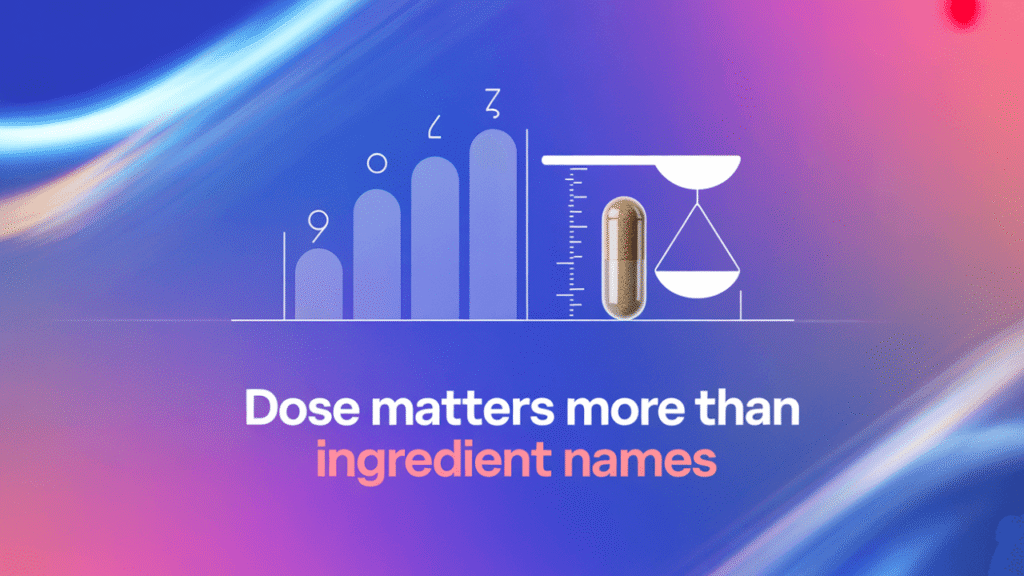
Dosage Matters More Than Ingredient Names
Ingredient names sell products.
Amounts determine whether anything happens.
A helpful habit is to ask:
- Are the ingredient amounts listed clearly?
- Do the doses look realistic for daily use?
- Is the serving size reasonable?
If ingredient amounts are hidden, vague, or missing, the formula can’t be evaluated honestly.
What counts as a “meaningful dose” (without guesswork)
You don’t need to memorize exact numbers to make smarter choices. Instead:
- Check whether the label lists the full amounts for each ingredient.
- Compare the ingredient’s dose to what reputable health sources describe as commonly studied or typically used.
- Be skeptical when dozens of “trendy” ingredients are packed into a single small serving.
If you want a simple reference point for how supplements are regulated and why label content can vary, review the NIH Office of Dietary Supplements guidance for consumers: what supplement labels can (and can’t) guarantee.
Proprietary Blends: Why They Hide More Than They Help
One of the most significant warning signs on supplement labels is the phrase “proprietary blend.”
What proprietary blends allow
When ingredients are grouped into a proprietary blend:
- Individual doses don’t have to be disclosed
- One cheap ingredient can dominate the blend
- The rest can be added in trace amounts
This creates the illusion of complexity and power without transparency.
Proprietary blend reality check
| What the label shows | What you can’t see |
|---|---|
| One large blend number | Individual ingredient doses |
| Long ingredient list | Which ingredient does the real work |
| Scientific-sounding name | Whether doses are meaningful |
Proprietary blends don’t automatically mean a supplement is fake — but they remove your ability to judge effectiveness.
Big Scientific Words Don’t Mean Real Science
Some supplements rely heavily on complex wording:
- “bio-optimized delivery system”
- “neuro-thermogenic matrix”
- “advanced metabolic amplification complex”
These phrases often sound scientific while revealing nothing about:
- dose
- testing
- formulation logic
A well-designed supplement can usually be explained in plain language. If clarity disappears behind jargon, that’s worth questioning.
Why Third-Party Lab Testing Actually Matters
Many supplements say “lab tested.”
The critical question is whether that testing can be verified.
What real testing usually includes
- named third-party labs
- Certificates of Analysis (COAs)
- batch or lot numbers
- contaminant and purity checks
When testing is real, transparency is usually easy.
When “lab tested” is just marketing
If a supplement:
- doesn’t show results
- doesn’t name the lab
- doesn’t provide documentation
Then the claim can’t be confirmed.
That doesn’t prove the product is contaminated. It does mean trust is being requested without evidence.
For an example of why verification matters, consider research highlighting that some “herbal” weight-loss supplements have contained undeclared pharmaceutical ingredients. See the NIH-hosted analysis of undeclared drugs found in certain over-the-counter herbal weight-loss products.
Expensive Doesn’t Mean Effective
Price often reflects branding, not formulation.
Some supplements cost more because they:
- Use luxury packaging
- List trendy ingredients
- Invest heavily in advertising
But a high price doesn’t guarantee:
- better dosing
- better testing
- better transparency
Price vs value comparison
| Price signal | What it may reflect |
|---|---|
| Very expensive | Branding and marketing costs |
| Very cheap | Cost-cutting somewhere |
| Mid-range | Often better balance |
The goal isn’t to be the cheapest or the most expensive — it’s clear value.
How to Use AI Tools to Evaluate a Label
A simple modern approach:
- Take a screenshot of the Supplement Facts label (make sure serving size and amounts are visible).
- Upload it to ChatGPT.
- Ask a neutral question, such as:
“Based on these ingredient amounts, are the doses likely meaningful, or are they too low to have a practical effect?”
This helps strip away branding and focus on what’s actually present.
Signs a Supplement Is More Likely to Be Ineffective Than Helpful
Watch for patterns, not single issues:
- very long ingredient lists
- proprietary blends with no dose clarity
- heavy marketing language
- no visible testing transparency
- unrealistic claims
- prices disconnected from formulation logic
One red flag doesn’t automatically mean a supplement is fake. Multiple red flags together usually do.
Scientific & Medical Context (Simple, Practical, Non-Hype)
Supplement quality is complex because regulations differ from those for prescription medicines. The NIH Office of Dietary Supplements explains why label claims and ingredient content can vary, and why consumers should evaluate products carefully — especially when claims sound too strong. Start with the NIH consumer guide on how to assess dietary supplements safely and realistically.
It also helps to remember that “evidence” can mean different things. A single ingredient may be studied, but that doesn’t prove a formula uses the right dose or form. Healthline summarizes how to read supplement labels and why dose and form matter in real-world outcomes: a practical guide to reading supplement labels.
Finally, when you see “herbal” weight-loss or “metabolism” products, caution is reasonable. Peer-reviewed research indexed by NIH has discussed cases where products contained undeclared drug-like substances. Review the NIH-hosted analysis of undeclared pharmaceutical agents found in certain herbal weight-loss supplements.
And if you buy herbal formulas, mislabeling can be a real issue in the marketplace. The NIH-hosted paper on DNA barcoding and herbal supplement identity shows why third-party verification and brand transparency matter.
If you want a fast way to check whether a specific study exists for an ingredient (and not just marketing claims), search it on PubMed. Here’s one example of a supplement-label accuracy paper indexed on PubMed: a study examining label accuracy in immune supplement products.
LiveGood Comparison Table (Standard Product vs LiveGood Approach)
This isn’t about “one brand is perfect.” It’s about how to evaluate value and transparency. Here’s a simple comparison framework you can use when deciding whether a formula is likely functional or mostly marketing:
| Feature | Standard Product (Typical Retail/Amazon) | LiveGood Product (What to look for) |
|---|---|---|
| Formula focus | Often “everything at once” blends | More focused formulas are easier to judge and compare |
| Dose transparency | Common use of proprietary blends | Clear Supplement Facts makes evaluation simpler |
| Value model | Price inflated by ads/branding | Membership pricing can reduce markup (when it fits your needs) |
| Decision clarity | Complex claims + vague “systems” | Plain-language goals and serving sizes are easier to trust |
| How to verify | “Lab tested” claims without proof | Look for documentation, lot/batch info, and transparent brand policies |
If you’re new to LiveGood and want to understand how the member model works (and when it makes sense), start with the LiveGood tour overview and then browse the LiveGood Supplement Reviews hub for product-by-product breakdowns.
LiveGood offers both retail access and an optional membership. The difference is mainly cost efficiency over time.
| Buyer Type | What You Get |
|---|---|
| Retail buyer | Product access without a monthly fee |
| Member ($9.95/month) | Lower pricing on products and better value for regular use |
For occasional use of supplements, retail access may be sufficient.
For daily or multi-product routines, membership pricing can reduce overall cost.
Pros & Cons of the “Label-First” vs “Transparent” Buying Approach
Pros
- Less wasted money: you avoid paying for long lists of trace ingredients.
- Better expectations: you focus on realistic support, not miracle promises.
- Cleaner comparisons: transparent labels make it easier to compare brands fairly.
- More confidence: you can verify claims (instead of trusting marketing language).
Cons
- Takes a few minutes: reading labels well is slower than buying hype.
- Some products require research; you may need to look up ingredient forms and typical ranges studied.
- Not all brands are transparent: you may need to skip products you can’t evaluate.
Personal Insight
After reviewing many supplement labels across popular categories (greens powders, multivitamins, sleep formulas, and weight-loss blends), the same pattern shows up again and again: the most disappointing products usually look the most “advanced.” They rely on long ingredient lists, vague blends, and flashy language, while dosing remains unclear or is spread across tiny amounts.
At LiveGoodForLife, my goal is to make label reading practical and straightforward for everyday buyers. I rely on reputable health sources (NIH, PubMed, and significant clinical education sites) to understand how supplements are regulated and how research is typically discussed, then translate that into a real-world checklist you can use before spending money. If you want to explore how pricing models can affect supplement value, you may also find this helpful: why many people overpay for supplements (and how to avoid it).
Related Reading on LiveGoodForLife
If you want to go deeper, these pages connect naturally with what you’ve learned here:
- Start here if you’re new: a step-by-step look at how LiveGood works.
- Explore product breakdowns: LiveGood Supplement Reviews.
- General brand trust context: are LiveGood products legit and safe?
- If you want to shop or browse: how to access the LiveGood shop.
- If you’re considering membership, see the: LiveGood member guide (login, benefits, fees).
FAQ: Reading Supplement Labels Like a Pro
What is “fairy dusting” in supplements?
It means a product contains many ingredients in amounts so small they’re unlikely to provide meaningful support—primarily to make the label look impressive.
Are proprietary blends always bad?
Not automatically, but they prevent you from evaluating individual doses. If you can’t see amounts, you can’t judge effectiveness honestly.
How can I tell if a supplement is “clinically tested” for real?
Look for details: which ingredient was studied, what dose was used, and whether the finished product is tested. Vague claims without specifics are a red flag.
What does third-party testing actually mean?
It usually means an independent lab tested for identity, purity, and contaminants. The strongest sign is a COA tied to a batch/lot number.
Is an expensive supplement always higher quality?
No. Price can reflect marketing and packaging. Focus on label transparency, dose logic, and verifiable testing instead.
Can I use AI to judge if a supplement will work?
AI can help you interpret labels and identify red flags (such as tiny doses or hidden blends). It can’t replace medical advice or guarantee outcomes — but it can help you avoid obvious label traps.
Final Thoughts
Most ineffective supplements aren’t scams.
They’re products designed to look advanced but are not functional.
Clarity beats complexity.
Transparency beats storytelling.
Consistency beats hype.
When you understand how to read labels, marketing loses its power — and better decisions follow.
Want a starting point?
Take the free health assessment.
It is educational only and not medical advice.
Why Take the Health Assessment?
- Personalized Health Insights: Get a deep dive into your current health, covering heart health, immune strength, stress levels, and more.
- Discover Your Hidden Potential: Uncover health risks you may not even be aware of and learn how to tackle them effectively.
- Actionable Expert Advice: Receive simple, customized tips that fit your lifestyle—whether you want to build muscle, lose weight, or improve your well-being overall.
- Quick & Easy: It only takes a few minutes, but the impact could last a lifetime.
- Absolutely Free: No hidden fees, no catch. Just a commitment to your better health.
Take the Quiz, Unlock Your Potential
Curious about what your body needs? Don’t let uncertainty hold you back any longer. Thousands have already taken their first step towards better health; now it’s your turn. This isn’t just a questionnaire—it’s your gateway to a healthier, more vibrant life.
Start Your Free Health Assessment Now

Disclosure & Health Disclaimer
This article is intended for educational and informational purposes only and does not provide medical advice. Nutritional needs and responses to supplements vary by individual. Always consult a qualified healthcare professional before starting or changing any supplement routine, especially if you are pregnant, nursing, have a medical condition, or are taking prescription medications.
Some links in this article may direct readers to additional resources or detailed product information. In certain cases, the author may receive a commission if a purchase is made, at no additional cost to the reader. All opinions expressed are independent and based on research, personal experience, and publicly available sources.