Capsules vs Powders vs Gummies: Which Is Best?
Last updated: August 9, 2026
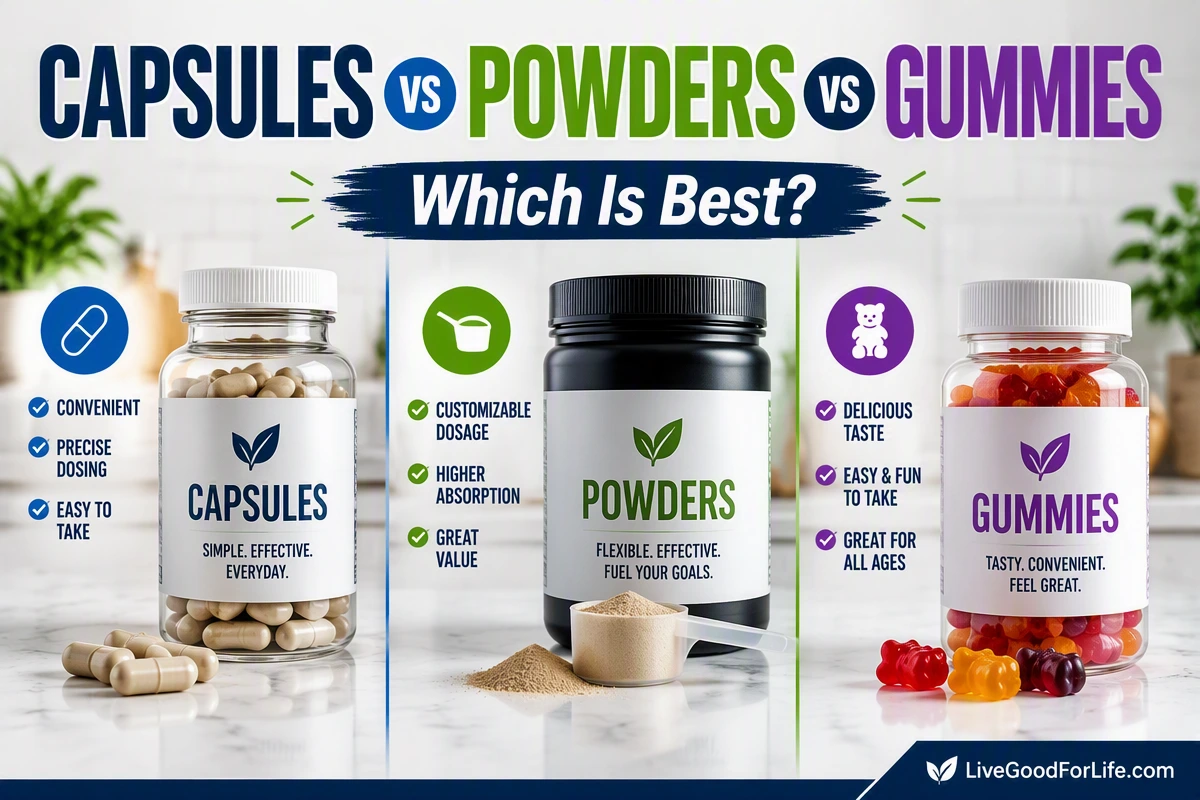
Capsules vs powders vs gummies is one of the most practical supplement questions because the form affects serving size, sugar, convenience, dose flexibility, taste, price, and how easy the product is to use consistently. The best supplement form is not the same for everyone.
Quick answer: Capsules are usually best for convenience and precise serving sizes. Powders are often best for larger servings, protein, greens, fiber, collagen, and hydration products. Gummies are usually best for taste and habit-building, but they often have more sugar, fewer active ingredients, and less dose flexibility.
Important: This guide is educational only and is not medical advice. Supplements can interact with medication, other supplements, surgery, pregnancy, breastfeeding, and health conditions. Always read the current Supplement Facts label and ask a qualified healthcare professional if you are unsure.
Capsules vs Powders vs Gummies: Quick Comparison
| Supplement form | Best for | Main drawback |
|---|---|---|
| Capsules | Convenience, travel, simple routines, precise serving size | Large servings may require several capsules |
| Powders | Protein, greens, fiber, hydration, collagen, flexible serving size | Needs mixing and may have taste or texture issues |
| Gummies | Taste, easy habit-building, people who dislike pills | Often add sugar and may provide smaller doses |
If you want the simplest rule, choose capsules for convenience, powders for bigger or adjustable servings, and gummies only when taste and consistency matter more than dose strength or sugar control.
Why Supplement Form Matters
The form of a supplement can change how much active ingredient fits into one serving, how easy the product is to take, whether sugar or flavoring is added, and how much value you get per serving. Two products can contain the same nutrient but feel very different in real life.
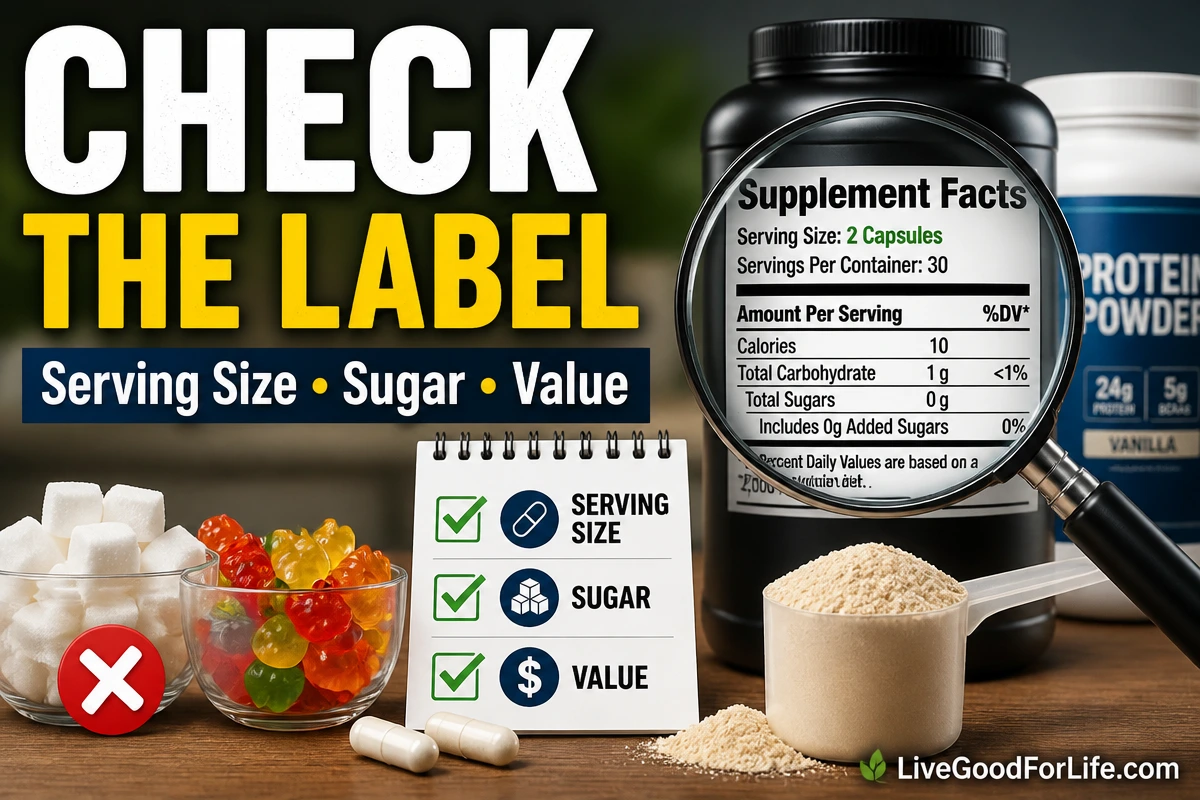
The NIH Office of Dietary Supplements explains that Supplement Facts labels list active ingredients, amounts, serving size, and other added ingredients. That means you should compare the full label, not only the front of the bottle or the flavor claim.
Capsules: Pros and Cons
Capsules are one of the most common supplement forms because they are portable, measured, and easy to add to a daily routine. They are especially useful for vitamins, minerals, herbal blends, probiotics, enzymes, omega-3 softgels, and targeted formulas.
| Capsule advantage | Why it helps |
|---|---|
| Precise serving size | Each capsule usually contains a set amount |
| Easy to travel with | No scoop, shaker, or measuring needed |
| Usually low sugar | Most capsules do not need sweeteners |
| Less taste issue | Useful for bitter herbs or minerals |
| Simple routine fit | Easy to take with meals if the label allows |
The main downside is serving size. If a formula needs a lot of powder, minerals, fiber, amino acids, or protein, the capsule serving may require several capsules or may not fit enough active ingredient to be practical.
Powders: Pros and Cons
Powders work well when a product needs a larger serving size. Protein powders, greens powders, reds powders, fiber, collagen, electrolyte mixes, creatine, and meal-style supplements are often powders because the serving would be too large for capsules or gummies.
| Powder advantage | Why it helps |
|---|---|
| Flexible serving size | You can often adjust the scoop amount |
| Better for larger doses | Useful for protein, fiber, collagen, greens, and electrolytes |
| Easy to mix into drinks | Works with water, smoothies, oats, or shakes |
| Can be better value | Cost per serving may be lower for high-volume nutrients |
| Good for hydration | Electrolytes and powders can fit workouts and heat |
The downside is effort. Powders need mixing, can clump, may taste strong, and may include sweeteners, flavors, gums, colors, or other added ingredients. Always check the serving size, sugar, sodium, caffeine, allergens, and total active ingredients.
Helpful next reads: Electrolytes vs Sports Drinks, Plant-Based Protein vs Whey, and Do I Really Need a Greens Powder?
Gummies: Pros and Cons
Gummies are popular because they taste good and feel easy. For people who dislike swallowing pills, gummies can make a supplement routine more consistent. That convenience can matter, but gummies deserve careful label checking.
| Gummy advantage | Why it helps |
|---|---|
| Easy to take | Useful for people who dislike pills |
| Taste-friendly | Can improve consistency |
| No mixing | More convenient than powders |
| Simple daily habit | Feels closer to a snack than a supplement |
The trade-off is that gummies often need sugar, sweeteners, flavors, colors, and texture ingredients. They may also contain smaller amounts of active nutrients because each gummy has limited space. Minerals, omega-3s, fiber, protein, and higher-dose formulas are often harder to deliver meaningfully in gummy form.
Absorption: Is One Form Always Better?
No single supplement form always absorbs better. Absorption depends on the ingredient, dose, form of the nutrient, whether it should be taken with food, your digestion, your health status, and the product formula. A capsule can be excellent for one nutrient, while a powder may be better for another.
For example, vitamin D is often taken with a meal that contains some fat, magnesium can vary by form and tolerance, and protein powders are used because the serving size is too large for capsules. The question is not just absorption. The better question is whether the product gives the right amount in a form you can use safely and consistently.
Sugar, Sweeteners, and Additives
This is where gummies and flavored powders need the most attention. Sugar can make a product taste better, but it also changes the daily value of the product. Sweeteners, flavors, colors, gums, and acids may be fine for some people and a problem for others.
| Check this | Why it matters |
|---|---|
| Added sugar | Can add up if taken daily |
| Sugar alcohols | May cause bloating or digestive discomfort |
| Artificial colors | Some readers prefer to avoid them |
| Natural flavors | Not automatically bad, but still worth noting |
| Citric acid | Common in gummies and flavored powders |
| Allergens | Check dairy, soy, gluten, gelatin, fish, shellfish, and tree nuts |
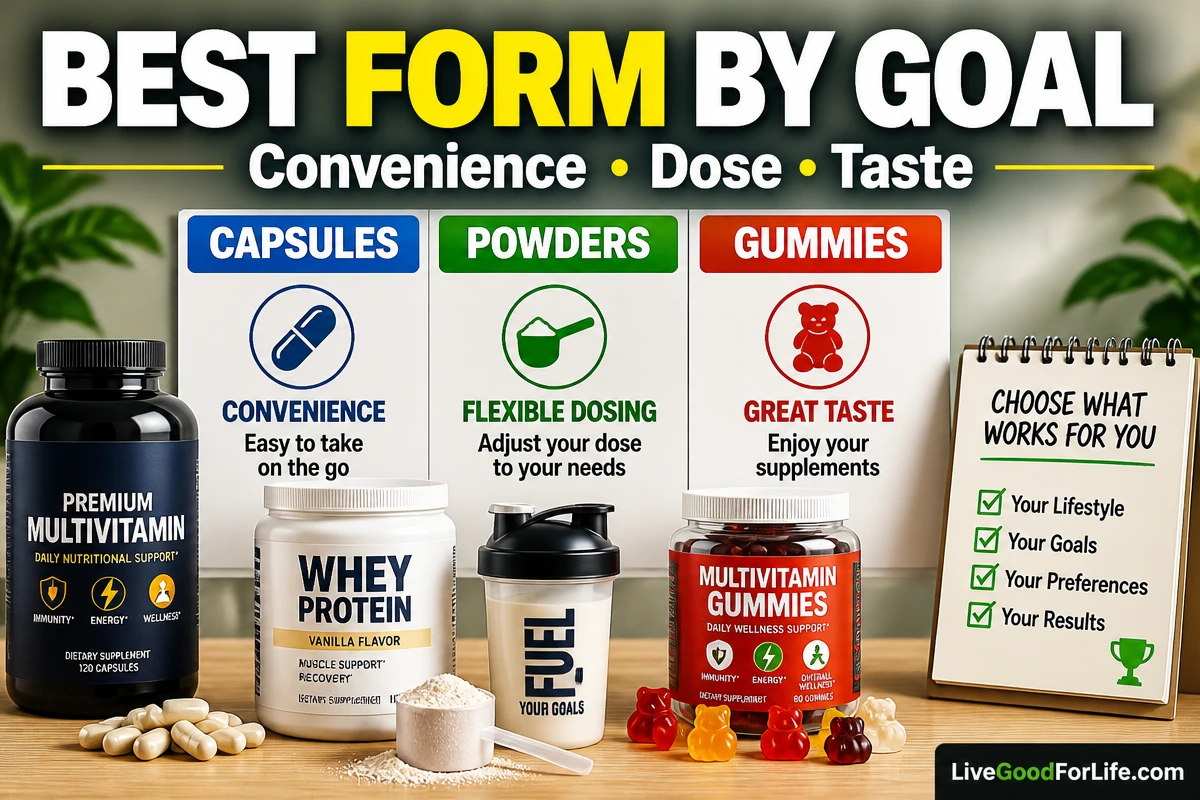
Best Supplement Form by Goal
| Your goal | Best form to compare first | Why |
|---|---|---|
| Simple daily vitamin routine | Capsules | Convenient and measured |
| Protein support | Powder | Protein requires a larger serving |
| Hydration or electrolytes | Powder or stick pack | Easy to mix with water |
| Greens or reds blend | Powder | Plant blends need more volume |
| People who dislike pills | Gummies or powders | May improve consistency |
| Low-sugar routine | Capsules or low-sugar powders | Usually easier to control sugar |
| Travel | Capsules or stick packs | Less mess and easier serving control |
| Best value per serving | Depends on label | Compare active ingredients, servings, and price |
How to Compare Value
Value is not just the price of the bottle. A gummy bottle may look cheaper but provide a smaller dose. A powder may look expensive but include more servings or a larger active amount. A capsule formula may be convenient but require four capsules per serving. Compare the real serving, not only the front label.
- Check the serving size.
- Check servings per container.
- Check active ingredient amount per serving.
- Check added sugar, sweeteners, and fillers.
- Calculate cost per serving.
- Ask whether you will actually use it consistently.
You can also use How to Compare Supplement Price Per Serving and the Supplement Capsule Count Calculator.
Label Checklist Before You Buy
- Supplement Facts label is clear and complete.
- Serving size matches how you plan to use it.
- Active ingredient amount is meaningful.
- Added sugar is acceptable for your routine.
- Allergens and warnings are easy to find.
- Directions explain when and how to take it.
- Claims are realistic and not disease-treatment promises.
- The form fits your budget, schedule, and taste.
Common Mistakes
- Choosing gummies only because they taste good.
- Ignoring sugar in daily gummy supplements.
- Assuming powders are always stronger or cleaner.
- Buying capsules without checking how many are in one serving.
- Comparing bottle price instead of cost per serving.
- Stacking multiple forms with overlapping nutrients.
- Ignoring medication, pregnancy, surgery, or health-condition warnings.
Where LiveGood Products Fit
LiveGood products come in different forms because different goals need different formats. Capsules can work well for daily essentials and targeted formulas. Powders can make sense for protein, greens, reds, collagen, or hydration products where a larger serving is expected. The right choice depends on your goal, label needs, taste preference, and budget.
Useful next reads: LiveGood Product Packs vs Single Products, Supplement Stack Builder, and 7 Multivitamin Label Red Flags.
Explore LiveGood wellness products
Frequently Asked Questions
Are capsules better than powders?
Capsules are usually better for convenience and precise serving sizes. Powders are usually better when the ingredient needs a larger serving, such as protein, fiber, greens, collagen, or electrolytes.
Are gummies as effective as capsules?
Sometimes, but not always. It depends on the nutrient amount, form, serving size, and label quality. Gummies often contain added sugar and may provide smaller amounts of active ingredients.
Do powders absorb better than capsules?
Not automatically. Absorption depends on the ingredient, dose, nutrient form, product formula, food timing, and personal digestion. No single form is always best for every supplement.
Which supplement form is best for travel?
Capsules and stick packs are usually easiest for travel. Powders can work if pre-portioned, while large tubs and gummies may be less convenient depending on temperature, space, and serving size.
Are gummies bad for daily supplements?
Not always, but check added sugar, serving size, active ingredient amounts, and total daily intake. Gummies can help consistency, but they are not always the best value or strongest formula.
How do I choose between capsules, powders, and gummies?
Choose based on your goal, label quality, serving size, sugar, cost per serving, dose needs, taste, and whether you can use the product consistently.
Final Thoughts
The best choice between capsules vs powders vs gummies depends on the supplement, the dose, and your routine. Capsules are practical and measured, powders are flexible and useful for larger servings, and gummies can help people stay consistent when taste matters.
Before buying, look past the front label. Check serving size, active ingredients, sugar, warnings, cost per serving, and whether the form fits your real life.