Supplement Education Hub: Labels, Dosage, COAs & Ingredient Research
Last Updated: February 2026
Welcome to the Supplement Education hub on LiveGoodForLife.com. This page is the educational center for learning how to evaluate supplements beyond marketing claims. It is designed to help you read labels correctly, understand dosage logic, interpret certificates of analysis (COAs), and compare products using a practical, evidence-aware framework.
If you are researching LiveGood products, comparing supplement brands, or trying to avoid underdosed formulas, this page gives you the foundation first. Use this hub before or alongside product reviews so you can judge value based on ingredient transparency, form quality, and cost per serving—not just branding or hype.
Smart Supplement Buyer Checklist
Use this quick education guide before buying any supplement. It helps you compare labels properly, avoid underdosed formulas, and calculate real value per serving instead of relying on front-label marketing.
Step 1
Check the label first
- Read the Supplement Facts panel (not just the front label)
- Check serving size and servings per container
- Look for exact ingredient amounts (avoid vague blends)
- Check the ingredient form (example: mineral form matters)
Green flag: full transparency with ingredient names + amounts.
Step 2
Calculate real value
- Calculate cost per serving (price ÷ servings)
- Estimate how many days it lasts based on your use
- Check if the serving size is realistic (1 serving/day or more?)
- Compare monthly cost, not just bottle price
Tip: Use your supplement savings calculator to compare daily and monthly value faster.
Step 3
Verify trust signals
- Is there a COA or testing documentation?
- Does the brand mention GMP or manufacturing standards?
- Are claims educational or overly hyped?
- Are there clear internal resources explaining ingredients?
Next step: cross-check with your COA resource page before buying.
Supplement Education Comparison Table (Quick Reference)
This table is designed for fast side-by-side checks when reading any supplement label. It works for LiveGood products and other brands too.
| What to Check | Why It Matters | Green Flag | Red Flag | Action Step |
|---|---|---|---|---|
| Supplement Facts panel | Shows what is actually in the product | Full panel visible and readable | Only front-label marketing claims | Read facts panel before comparing price |
| Serving size | Changes dose and value calculations | Clear and practical daily serving | Unclear or unrealistic serving instructions | Check servings/day before buying |
| Servings per container | Tells you how long it lasts | 30+ servings for daily-use products (when applicable) | Low serving count hidden by “cheap” price | Calculate how many days it will last |
| Ingredient amounts | Needed to compare formulas fairly | Exact amounts listed for key actives | Proprietary blend with hidden doses | Treat comparisons with caution |
| Ingredient forms | Can affect absorption/tolerance | Forms listed clearly (especially minerals/vitamins) | Generic ingredient names only | Compare forms, not just ingredient names |
| Cost per serving | Shows real value | Low/competitive daily cost with transparent label | Only bottle price promoted | Use cost-per-serving and monthly cost |
| How many days it lasts | Improves budgeting and stack planning | Easy to estimate from serving instructions | Confusing use directions | Estimate 30-day or 60-day use cost |
| Organic / premium claims | Marketing terms need proof | Claim supported by label details or certifications | “Premium” used without explanation | Check label and documentation, not buzzwords |
| COA / certificate | Supports transparency and trust | COA or testing documentation available | No documentation or vague testing claims | Use the COA resource to verify |
| GMP / manufacturing quality | Adds confidence in production standards | Clear manufacturing quality signals | No manufacturing info at all | Treat GMP as a trust layer, not a substitute for label review |
Fast Formula Scoring Guide (Reader-Friendly)
Use this simple scoring system to quickly rate a supplement before you buy it. It is not a medical score — it is a transparency and value score for smarter shopping.
| Category | Score 0 | Score 1 | Score 2 |
|---|---|---|---|
| Label transparency | No clear facts panel | Partial disclosure | Full ingredients + amounts listed |
| Serving clarity | Confusing serving info | Usable but not ideal | Very clear serving + servings count |
| Ingredient form quality | Forms not listed | Mixed clarity | Forms clearly identified where relevant |
| Value | Price-only marketing | Basic value visible | Clear cost-per-serving and good monthly value |
| Trust signals | No COA/GMP/testing context | Some quality signals | Strong transparency (COA/GMP/testing support) |
How to use it: Add the points (max 10). A higher score usually means the product is easier to trust and compare, even before you decide if it fits your goal.
Helpful Internal Pages to Use With This Guide
- Supplement label guide for underdosing and fairy-dusting checks
- Certificates of Analysis resource for documentation and testing transparency
- Supplement savings calculator for cost-per-serving and monthly value
- Membership guide for pricing structure context
- LiveGood Supplement Reviews hub to apply this framework on real products
This education hub supports the full review ecosystem on this site, including the LiveGood Supplement Reviews hub, the certificates of analysis resource, and the supplement label guide.
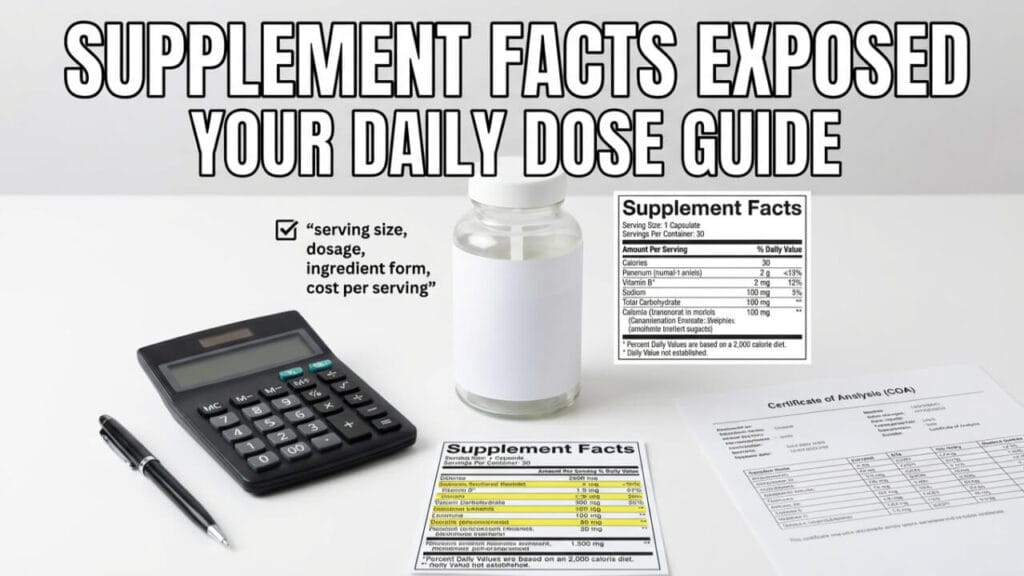
How to Use This Supplement Education Hub
This page is structured as a practical learning path. Start with label reading basics, then move into dosage logic and ingredient forms. After that, learn how COAs and GMP standards fit into quality evaluation. Once you understand those pieces, product reviews become much easier to interpret.
- Start here if you want to learn how to read supplement labels
- Use the dosage section if you want to understand what “effective dose” really means
- Use the COA section if you want to verify manufacturing transparency
- Use the comparison framework if you want to compare LiveGood vs retail brands more objectively
After reading this page, you can apply the framework directly to your product research inside the LiveGood reviews authority hub and the LiveGood products hub.
Why Supplement Education Matters Before You Buy
Most supplement buyers make decisions using the front label, a few marketing claims, and the price. That approach often leads to confusion because two products can look similar on the front but be very different on the Supplement Facts panel.
For example, one product may list a long “proprietary blend” with no meaningful dosages, while another clearly discloses every active ingredient and amount. One may use lower-cost ingredient forms with weaker absorption potential, while another uses more bioavailable forms. Without education, those differences are easy to miss.
This is exactly why this page exists. It reduces the “affiliate-only” feel by giving you a reusable evaluation system you can apply to any supplement brand, not just LiveGood. It also strengthens the way you read product reviews across this site because you’ll understand the criteria behind every review conclusion.
If your goal is to evaluate actual products after learning the framework, start with the LiveGood Supplement Reviews hub and then branch into category pages such as NAD+ Dissolvable Strips review, Ultra Magnesium review, or Organic Super Greens review.
Supplement Labels 101: How to Read a Label Correctly
The Supplement Facts panel is where the real evaluation begins. Marketing text on the front of a bottle is designed to catch attention, but the label panel shows what you are actually getting per serving.
1) Serving Size Comes First
Always start with serving size. Many comparisons go wrong because one product lists ingredients per 1 capsule while another lists them per 2 capsules or 1 scoop. If you compare ingredient amounts without adjusting for serving size, you can misjudge both dosage and value.
Serving size also matters for cost-per-serving analysis. A bottle may look cheaper, but if it contains fewer real servings, the monthly cost may be higher. This is one reason we recommend pairing label reading with cost calculations inside the supplement savings calculator.
2) Active Ingredients vs Support Ingredients
Separate the active ingredients (the ones responsible for the main work) from support ingredients, fillers, capsule materials, and flavoring components. Many labels look “long” because they list many non-active ingredients, but that does not mean the formula is stronger.
When reviewing a supplement, focus first on what the formula is supposed to do, then identify the primary active ingredients and their amounts. This helps you avoid being distracted by label length or flashy naming.
3) Proprietary Blends vs Full Disclosure
A proprietary blend lists the total weight of a group of ingredients, but does not show how much of each ingredient is inside. That can make objective comparison much harder and may hide underdosed ingredients.
Full disclosure labels are easier to evaluate because each ingredient is listed with a specific amount. This is one of the strongest trust signals in supplement reviews and a core criterion used throughout the LiveGood reviews hub.
For a deeper walkthrough on underdosing and “fairy dusting,” use the dedicated guide on how to read supplement labels and spot fairy-dusting.
4) Ingredient Forms Matter More Than Many Buyers Realize
Two products may list the same nutrient, but the ingredient form can differ significantly. This matters because form can affect absorption, tolerance, and practical results. For example, some mineral forms are better tolerated or more bioavailable than others, and some vitamin pairings are more logical than single-ingredient formulas depending on the use case.
When reviewing labels, don’t stop at the ingredient name—look at the form listed in parentheses or in the ingredient line itself. This becomes especially important in categories like magnesium, multivitamins, and D3/K2 combinations.
5) Percent Daily Value Is Useful, But Not the Full Story
% Daily Value (%DV) helps you understand general nutrient contribution, but it is not a complete quality score. Some ingredients do not have a meaningful %DV, and some targeted formulas are not designed around daily value percentages at all. A strong evaluation combines %DV context with label transparency, ingredient form quality, and dosage logic.
This is why educational reading and product review reading work best together. Start with the label framework here, then apply it to real examples inside the Organic Super Reds review or Creatine + HMB review to see how the same rules apply across categories.
Dosage Comparisons: How to Think About “Effective” Dosing
One of the most common supplement mistakes is treating ingredient presence as the same thing as ingredient usefulness. A label can include a trendy ingredient, but if the amount is too low to support the intended purpose, the label may be more marketing than formulation.
At the same time, “more” is not always better. The best dosage is the one that matches the product goal, delivery format, user tolerance, and the broader formula design. A practical evaluation looks at dosage in context rather than chasing the highest number.
What a Good Dosage Comparison Looks Like
- Compare ingredient amounts per serving, not per bottle
- Check whether the product is a single-ingredient formula or a multi-ingredient blend
- Evaluate whether the dose matches the intended use case (daily baseline, targeted support, workout support, etc.)
- Look at the delivery format (capsule, powder, strip, patch) because format may change expectations
- Consider stacking overlap if you already use other supplements
This is the same logic used across product reviews on this site. For example, a greens powder review is not judged the same way as a creatine formula or a multivitamin. The category changes the dosage discussion, which is why this education hub is designed to support the category-based structure in the LiveGood Supplement Reviews hub.
Dosage Context by Product Type
Different categories require different dosage expectations. A multivitamin is usually designed for broad daily coverage, not high-dose targeted intervention. A performance formula may prioritize fewer ingredients with more focused doses. A superfood blend may include many ingredients, so transparency becomes even more important to determine whether the amounts are meaningful.
That is why category context matters so much. If you are comparing products by category, this site’s product map and review framework inside the LiveGood reviews hub helps keep those comparisons fair and consistent.
Ingredient Research Basics: What to Check Before Trusting a Claim
Ingredient research does not mean you need to become a scientist before buying a supplement. It means learning how to ask better questions. The goal is not to “prove” a product works from one article; the goal is to understand whether the product’s claims align with what the formula is actually designed to support.
Start With the Ingredient, Not the Marketing Headline
When you see a claim like “supports energy” or “supports immune health,” trace it back to the actual ingredients listed on the label. Ask: Which ingredient is responsible for that function, and is the amount disclosed clearly?
This simple shift instantly improves review quality and makes it much easier to spot weak comparisons online. It also helps you use product pages correctly. For example, official pages inside the LiveGood products hub are useful for verifying label details, while review pages provide the interpretation framework.
Use Reliable Reference Sources for Ingredient Education
For ingredient education, it helps to cross-check with recognized health and research sources. This site encourages readers to use the NIH Office of Dietary Supplements for fact sheets, PubMed for research abstracts, and FDA dietary supplement guidance for general regulatory context. These sources support educational reading and help reduce overreliance on marketing pages.
You can also use the site’s own education resources to build confidence first, especially the label-reading and fairy-dusting guide and the COA resource center.
Supplement Education and Reviews Work Better Together
This education page is not separate from product reviews—it improves how you use them. Once you understand labels, dosage logic, and ingredient forms, review pages become more useful because you can see the “why” behind each analysis point.
If you want to apply this framework immediately, use the LiveGood Supplement Reviews hub and choose one category based on your goal. A good starting combination is:
- Label guide (learn the framework)
- COA resource (learn transparency verification)
- Reviews hub (apply the framework to real products)
Certificates of Analysis (COAs): What They Are and Why They Matter
A Certificate of Analysis (COA) is a quality-control document that helps verify key details about a product batch. In practical terms, a COA can support transparency by showing testing information related to identity, purity, potency, or contaminants, depending on what is included in the document.
Not every COA is identical, and not every reader needs to interpret every line. The goal for most supplement buyers is simpler: understand what a COA is, why it matters, and how it supports trust when evaluating a brand’s transparency.
On this site, the easiest place to start is the LiveGood Certificates of Analysis resource, which is designed as a practical reference alongside product reviews and label analysis.
What a COA Can Help You Verify
- That a product batch has been tested
- That listed ingredients or actives are supported by documentation (where applicable)
- That quality control is part of the brand’s process
- That transparency goes beyond front-label marketing claims
COAs do not replace label reading, and labels do not replace COAs. The strongest evaluation combines both: label transparency for formula understanding and COA transparency for manufacturing confidence.
How to Read COAs Without Overcomplicating It
Many people open a COA, see technical formatting, and immediately feel lost. You do not need to interpret every laboratory detail to benefit from it. Focus on the practical signals that matter for consumer-level evaluation.
Practical COA Reading Checklist
- Product identification: Does the document clearly match the product you are evaluating?
- Batch/lot reference: Is there batch-level specificity or identifying information?
- Test categories: Does the COA indicate what was tested (purity, potency, etc.)?
- Result clarity: Are results presented clearly enough to understand pass/fail or compliance-style outcomes?
- Consistency: Does the brand treat COA access as a normal transparency practice?
If you want a product-specific application of this process, use the COA resource together with a review page such as the Ultra Magnesium review or Organic Super Greens review, then compare what the label communicates versus what the documentation supports.
GMP Discussion: What Good Manufacturing Practice Means for Supplement Buyers
GMP stands for Good Manufacturing Practice. In supplement education, GMP matters because it shifts the conversation from “what the label claims” to “how products are made, controlled, and documented.”
Most buyers understandably focus on ingredients first, but manufacturing quality is part of trust and consistency. A strong supplement education framework includes both formulation quality and production standards.
Why GMP Matters in Real-World Evaluation
- Supports more consistent production practices
- Improves confidence in quality-control systems
- Strengthens trust when combined with transparent labeling and COAs
- Helps separate serious brands from “label-only” marketing operations
GMP discussion should not be used as a replacement for reviewing the actual formula. The best approach is layered:
- Layer 1: Label transparency (what is in the product)
- Layer 2: Dosage logic and ingredient forms (whether the formula is sensible)
- Layer 3: COAs and manufacturing standards (how trust is supported behind the product)
This layered approach is what makes review content more credible and less promotional. It is also the reason this Supplement Education hub supports the LiveGood reviews hub instead of duplicating it.
How to Compare Supplements Without Falling for “Best Product” Lists
Many supplement comparisons online use broad statements like “best for energy” or “best for immunity” without explaining what makes one formula better than another. That style may rank, but it often does not educate. This page is built to give you a more useful comparison method.
A Better 5-Step Comparison Method
- Step 1: Define the goal — daily baseline, sleep support, performance, healthy aging, gut support, etc.
- Step 2: Compare labels — ingredient transparency, serving size, and forms
- Step 3: Compare dosage logic — meaningful amounts in the context of the formula type
- Step 4: Compare value — cost per serving, not just bottle price
- Step 5: Verify trust signals — COA transparency, manufacturing standards, and review quality
This is the same process behind the structured reviews on this site. If you want to apply it by category, use the LiveGood Supplement Reviews hub and choose a path based on your goal. If you want to browse products first, use the LiveGood products hub and come back here to evaluate what you find.
Dosage Comparisons in Practice: Common Buyer Mistakes to Avoid
Even careful buyers can make the wrong comparison if they do not use a consistent method. Here are the most common mistakes and how to avoid them.
Mistake 1: Comparing Bottle Prices Instead of Cost Per Serving
A lower bottle price may look better until you calculate how many real servings are included. Always compare cost per serving, then estimate the monthly cost based on how often you would actually use the product.
Use the supplement savings calculator to make this step easier, especially when comparing member vs retail pricing structures.
Mistake 2: Treating “More Ingredients” as Better
A longer ingredient list can look impressive, but a shorter formula with clearer dosing and better ingredient forms may be the stronger product. Evaluate clarity and functional design, not just ingredient count.
Mistake 3: Ignoring Overlap Across Products
If you are building a supplement routine, compare labels across your stack. It is easy to duplicate certain vitamins, minerals, or support ingredients without realizing it. Education-first reading helps you spot overlap and choose a more efficient setup.
This is one reason the reviews hub is organized by category and use case—so readers can plan intelligently instead of collecting random products.
Bonus Education Hub
This hub teaches how to judge supplements using labels, dosages, ingredient forms, COAs, and manufacturing quality. That improves trust and strengthens the credibility of product reviews linked across the site.
For practical next steps after reading this page, readers can move into:
- LiveGood Supplement Reviews hub for category-based product evaluation
- Certificates of Analysis resource for transparency verification
- Supplement label guide for a deeper label-reading walkthrough
- Membership guide for pricing structure context
- Savings calculator for cost-per-serving and monthly-use estimates
How to Compare Supplements Like a Smart Buyer (Not a Hype Buyer)
Most supplement shoppers compare the wrong thing first. They compare the front label, the price tag, or the marketing claims. A better method is to compare the Supplement Facts panel, the ingredient forms, and the cost per serving in that order.
This is the exact process used across our reviews on LiveGoodForLife.com. If you are also reviewing value, combine label analysis with the LiveGood supplement savings calculator and the LiveGood membership plans guide so you can compare actual monthly cost, not just sticker price.
- Step 1: Read the label (what is actually inside)
- Step 2: Check the form (how usable or bioavailable it may be)
- Step 3: Check serving size and servings per container
- Step 4: Calculate cost per serving and monthly cost
- Step 5: Verify quality signals (COA, GMP, transparency)
Quick Comparison Framework (Use This on Any Product)
Use the table below when comparing LiveGood products or any other supplement brand. This keeps your decision grounded in measurable criteria instead of marketing copy.
| Comparison Factor | What to Check | Common Problem | Better Signal |
|---|---|---|---|
| Ingredient transparency | Full label with amounts listed | Proprietary blends with hidden doses | Clear amounts for key ingredients |
| Ingredient forms | Mineral/vitamin form listed | Cheap forms without context | Bioavailable forms where relevant |
| Serving size | Capsules/scoops/strips per serving | Large serving hides weak value | Practical daily serving size |
| Servings per container | How long it lasts | Looks cheap but lasts very little | 30+ servings for daily-use products |
| Cost per serving | Price ÷ servings | Only comparing bottle price | Monthly cost comparison |
| Quality documentation | COA / manufacturing transparency | No supporting documentation | Verifiable testing and sourcing info |
If you are new to this process, start with our supplement label guide on fairy-dusting and underdosing, then cross-check product documentation in the LiveGood certificates of analysis resource.
Dosage Comparison Basics (Why “More” Is Not Always Better)
One of the biggest mistakes in supplement education is assuming that a larger number automatically means a better formula. In reality, dosage quality depends on the ingredient, the form, the goal, and whether the amount is practical and evidence-aligned for that use case.
For example, a product can look impressive on the front label but still be weak if the key ingredients are underdosed or buried in a blend. On the other hand, a simpler formula with fewer ingredients can be stronger if the doses are clear and the forms are chosen well.
- Watch for “pixie dusting”: tiny doses added for label appeal only
- Watch for blend stacking: many ingredients, but no clear amounts
- Watch for impossible promises: “instant” or “works for everyone” language
- Focus on fit: the right dose depends on your goal and tolerance
This is why our product reviews link back to education pages before making conclusions. If you want to see this applied in real examples, compare review structures inside the LiveGood supplement reviews hub and then open any individual review page to see how the same framework is used consistently.
GMP, Testing, and COA: What These Terms Actually Mean
Many supplement sites mention GMP or testing, but very few explain what those terms actually help you verify. This section is here to reduce confusion and help you ask better questions when reviewing any product label.
| Term | Meaning (Simple) | Why It Matters | What to Look For |
|---|---|---|---|
| GMP | Good Manufacturing Practices | Shows manufacturing standards and process controls | Clear manufacturing quality statements and consistency |
| COA | Certificate of Analysis | Supports verification of identity/purity/testing | Batch-level or product-level documentation where available |
| 3rd-party testing | Independent lab testing (if used) | Adds trust beyond marketing claims | Specific testing references, not vague claims |
| Transparency | Open label + clear disclosures | Makes comparison possible | Complete ingredient panel + serving details |
For product-specific documentation, use the certificates of analysis page as your verification checkpoint. For broader educational context, keep this page bookmarked and return to it whenever you’re comparing labels side-by-side.
Red Flags to Avoid on Supplement Websites
Whether you are reviewing LiveGood products or any other supplement line, these are the most common warning signs that a page is focused more on promotion than education.
- No ingredient amounts listed (or no visible label image at all)
- Only benefits, no limitations (no discussion of who may not need the product)
- No cost-per-serving breakdown (only total bottle price mentioned)
- No manufacturing transparency (testing language is vague or generic)
- Overly aggressive claims without educational explanation
- No internal educational links to label guidance or dosage context
Suggested Research Path (Best Pages to Read Next)
If you want to build real supplement literacy and make better buying decisions, use this reading path:
- Start with the supplement label guide to understand ingredient transparency and underdosing.
- Review the COA and product documentation resource to understand verification signals.
- Use the LiveGood supplement reviews hub to compare products by goal and use case.
- Use the savings calculator and membership guide to compare monthly value.
- Open the LiveGood products hub when you want to browse the catalog after you understand the framework.
This sequence provides you with a stronger foundation and improves decision-making quality before they buy any supplement — whether for daily nutrition, gut health, sleep support, performance, or healthy aging.
How to Read Supplement Labels Like a Smart Buyer (Not a Marketing Victim)
Most supplement buyers do not make bad decisions because they lack discipline. They make bad decisions because labels are designed to look impressive before they are designed to be understood. This is exactly why supplement education matters.
If you want to compare products properly, you need a repeatable way to read labels. That means looking beyond front-label claims and checking the Supplement Facts panel, serving size, ingredient forms, dose amounts, and whether the formula is transparent enough to evaluate at all.
This is also where the difference between “cheap” and “good value” becomes clear. A product can look affordable and still be poor value if the serving size is unrealistic, the dose is too low, or the ingredient forms are weak. If you are comparing LiveGood products specifically, use this framework together with the LiveGood supplement savings calculator and the LiveGood supplement reviews hub so pricing and label quality are evaluated together.
Step 1: Start With Serving Size (This Changes Everything)
The first thing to check is serving size and servings per container. This sounds basic, but it is one of the most common places people get misled. A formula may look strong on the front label, but the effective amount may require multiple scoops or multiple capsules per day.
Before judging price, always ask:
- How many capsules, tablets, scoops, or strips equal one serving?
- How many servings are in the container?
- Is that serving size realistic for daily use?
- What is the actual cost per serving, not just the bottle price?
This is why cost-per-serving should always come before “cheap vs expensive” conclusions. A lower bottle price can be misleading if the serving count is low or the formula is underdosed.
| What brands show | What you should calculate | Why it matters |
|---|---|---|
| Bottle price | Cost per serving | Shows real daily cost |
| “30-day supply” claim | Actual serving instructions | Some products require 2+ servings/day |
| Big mg number on front | Dose per serving + ingredient form | Big numbers alone do not equal quality |
Step 2: Read the Supplement Facts Panel, Not Just the Front Label
The front label is marketing. The Supplement Facts panel is where the real evaluation starts. Terms like “advanced,” “premium,” “bioactive,” or “clinically inspired” do not tell you whether the product is actually well built.
On the facts panel, focus on these core checks:
- Active ingredients listed clearly: You should be able to see what is inside without guessing.
- Amounts disclosed: Meaningful formulas show quantities, not vague categories.
- Serving unit clarity: mg, mcg, IU, and percentages should be understandable.
- No hidden blend tricks: If ingredients are grouped without individual amounts, comparison becomes harder.
- Other ingredients section: Useful for checking fillers, capsule type, and additives.
If you are reviewing LiveGood products, this same method applies across categories including multivitamins, magnesium, greens, reds, collagen, and NAD+ products. That consistency is what improves your decision quality over time and helps you avoid buying based only on hype.
Step 3: Ingredient Form Matters More Than Most People Realize
Two labels can show the same nutrient name but use different forms, and those forms may behave differently in the body. This is one reason ingredient education is a major EEAT signal: it proves your site is teaching readers how to evaluate products, not just sending them to affiliate links.
Examples of what to look for:
- Magnesium: The form (such as citrate, glycinate, oxide, etc.) influences tolerance and use-case positioning.
- Vitamin D: D3 is commonly preferred in supplement formulas, and pairings like D3 + K2 are often used for practical formulation logic.
- B vitamins: “Active” or methylated forms may be used in some formulas, but labels should still be read carefully for dose and context.
- Minerals: Chelated forms are often highlighted because form can affect absorption and stomach tolerance.
This is also where your review framework becomes stronger than generic “top 10 supplements” articles. You are not just listing products. You are showing readers how to judge form quality, dose logic, and value in a repeatable way.
For a product-by-product application of this method, readers can move from this education hub into the LiveGood reviews hub and then into the specific review pages for categories they care about most.
Step 4: Spot the Difference Between Transparent Formulas and “Fairy-Dusted” Formulas
“Fairy-dusting” is when labels include appealing ingredients in amounts that are too small to have practical impact, or when ingredients are buried inside proprietary blends so the exact dose is hidden. A product may still sound impressive, but the label does not allow a fair comparison.
Use this quick screening table when reviewing any supplement label:
| Green Flag | Red Flag | What to do next |
|---|---|---|
| Ingredients listed with exact amounts | Proprietary blend with no per-ingredient doses | Treat comparisons with caution |
| Serving size is practical and clear | Serving size is unclear or unrealistic | Recalculate daily use cost |
| Ingredient forms disclosed | Generic names only | Look for better label transparency |
| Purpose matches formula design | Front label claims do not match facts panel | Check for marketing-heavy positioning |
If you want a deeper explanation specifically on this topic, link this section with your existing educational article on how to read supplement labels and spot fairy-dusting. That internal link is highly relevant and strengthens topical clustering for your supplement education silo.
Step 5: Use a Practical Comparison Process Before You Buy
Here is a simple decision flow that readers can use before buying any supplement. This works especially well for LiveGood comparisons because it combines education, pricing, and product-specific review content.
- Step A: Identify your goal (sleep, recovery, daily nutrition, healthy aging, performance, digestive support, etc.).
- Step B: Check the label for transparency, ingredient forms, and serving size.
- Step C: Calculate cost per serving and monthly use cost.
- Step D: Compare member vs retail pricing if applicable.
- Step E: Read the product-specific review for context, pros/cons, and who it may fit.
Quick Supplement Label Checklist (Save This Before You Buy)
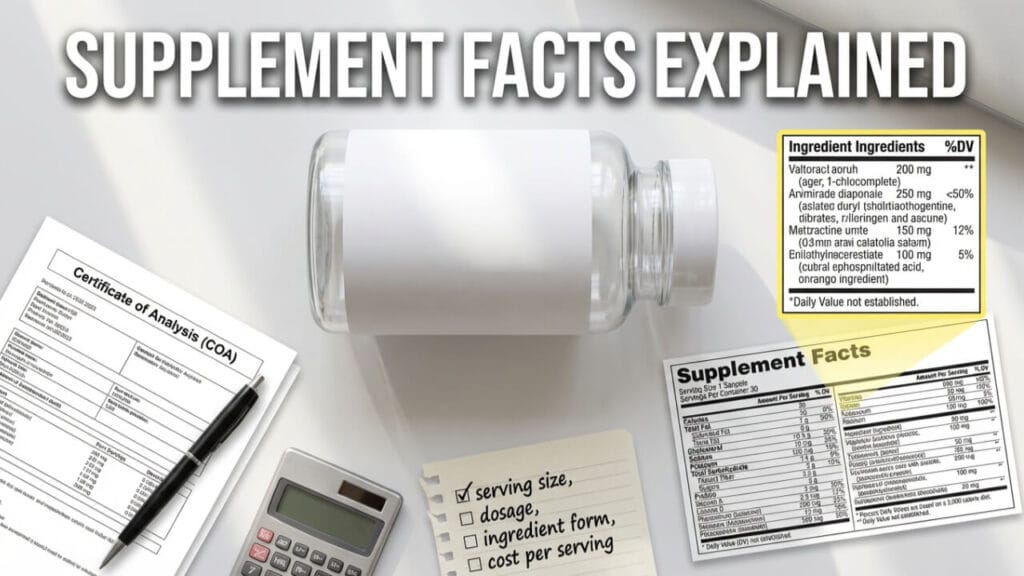
Use this checklist as a final screen any time you compare supplements online:
- Check serving size and servings per container
- Read the Supplement Facts panel fully
- Look for exact ingredient amounts
- Check ingredient forms where relevant
- Avoid judging quality by front-label claims only
- Calculate cost per serving and monthly use
- Use product reviews to understand use case fit
- Cross-check transparency resources (COA / GMP / testing info)
Supplement Education FAQ
What is the difference between a supplement label and a COA?
The label explains what the product contains and how it is served. A COA is a supporting quality-control document related to testing and batch-level verification. Good supplement evaluation uses both: labels for formula understanding and COAs for transparency support.
Why is cost per serving better than comparing bottle price?
Cost per serving reflects actual usage value. Bottle prices can be misleading if serving sizes differ or if one product contains fewer practical servings. Cost-per-serving comparison is one of the core methods used throughout this site’s review framework.
What does “fairy-dusting” mean in supplements?
Fairy-dusting refers to including small amounts of popular ingredients mainly for label appeal rather than meaningful formulation impact. The best way to spot it is by checking label transparency and dosage disclosure. See the full guide on how to read labels and spot fairy-dusting.
Do I need scientific training to evaluate supplements properly?
No. You do not need advanced scientific training to improve your supplement decisions. You just need a repeatable framework: serving size, ingredient transparency, dosage logic, ingredient forms, cost per serving, and trust signals like COAs and manufacturing standards.
Should I read this page before product reviews?
Yes, especially if you want to understand why a product is rated or positioned a certain way. This page gives you the evaluation language used across the LiveGood reviews hub, so the review content becomes more useful and easier to compare.
Can this framework be used for brands other than LiveGood?
Yes. This framework is intentionally brand-agnostic. It was built to help readers evaluate supplements more intelligently in general, which also improves trust and consistency when reading product reviews on LiveGoodForLife.com.
Editorial Standards & Reader Safety
This website provides educational content only and does not replace medical advice. Supplements can interact with medications and may not be appropriate for every health condition. Always consult a qualified healthcare professional before starting new supplements.
Content on this page is designed to improve supplement literacy, not diagnose, treat, cure, or prevent disease. Product-specific decisions should be based on your goals, current health status, and, where needed, professional medical guidance.
Affiliate Disclosure
This website contains affiliate links. If you choose to purchase through links on this site, I may earn a commission at no additional cost to you. Educational content and product reviews are structured to prioritize label transparency, dosage logic, and value-based comparison rather than hype-based promotion.
Pricing and product availability can change. For pricing context, use the membership guide and the supplement savings calculator together with product labels and review content.
Continue Your Research
Now that you have the supplement education framework, the best next step is to apply it to real products. Start with the LiveGood Supplement Reviews hub, then move into the category that matches your goal. If you want to browse products first, use the LiveGood products hub and return here to evaluate what you find.
If your main focus is label interpretation, continue with the supplement label guide. If your focus is on manufacturing transparency and documentation, use the COA resource center.