Best Omega 3 Supplements for 2026
Shopping for omega 3 supplements and feeling swamped by choices. Whether the goal is heart support, brain health, or cutting down inflammation, picking the right supplement matters. This guide walks through the top options for 2026 and what to watch for when buying.
We reviewed leading fish oil brands, compared forms and dosages, and focused on safety, third-party testing, and value. Below are nine top picks — LiveGood is our top recommendation — plus clear tips on dosing, what labels mean, and common mistakes to avoid.
Best Omega 3 Supplements for 2026
Not all inflammation support supplements are built the same. The list below should focus on formula strength, ingredient synergy, daily usability, label transparency, testing standards, and overall value. LiveGood Factor4 stands out for combining four widely recognized wellness ingredients into one formula, making it a practical option for people who want broad daily inflammation support without buying multiple separate supplements.
1. LiveGood Factor4 — High-Value Daily Inflammation Support
Website: LiveGood For Life
What it is:
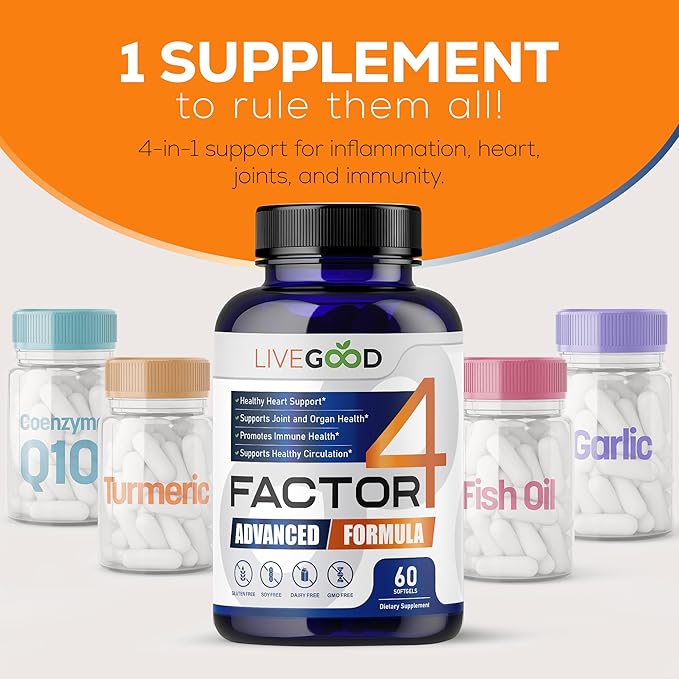
LiveGood Factor4 is an advanced daily wellness supplement designed to support the body’s natural inflammatory response. Instead of relying on just one popular ingredient, it combines fish oil, turmeric, coenzyme Q10, and garlic in one formula, giving users a more complete approach to daily inflammation support.
Why it stands out:
Factor4 is positioned as a convenient all-in-one formula for people who want more than a basic fish oil or turmeric product alone. Rather than buying multiple bottles, users get a blend of four well-known ingredients in one supplement. LiveGood also keeps the product straightforward, with clear usage instructions, a competitive member price, and a formula designed for daily use.
Why LiveGood Factor4 Is Ranked #1
- Combines four popular inflammation-support ingredients in one formula.
- Strong overall value compared with buying separate products individually.
- Clear labeling, practical dosing guidance, and simple daily use.
- Designed for long-term wellness support rather than short-term trend use.
- Competitive pricing compared with higher-cost comparable products.
Best Features
- All-in-one support: Includes fish oil, turmeric, CoQ10, and garlic in one product.
- Convenient routine: Helps reduce the need to purchase multiple separate supplements.
- Daily-use formula: Designed to fit easily into a consistent wellness routine.
- Transparent product guidance: Clear instructions on how to take it and what it contains.
- Value positioning: Member pricing makes it more accessible than many premium alternatives.
Pros
- Combines several well-known wellness ingredients into one bottle.
- Good value for people looking for daily inflammation support.
- Simple to use with clear serving guidance.
- Available directly through LiveGood with straightforward ordering.
- Suitable for long-term routine use.
Cons
- Some users may prefer separate single-ingredient products for more customized dosing.
- Requires consistency to become part of a daily routine.
- Brand recognition may be lower than some mainstream supplement companies.
Who It’s Best For
- Adults looking for a convenient daily inflammation support formula.
- People who want an alternative to buying fish oil, turmeric, CoQ10, and garlic separately.
- Budget-conscious supplement users looking for strong ingredient variety at a lower price point.
- Those who prefer ordering from a health-focused direct brand.
Pricing
LiveGood Factor4 is competitively priced, especially for a formula that combines four popular ingredients in one product. At the time of the product details provided, the member price is $19.95, with Subscribe & Save bringing it down to $18.95, while the retail price is $29.95.
Product Highlights
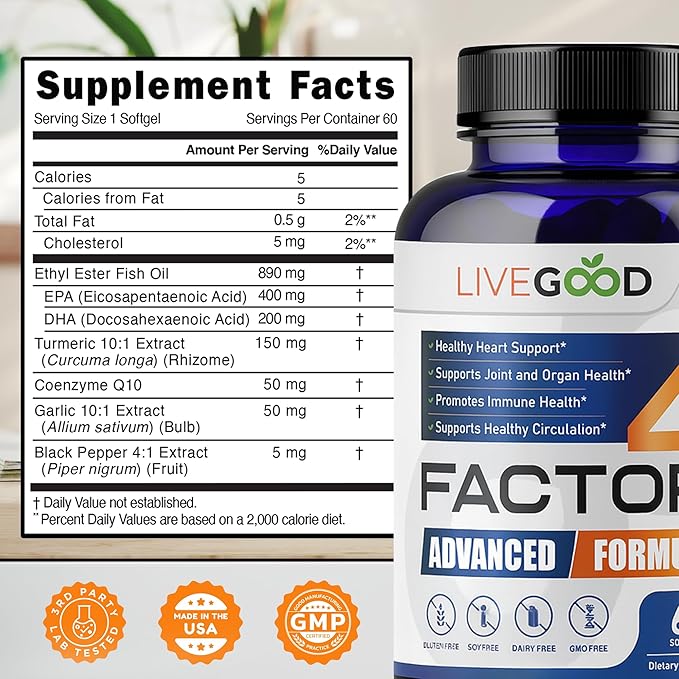
LiveGood Factor4 is formulated with:
- Fish Oil
- Turmeric
- Coenzyme Q10
- Garlic
The formula is designed for daily use and is positioned as a practical way to support the body’s natural response to inflammation. According to the product guidance, the standard use is 1 softgel twice daily with food, increasing as tolerated.
It is also presented as:
- Cruelty Free
- Gluten Free
- GMP Certified
- Non-GMO
- Soy Free
- Third Party Tested
Why Many People Like the Formula
One of the biggest strengths of Factor4 is convenience. Many people interested in inflammation support end up researching several separate ingredients, but this formula brings together four commonly discussed options into one bottle. That makes it easier for users to stay consistent without building a more complicated supplement stack.
Another strong point is the value comparison. Based on the product details shared, Factor4 is priced far below some competitor products, making it especially appealing for people who want a broader formula without premium-brand pricing.
2. Nordic Naturals Ultimate Omega — Potent and Well-Tested
Website:nordicnaturals.com
What it is: A concentrated fish oil known for high EPA/DHA per serving and a reputation for freshness. Nordic Naturals uses a re‑esterified triglyceride (rTG) form, which many reviewers say improves absorption and reduces aftertaste.
Key reasons to consider this product include strong EPA/DHA totals (for example, many versions provide around 650mg EPA + 450mg DHA per serving) and third-party testing that supports freshness and purity claims. It’s a good pick for people who want higher potency per capsule and reputable testing standards BodyScienceReview.
Pros
- High EPA/DHA per serving for robust daily support.
- rTG form noted for good absorption and minimal fishy aftertaste.
- Often IFOS-certified for freshness and purity.
Cons
- Higher price per serving compared with budget brands.
Best For: Users who want high potency and strong third-party freshness testing. NordicNaturals
3. Carlson Labs Elite Omega-3 Gems — Trusted, Clean Fish Oil
Website:carlsonlabs.com
What it is: A longstanding brand with a natural triglyceride (TG) fish oil formula that’s IFOS-certified and aimed at people seeking reliable quality. Typical formulations offer a balanced EPA/DHA blend (around 600mg EPA + 400mg DHA per serving) and a long track record going back decades.
Pros
- IFOS-certified freshness and purity.
- Natural triglyceride form supports absorption.
- Reputable brand with consistent quality control.
Cons
- Lower EPA/DHA per softgel than some concentrated formulas.
Best For: People who prefer long-standing, third-party tested fish oil brands. CarlsonLabs
4. Thorne Super EPA — Athlete-Friendly and Practitioner-Grade
Website:thorne.com
What it is: A practitioner-grade omega-3 product favored by athletes and clinicians for its purity standards. Thorne’s formulas often use rTG or high-quality forms and carry sport-safe certifications such as NSF Certified for Sport on some products.
Thorne’s Super EPA is commonly recommended when a trusted, tested option is needed for people who undergo drug testing or who work with clinicians BodyScienceReview.
Pros
- NSF Certified for Sport on qualifying formulas, making it suitable for tested athletes.
- High purity and practitioner-grade quality.
Cons
- Price is on the higher side for practitioner-grade supplements.
- Some products have lower EPA/DHA per capsule than concentrated options.
Best For: Athletes and people working with health professionals who need high testing standards. Thorne
5. Sports Research Omega-3 Fish Oil — Solid Value with High Potency
What it is: A consumer-friendly brand offering concentrated fish oil at a mid-range price. Sports Research products usually aim to balance potency, taste control (lemon flavor or enteric coating), and affordability.
Pros
- Good balance of price and EPA/DHA content for most users.
- Often available in flavored options to reduce fishy aftertaste.
Cons
- Not all formulas carry the same third-party certifications as premium brands.
Best For: Buyers who want higher potency without paying top-tier brand prices.
6. Viva Naturals Omega-3 — High-Concentration Option
What it is: A popular concentrated fish oil option that focuses on delivering higher EPA/DHA per serving. It tends to be positioned as a value choice for people who want potency without specialty pricing.
Pros
- High EPA/DHA per serving in many formulations.
- Packed to support daily cardiovascular and cognitive health.
Cons
- Third-party certifications vary across product lines.
Best For: Users who want concentrated doses without premium-brand pricing.
7. Omegavia (or Similar High-Potency Brands) — Clinical Dose Options
What it is: Brands like Omegavia specialize in high-strength fish oil or concentrated EPA/DHA capsules made for people who need clinical-level doses. These are used when higher daily intake is recommended by a clinician.
Pros
- Higher EPA/DHA options suitable for clinical recommendations.
- Often focused on purity and minimal additives.
Cons
- Not necessary for casual users; more expensive per capsule.
Best For: People under clinician supervision who need higher daily omega-3 doses.
8. Garden of Life & Other Whole-Food Brands — Food-First Omega-3s
What it is: Some brands lean into whole-food or sustainably sourced approaches, offering plant-based or algae-based DHA/EPA options as well as fish oil. These appeal to people seeking sustainable or vegetarian sources.
Pros
- Plant-based or sustainably sourced options exist for non-fish eaters.
- Often combined with food-sourced nutrients for broader appeal.
Cons
- Algae-based EPA/DHA can be pricier per mg compared to fish oil.
Best For: Vegetarians, vegans, or buyers focused on sustainability.
9. Nature Made Fish Oil — Budget-Friendly Basics
What it is: Widely available drugstore brand offering basic omega-3 coverage at a low price point. Good for new users who want a simple, inexpensive option.
Pros
- Very affordable and easy to find in stores.
- Works for people wanting basic omega-3 intake without fuss.
Cons
- Lower EPA/DHA per serving and fewer premium testing claims.
Best For: Budget-conscious buyers or first-time users testing whether omega-3s help them.
How to Choose the Right Omega-3 Supplement
Choosing a supplement should be practical. Focus on EPA/DHA totals, the oil form, third-party testing, taste control, and price per dose. Here’s a straightforward checklist to use while shopping.
Key Factors to Consider
- EPA + DHA Amount: Look at combined EPA and DHA per serving, not just “fish oil” totals. Many experts recommend at least 250–500 mg combined for general health, while higher doses are used for specific conditions Fortune.
- Oil Form: Re-esterified triglyceride (rTG) and natural triglyceride (TG) forms tend to absorb better than ethyl ester (EE) forms for many users.
- Third-Party Testing: IFOS, NSF, or similar testing gives confidence on purity and freshness. Brands like Nordic Naturals and Carlson often carry these certifications BodyScienceReview.
- Taste/Aftertaste Control: Look for lemon flavoring, enteric coating, or rTG/TG forms that reduce fishy burps.
- Price Per mg: Compare cost per 100mg of combined EPA/DHA to judge value.
- Sustainability: Check for wild-caught labels or sustainability certifications if that matters to you.
Quick Guide to Dosing and Safety
Most people can take a standard daily dose for general health. Higher doses are used under medical supervision for certain conditions such as high triglycerides.
- General maintenance: 250–500 mg combined EPA+DHA daily is a reasonable baseline for healthy adults Fortune.
- Therapeutic doses: Clinicians sometimes recommend 1,000–4,000 mg daily for elevated triglycerides or inflammatory conditions — these should be supervised by a provider.
- Blood thinners: People on blood-thinning medication should check with a clinician before starting high-dose omega-3s.
- Pregnancy: Pregnant people often need DHA specifically for fetal brain development; check a prenatal plan or clinician guidance.
How to Read an Omega-3 Label
Labels can be confusing. Always read the “Supplement Facts” panel and follow these rules:
- Ignore the total “fish oil” mg. Look for EPA mg and DHA mg separately.
- Check serving size — some bottles list two capsules as a serving; adjust math accordingly.
- Look for form (rTG, TG, EE) if the brand lists it; rTG and TG are generally preferable for absorption.
- Search the product page for third-party test reports or certificates.

Actionable Tips: How to Start an Omega-3 Routine
Here are clear steps to start taking omega-3s with minimal fuss.
Step 1: Pick a Goal
Decide whether the primary aim is general heart health, brain support, join comfort, or lowering triglycerides. Your goal influences dose. For general support, choose a daily product with 250–1,000 mg combined EPA+DHA.
Step 2: Choose the Right Form
Select rTG or TG if absorption and lower aftertaste are priorities. Enteric-coated capsules help reduce burps. If you avoid fish, pick an algae-based DHA/EPA product.
Step 3: Check Third-Party Testing
Prefer products with IFOS, NSF, or equivalent testing. These certifications reduce risk of heavy metals and oxidation.
Step 4: Start with a Trial Period
Try a product for 6–12 weeks and track any changes in energy, joint comfort, or cognitive clarity. Keep other habits stable so you can see if the supplement helps.
Step 5: Reassess with Blood Work if Needed
If taking omega-3s for clinical reasons (like high triglycerides), recheck blood lipids after a few months and adjust dose with your clinician’s input.
Comparison Snapshot: Key Differences at a Glance
Here’s a short comparison to help decide quickly.
- Best Value + Guidance: LiveGood — clear labeling and competitive pricing.
- Best for High Potency & Absorption: Nordic Naturals Ultimate Omega (rTG form, high EPA/DHA) BodyScienceReview.
- Best Trusted Legacy Brand: Carlson Labs — natural TG form and IFOS testing CarlsonLabs.
- Best for Athletes/Clinician Use: Thorne Super EPA — practitioner-grade, sport-tested formulas Thorne.
Which Omega 3 Supplements Is Actually the Best?
For most people, the best omega 3 supplement is the one they take consistently. LiveGood earns top placement because it balances value, plain labeling, and practical guidance, making daily use simple and affordable. If higher potency or specific testing is the priority, Nordic Naturals, Carlson Labs, and Thorne are excellent alternatives with strong track records and testing standards BodyScienceReview.
Try LiveGood:https://livegoodforlife.com/
FAQ — Omega 3 Supplements
1. What are omega 3 supplements and why they matter?
Omega 3 supplements provide essential fatty acids — mainly EPA and DHA — that support heart and brain health and help control inflammation. These fats are important because many diets don’t include enough oily fish to provide therapeutic amounts Fortune.
2. How much EPA and DHA should I take daily?
For general health, 250–500 mg combined EPA+DHA per day is a common recommendation. Clinically higher doses, often 1,000–4,000 mg, are used under medical supervision for specific conditions like high triglycerides Fortune.
3. What’s the difference between triglyceride (TG), re-esterified TG (rTG), and ethyl ester (EE) forms?
rTG and TG forms are closer to natural fish oil and are typically better absorbed and easier on the stomach. EE forms may be cheaper but can be less well absorbed by some people.
4. Should I worry about fishy burps?
Taste is manageable. Look for rTG/TG forms, enteric-coated capsules, or flavored softgels (lemon, orange) to reduce fishy aftertaste. Taking capsules with food helps reduce burps, too.
5. How important is third-party testing?
Third-party testing matters for purity and freshness. Certifications such as IFOS, NSF, or independent lab reports reduce the risk of oxidation, heavy metals, or contamination. Brands like Nordic Naturals and Carlson commonly highlight these tests BodyScienceReview.
6. Can vegetarians get EPA/DHA from supplements?
Yes. Algae-based omega-3 supplements provide DHA and sometimes EPA and are suitable for vegetarians and vegans. They tend to be pricier per mg but avoid fish sources.
7. Are omega-3 supplements safe with blood thinners?
Low to moderate doses are usually safe, but higher therapeutic doses can affect bleeding risk. Speak with your clinician if you’re on blood-thinning medication before starting high-dose omega-3s.
8. Can omega-3s help with joint pain or inflammation?
Omega-3s have anti-inflammatory effects and can help some people with joint comfort. Effects are often modest and may take several weeks of consistent use to appear.
9. How do I compare price between brands?
Compare cost per 100 mg of combined EPA+DHA. That gives a real sense of value rather than bottle price alone.
10. How long before I see benefits?
Some people notice small changes (energy, joint comfort) in a few weeks. Blood markers like triglycerides typically change over 8–12 weeks when used consistently at therapeutic doses.
11. Is it better to get omega-3s from food?
Eating oily fish (salmon, mackerel, sardines) provides omega-3s and other nutrients. Supplements are useful when diet doesn’t provide enough or when higher doses are needed for clinical reasons.
12. What should I avoid when buying an omega-3 supplement?
Avoid products that don’t list EPA/DHA amounts, have unclear serving sizes, or show no third-party testing or freshness claims. Also watch out for oxidized oils — stale smell is a red flag.
Sources
- Fortune
- BodyScienceReview — Best Omega-3 Fish Oil Supplement
- Nordic Naturals
- Carlson Labs
- Thorne
- LiveGood
Conclusion
Picking an omega 3 supplement gets easier when you focus on EPA/DHA totals, the oil form, testing, and long-term cost per dose. LiveGood is our top pick for everyday value and clear guidance, while Nordic Naturals, Carlson, and Thorne are excellent if you prioritize potency or specific certifications. Start with a clear goal, pick a product that matches it, and stay consistent for several weeks to judge benefit.
Start with LiveGood:https://livegoodforlife.com/