17 Benefits of Bone and Joint Support Supplements
Bone and Joint Support Supplement Benefits: 17 Things to Know
Bone and joint support supplements are designed for people who want to stay active, mobile, and confident as they age. They usually combine nutrients for bone strength with ingredients that support cartilage, connective tissue, mineral use, and everyday movement.
Calcium is important, but bone and joint health is not just about calcium. The body also needs vitamin D, magnesium, trace minerals, protein, movement, and a balanced diet. Joints also rely on cartilage, tendons, ligaments, synovial fluid, and connective tissue support.
This guide explains 17 bone and joint support supplement benefits, what ingredients to check, who should be careful, and how to compare a complete formula before buying.
Health note: This article is educational and is not medical advice. Supplements are not intended to diagnose, treat, cure, or prevent disease. Speak with a qualified healthcare professional if you have osteoporosis, arthritis, kidney disease, high calcium levels, kidney stones, heart disease, medication use, pregnancy, nursing, or ongoing joint pain, swelling, or mobility problems.

Quick Answer: What Do Bone and Joint Support Supplements Do?
Bone and joint support supplements help fill nutritional gaps that may affect bone strength, mineral balance, cartilage support, connective tissue, and everyday mobility. A good formula may include calcium, vitamin D, magnesium, boron, silica, amino acids, glucosamine, or other support nutrients.
They are not a replacement for weight-bearing exercise, protein, sunlight, medical screening, or a balanced diet. They are best used as part of a complete routine.
If you have been diagnosed with osteoporosis, arthritis, fractures, severe stiffness, swelling, or joint pain, use supplements only with professional guidance.
Bone and Joint Support at a Glance
| Support Area | Why It Matters | Common Ingredients |
|---|---|---|
| Bone structure | Bones need minerals and protein matrix support | Calcium, magnesium, vitamin D, boron |
| Mineral absorption | The body must absorb and use minerals properly | Vitamin D, boron, betaine, cofactors |
| Cartilage support | Cartilage helps cushion joints | Glucosamine, eggshell membrane, collagen-related nutrients |
| Connective tissue | Tendons and ligaments support movement | Glycine, silica, amino acids |
| Mobility routine | Comfortable movement supports independence | Complete formulas plus exercise and protein |
For a broader supplement comparison method, read How to Compare Supplement Ingredients Before You Buy.
1. Supports Bone Mineral Needs
Bones store minerals, including calcium and phosphorus. A bone support supplement may help people who do not get enough key minerals from food alone.
This matters more as people age, eat less dairy or fortified foods, avoid certain food groups, or have higher nutritional needs.
2. Helps Support Bone Density Maintenance
Bone density can decline with age, especially after menopause and during periods of lower activity. Supplements cannot replace medical bone-density screening, but nutrients can support a bone-health routine.
Weight-bearing exercise, resistance training, protein, vitamin D status, and mineral intake all matter.
3. Provides More Than Plain Calcium
Calcium is important, but relying only on calcium can leave other parts of bone support missing. A complete formula may include cofactors that help the body use minerals more effectively.
Look for a formula that explains the full ingredient list, not just the calcium amount.
4. Supports Calcium Absorption and Use
Calcium must be absorbed and used properly. Vitamin D is well known for helping the body absorb calcium, while other nutrients can support mineral metabolism in different ways.
If you already take calcium or vitamin D separately, check your total intake before adding another bone formula.
5. May Support Cartilage Nutrition
Cartilage helps cushion joints and supports smoother movement. Some bone and joint formulas include ingredients such as glucosamine or eggshell membrane to support cartilage and connective tissue nutrition.
These ingredients should be seen as support, not as a cure for arthritis or joint disease.

6. Helps Support Connective Tissue
Joints rely on connective tissues such as tendons and ligaments. Nutrients like glycine, silica, and amino acids can be useful pieces of a complete movement routine.
This is one reason some formulas combine bone minerals with joint and connective tissue ingredients.
7. Supports Mobility Habits
Good joint support is not just about supplements. Walking, resistance training, stretching, balance work, hydration, and recovery all help support mobility.
A supplement can support the nutrition side while your daily habits support the movement side.
8. Helps Active Adults Stay Consistent
People who walk, lift, garden, work on their feet, travel, or exercise regularly may pay more attention to joint comfort and bone resilience.
A bone and joint formula can be part of a long-term active lifestyle routine.
9. May Support Healthy Aging
Bone strength and mobility are important for independence. As people age, the goal is often to maintain movement, confidence, balance, and daily function.
Nutrition, strength training, protein, vitamin D, and regular movement become more important over time.
10. Supports People With Low Calcium Intake
Some people do not get enough calcium-rich foods. This can include people who avoid dairy, eat very limited diets, or do not use fortified foods.
Food should come first when possible, but supplements may help fill gaps when diet is not enough.
11. Helps People Compare Complete Formulas
A complete bone and joint formula can be easier to compare than buying separate bottles of calcium, minerals, and joint-support ingredients.
The key is to check the actual amounts and ingredient forms instead of assuming a long label is always better.
12. May Support Post-Workout Joint Recovery Routines
Exercise puts healthy stress on bones and muscles, but joints also need recovery. Protein, sleep, hydration, and mobility work matter most, while joint-support nutrients may help round out the routine.
If joint pain gets worse with exercise, stop and get proper guidance.
13. Supports Mineral Cofactor Intake
Bone formulas may include trace minerals such as boron or silica. These are often included because bone health depends on a network of nutrients, not just one mineral.
Trace minerals should still be used responsibly. More is not automatically better.
14. Helps Replace Guesswork With a Structured Routine
Many people buy separate supplements without knowing whether they overlap. A structured bone and joint formula may make the routine simpler.
If you already take multivitamins, magnesium, vitamin D, calcium, or joint products, compare labels before stacking.
15. May Be Easier Than Multiple Bottles
A combined product can be more convenient than managing several separate supplements. Convenience matters because people are more likely to stick with a routine that is simple.
Still, convenience should not replace careful label reading.
16. Can Support a Long-Term Mobility Plan
Bone and joint health is a long game. You will not build resilient bones or comfortable movement from one serving of anything.
The better goal is a repeatable routine: nutrition, strength training, walking, mobility work, sleep, and supplement support when appropriate.
17. Encourages Better Label Reading
A good bone and joint supplement should make you want to read the label. The ingredients, amounts, forms, serving size, and warnings all matter.
Before buying, compare what the product actually provides.
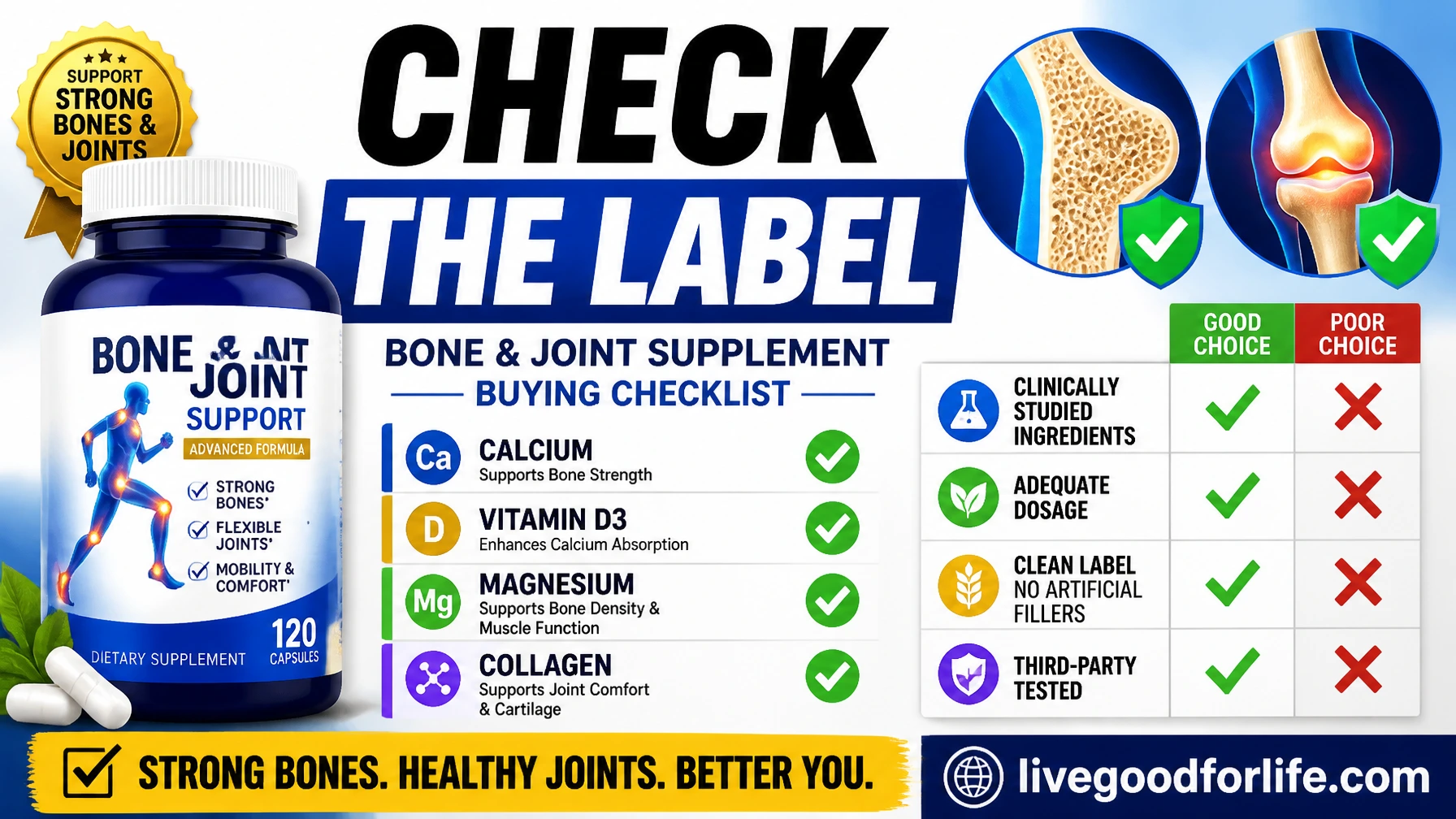
Ingredients to Look For in a Bone and Joint Formula
| Ingredient Type | Why It May Be Included | What to Check |
|---|---|---|
| Calcium | Core bone mineral | Form, amount, and total daily calcium intake |
| Vitamin D | Supports calcium absorption | Total intake from all supplements |
| Boron | Trace mineral used in some bone formulas | Dose and overlap with other products |
| Silica | Connective tissue and structural support nutrient | Source, amount, and formula context |
| Glycine | Amino acid involved in connective tissue proteins | Amount and overall protein intake |
| Glucosamine | Common joint-support ingredient | Allergy concerns and medication questions |
| Eggshell membrane | Used in some joint and connective tissue formulas | Egg allergy concerns |
What to Check Before Buying
| Check | Why It Matters | Reader Tip |
|---|---|---|
| Serving size | Shows how much you must take for the listed amounts | Compare serving to serving |
| Calcium form | Different forms may absorb and tolerate differently | Look beyond “calcium” on the front label |
| Vitamin and mineral overlap | Multiple supplements can add up | Check multivitamins and bone formulas together |
| Joint-support ingredients | Bone and joint support are not identical | Look for cartilage and connective tissue support |
| Testing and quality | Purity and potency matter | Prefer brands that discuss testing standards |
| Price per serving | The cheapest bottle may not be best value | Compare daily cost |
You can compare value with the LiveGood Supplement Savings Calculator.
Who Should Be Careful With Bone and Joint Supplements?
Ask a qualified healthcare professional before using a bone and joint supplement if you:
- Have kidney disease or a history of kidney stones
- Have high calcium levels or parathyroid issues
- Take blood thinners, diabetes medication, thyroid medication, antibiotics, osteoporosis medication, or heart medication
- Have shellfish, egg, or ingredient allergies
- Have osteoporosis, arthritis, severe joint pain, swelling, or recent injury
- Are you pregnant or nursing
- Are you buying for a child or an older adult with medical conditions
Seek medical care for sudden swelling, severe pain, joint redness, fever, injury, unexplained fracture, loss of mobility, numbness, or pain that does not improve.
LiveGood Osteo Complete
LiveGood Osteo Complete is an advanced bone and joint support formula that goes beyond plain calcium. The label you provided shows a serving size of 4 capsules and a formula that includes calcium plus supporting nutrients such as boron, glycine, betaine, glucosamine sulfate, genistein, bamboo extract, and eggshell membrane.
The product information also highlights DimaCal DiCalcium Malate and Calcium Hydroxyapatite as calcium sources, along with third-party testing, vegetable capsules, and a 90-day empty-bottle money-back guarantee.
| Label Detail | Amount Listed Per Serving |
|---|---|
| Vitamin B6 | 20 mg |
| Folate | 150 mcg DFE |
| Vitamin B12 | 50 mcg |
| Vitamin B3 | 18 mg |
| Calcium | 500 mg |
| Boron | 3 mg |
| Glycine | 50 mg |
| Betaine Anhydrous | 50 mg |
| Glucosamine Sulfate 2KCL | 50 mg |
| Genistein | 50 mg |
| Bamboo Extract | 50 mg |
| Eggshell Membrane | 25 mg |
For the product overview on this website, read Osteo Complete Advanced Bone and Joint Support.
Affiliate disclosure: I am an independent LiveGood affiliate. If you choose to buy through my links, I may earn a commission at no extra cost to you.
Bone and Joint Support FAQs
Are bone and joint supplements worth taking?
They may be useful if your diet or routine lacks key bone and joint support nutrients. They work best alongside protein, weight-bearing exercise, resistance training, sleep, hydration, and medical guidance when needed.
Is calcium enough for bone health?
Calcium is important, but it is not the only factor. Vitamin D, magnesium, trace minerals, protein, exercise, and overall nutrition also matter.
Can bone supplements improve bone density?
Supplements can support nutrient intake, but bone density depends on many factors. If bone density is a concern, ask a healthcare professional about testing, diet, exercise, vitamin D status, and appropriate treatment options.
Can joint supplements cure arthritis?
No. Joint supplements should not be treated as arthritis cures. They may support a joint-health routine, but arthritis symptoms should be discussed with a qualified healthcare professional.
Can I take a bone and joint supplement with a multivitamin?
Maybe, but compare labels first. Calcium, vitamin D, magnesium, boron, and other nutrients can overlap. Ask a professional if you take medication or have health conditions.
Who should avoid calcium supplements?
People with kidney disease, kidney stones, high calcium levels, parathyroid conditions, or certain medication use should ask a healthcare professional before taking calcium supplements.
How long does bone and joint support take?
Bone and joint support is a long-term routine, not an overnight result. Consistency with nutrition, movement, sleep, and appropriate supplementation matters more than quick expectations.
What is the best time to take bone and joint supplements?
Follow the product label. Some people prefer taking mineral supplements with meals for tolerance. If you take medication, ask a pharmacist about timing because minerals can interfere with some medicines.
Build Stronger Habits Around Bone and Joint Health
Bone and joint support supplements can be useful, but they are only one part of the picture. Stronger bones and better movement habits come from a complete routine: nutrient-dense food, protein, weight-bearing exercise, resistance training, mobility work, sleep, and smart supplementation.
Choose formulas carefully, compare labels, avoid unnecessary overlap, and ask for professional guidance if you have bone-density concerns, joint pain, medication use, or medical conditions.
Reminder: Supplements can support wellness routines, but they do not replace medical diagnosis, treatment, bone-density testing, injury care, or professional advice.