What “Clinically Studied Ingredients” Really Means
“Clinically studied ingredients” on supplement labels sounds reassuring. It suggests science, testing, and proof.
What Does “Clinically Studied Ingredients” Mean on a Supplement Label?
On a supplement label, “clinically studied ingredients” typically means that one or more individual ingredients have been studied in human trials, not that the finished product was tested. Whether that research applies depends on the ingredient’s dose, form, and the level of transparency in the formulation’s disclosure.
But on supplement labels, this phrase often means far less than consumers assume — and sometimes almost nothing at all.
This guide explains what “clinically studied ingredients” mean, what they don’t guarantee, and how to evaluate these claims objectively. If you’re new to label evaluation, this article builds on our foundational guide to reading supplement labels and spotting fairy dusting.
Why This Phrase Causes So Much Confusion
Unlike prescription drugs, dietary supplements are not required to prove effectiveness before being sold. As a result, marketing language bridges the gap between regulation and consumer expectations.
“Clinically studied ingredients” is one of the most commonly misunderstood phrases because it sounds like the product itself was tested, when that is rarely the case.
The NIH Office of Dietary Supplements explains that supplement manufacturers can reference existing research on ingredients without testing the finished product itself. This regulatory context is outlined in the NIH consumer guidance on how dietary supplements are evaluated and regulated.
Quick Checklist: When “Clinically Studied” Is Meaningful
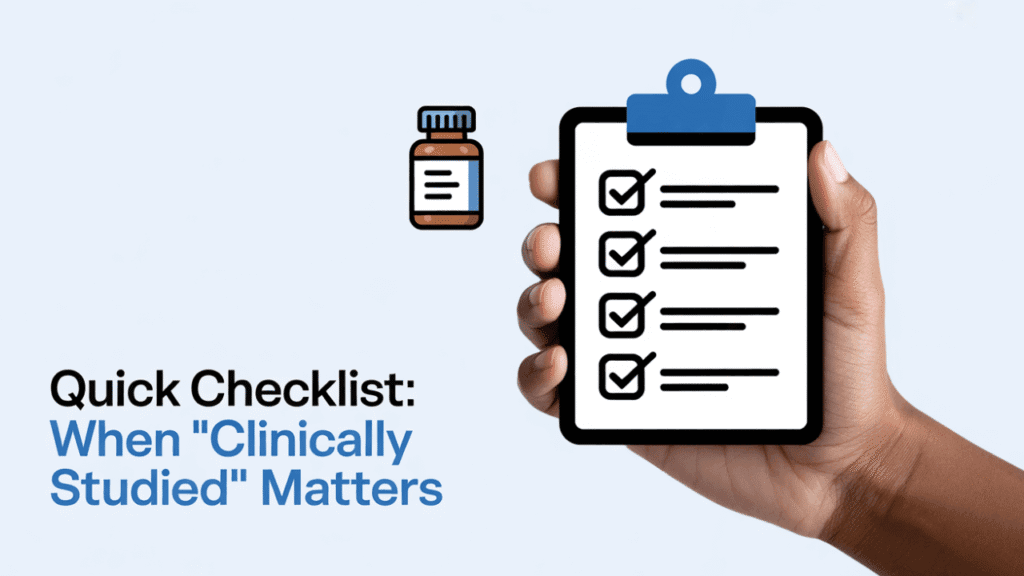
- Ingredient amounts fully listed (no proprietary blends)
- Dose resembles common studied ranges (not tiny sprinkle amounts)
- Ingredient form matches studies (extract type, chelated mineral, etc.)
- Finished product has transparent testing info (COA or batch info)
- Claims are modest (“supports”), not guaranteed outcomes
If a brand claims testing, look for a posted Certificate of Analysis (COA) that lists a batch/lot number and matches the product you’re buying.
What “Clinically Studied Ingredients” Usually Means
In most cases, this phrase means:
- An individual ingredient (not the full product) has been studied at some point
- The study may involve a different dose than what’s in the supplement
- The study may use a different form of the ingredient
- The study may not involve the brand or formula being sold
In other words, the ingredient has scientific literature behind it — but that does not automatically validate the product you’re holding.
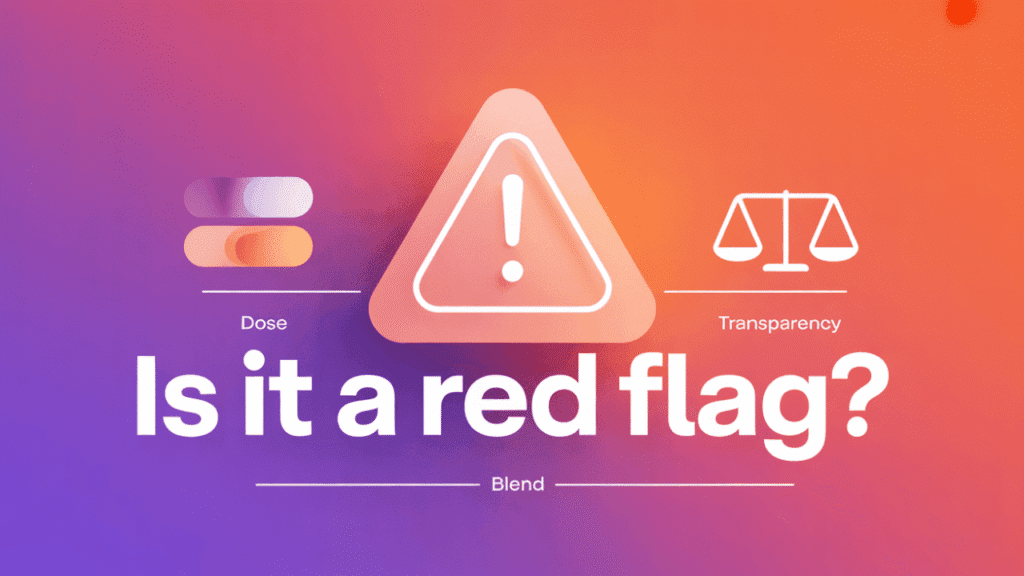
Is “Clinically Studied Ingredients” a Red Flag?
- Not automatically bad
- It becomes a red flag when paired with hidden blends, vague claims, or tiny doses
- It’s a “starting point,” not proof
What the Phrase Does NOT Mean
This is where expectations often drift too far from reality.
- It does not mean the finished supplement was tested
- It does not mean the dose in the product matches the studied dose
- It does not mean results are guaranteed
- It does not mean long-term safety or effectiveness has been proven for that formula
Many consumers interpret “clinically studied” as “clinically proven.” Those are very different things.
| Label Claim | What It Sounds Like | What It Usually Means |
|---|---|---|
| Clinically studied ingredients | The formula was tested as a whole | One ingredient has been researched somewhere |
| Science-backed formula | Strong clinical validation | Marketing language referencing general research |
| Research-driven blend | Formula was tested as a whole | Marketing language referencing research, often without finished-product testing |
Ingredient Studies vs Finished Product Studies
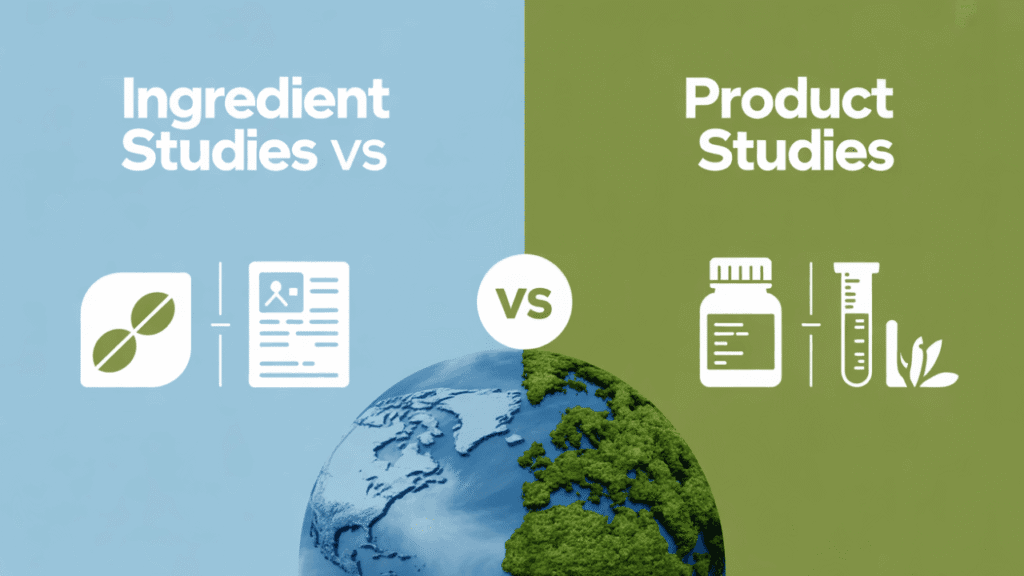
Understanding this distinction instantly improves your ability to read supplement labels.
| Claim Type | What Was Studied | What It Proves |
|---|---|---|
| Clinically studied ingredient | One isolated compound | That ingredient showed an effect under study conditions |
| Clinically tested product | The finished supplement | The full formula was evaluated as sold |
| Proprietary blend study | Rarely disclosed | Usually impossible to verify |
Most supplements fall into the first category — not the second.
Dose and Form: The Details That Matter Most
Even when an ingredient has strong research behind it, two details determine whether that research applies to your supplement:
- Dose: Is the amount in the product similar to what was studied?
- Form: Is the same form (e.g., chelated mineral, standardized extract) used?
Healthline explains why form and dose matter so much when interpreting supplement research in its guide on how to read supplement labels accurately.
If a supplement uses a much smaller dose or a different form, the study may no longer be relevant.
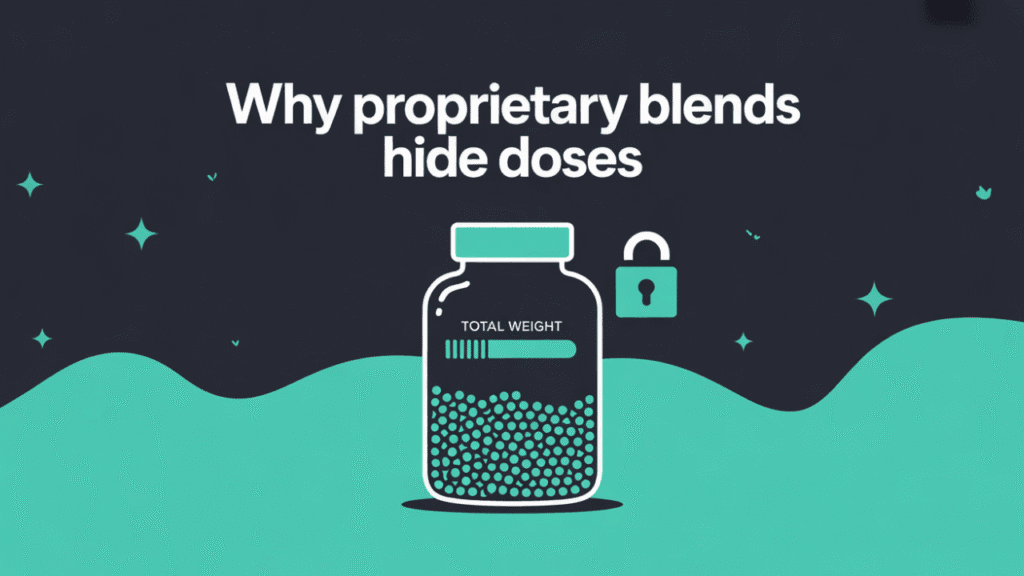
Why Proprietary Blends Complicate “Clinically Studied” Claims
Proprietary blends allow multiple ingredients to be grouped under a single combined weight. This makes it impossible to know how much of each ingredient you’re actually getting.
When a product with a proprietary blend claims “clinically studied ingredients,” you can’t confirm whether any ingredient appears at a meaningful dose.
The NIH Office of Dietary Supplements notes that supplement content can vary significantly from what consumers expect based on labels alone, reinforcing why dose transparency matters. See the NIH overview on limitations of supplement labeling.
Real Research vs Marketing Language
Another source of confusion is how marketing borrows scientific language.
- “Clinically studied ingredients”
- “Science-backed formula”
- “Research-driven blend”
These phrases can be technically true while still misleading. They often reference the existence of research — not the quality, relevance, or applicability of that research.
For a concrete example of how ingredient labels differ from what’s claimed — especially in weight-loss and metabolic formulas — see the weight-loss supplement label accuracy research. You can also explore findings from the Amazon supplement label accuracy study, which highlights how many best-selling products fail to match label claims under independent testing.
PubMed, the NIH’s research database, makes it clear how narrow and specific many ingredient studies are. You can see an example of how supplement label accuracy and interpretation are studied in this PubMed-indexed paper on label accuracy and consumer perception in dietary supplements.
How to Evaluate These Claims in 3 Simple Steps
- Check the Supplement Facts panel: Are individual doses listed clearly?
- Compare dose and form: Does the ingredient match how it’s typically studied?
- Look for transparency: Can you verify testing, sourcing, or documentation?
If any of these steps fail, the phrase “clinically studied ingredients” should be treated as background information — not proof. For a real-world example of label discrepancies, see the Amazon supplement label accuracy study, which found many popular products didn’t contain what their labels claimed when independently analyzed.
How This Connects to Smarter Supplement Buying
Understanding these distinctions helps explain why many people feel supplements “don’t work.” The issue is often not the ingredient — but the dose, form, or transparency.
This is also why pricing models matter. When you remove heavy advertising and focus on simpler formulas, transparency tends to improve. We explore this idea further in our breakdown of why most people overpay for supplements.
If you want to see how transparent labeling looks in practice, you can browse real-world examples in the LiveGood Supplement Reviews section, where doses and formulas are discussed openly.
You can also browse more education-first articles in our LiveGood category, where we cover pricing models, transparency, and how to evaluate products realistically.
Personal Insight and Research Context
After reviewing a wide range of supplement labels and cross-checking ingredient claims against publicly available research, one pattern is consistent: most disappointment comes from misunderstood language, not malicious intent. Brands often rely on technically accurate phrases that sound stronger than they are.
My approach on LiveGoodForLife is to translate regulatory language and research context into practical decision tools. By leaning on NIH guidance, PubMed-indexed studies, and transparent label analysis, the goal is not to promote fear — but to help readers buy supplements with realistic expectations and clearer reasoning.
This article is part of an ongoing research-based series on supplement label accuracy and marketing claims, published on LiveGoodForLife, where labeling practices are compared across categories such as weight-loss, metabolic, and general wellness products.
For each topic, I compare label wording with the Supplement Facts panel disclosures, then cross-check ingredient claims against NIH guidance and PubMed-indexed research.
The goal is clarity over hype: understanding what labels can prove, what they can’t, and what questions to ask before spending money.
FAQ: Clinically Studied Ingredients
Does “clinically studied ingredients” mean the supplement works?
No. It means an ingredient has been studied somewhere. Effectiveness depends on dose, form, and the full formula.
Is “clinically studied” the same as “clinically proven”?
No. “Clinically proven” suggests consistent evidence for a specific product, which most supplements do not have.
Why do companies use this phrase if it’s confusing?
Because it’s legally permissible and sounds reassuring, even though it leaves out important context.
Can proprietary blends be clinically studied?
In theory yes, but in practice it’s rare. Without disclosed doses, studies are difficult to verify.
How can I check if an ingredient is actually studied?
You can search the ingredient name on PubMed and compare the studied dose and form with what’s listed on the label.
Can a supplement be effective without clinical studies?
Yes. Some supplements rely on well-understood nutrients or traditional use rather than formal trials. Effectiveness still depends on dose, form, and individual context.
Final Thoughts
“Clinically studied ingredients” is not a lie — but it is incomplete.
Once you understand what the phrase really means, it loses its power as a marketing shortcut and becomes just one small piece of information.
Clarity, transparency, and realistic expectations matter more than impressive wording.
Disclaimer: This article is for educational purposes only and does not provide medical advice. Always consult a qualified healthcare professional for personal guidance. This post may contain affiliate links.
Quick Recap: “Clinically Studied Ingredients” in Plain English
If you want the entire article in 30 seconds, this table summarizes what matters most when you see “clinically studied ingredients” on a supplement label.
| What You See on the Label | What It Usually Means | What to Do Next |
|---|---|---|
|
Common claim “Clinically studied ingredients” |
Reality One or more ingredients may have been studied somewhere — but the finished product usually wasn’t tested as sold. |
Action Check the Supplement Facts panel for fully disclosed doses and forms. |
|
Easy to miss A studied ingredient name, but tiny amounts |
Reality The ingredient may be present at a dose far below what studies typically use, so results may not translate. |
Action Compare the dose and form to common researched ranges (and avoid “sprinkle” amounts). |
|
Red flag pattern Proprietary blend / hidden amounts |
Reality You can’t verify whether any ingredient is included at a meaningful dose, even if the label sounds scientific. |
Action Prefer formulas with transparent dosing (no blends) and clear serving sizes. |
|
Marketing language “Science-backed” / “research-driven” |
Reality Often references the existence of research, not the quality or relevance of research to that exact product. |
Action Treat the claim as a starting point — then verify doses, forms, and transparency. |
|
Best-case scenario Full doses + matching forms + verifiable testing |
Reality The claim is more likely meaningful when the label is transparent and the formula logic is clear. |
Action Look for a COA/batch info (if available) and keep expectations realistic. |
What If You Could Unlock the Secrets of Your Health?
Have you ever wondered what your body really needs to thrive? Imagine if you could uncover the exact steps to transform your health—effortlessly. The secret? It’s right here, and it’s free.
With the Free Health Assessment, you can finally get the answers you’ve been seeking. Whether you want to lose weight, boost your energy, or simply feel better every day, this personalized health report will point you in the right direction.
Why Take the Health Assessment?
- Personalized Health Insights: Get a deep dive into your current health, covering heart health, immune strength, stress levels, and more.
- Discover Your Hidden Potential: Uncover health risks you may not even be aware of and learn how to tackle them effectively.
- Actionable Expert Advice: Receive simple, customized tips that fit your lifestyle—whether you want to build muscle, lose weight, or improve your well-being overall.
- Quick & Easy: It only takes a few minutes, but the impact could last a lifetime.
- Absolutely Free: No hidden fees, no catch. Just a commitment to your better health.
Take the Quiz, Unlock Your Potential
Curious about what your body needs? Don’t let uncertainty hold you back any longer. Thousands have already taken their first step towards better health; now it’s your turn. This isn’t just a questionnaire—it’s your gateway to a healthier, more vibrant life.
Start Your Free Health Assessment Now