The Complete Food Label Guide: How to Read Nutrition Labels With More Confidence
Food labels are supposed to help you make informed choices, but in real life they often do the opposite. Between front-of-pack marketing claims, busy Nutrition Facts panels, long ingredient lists, and confusing “healthy” buzzwords, even basic grocery shopping can feel harder than it should.
That is exactly why I created The Complete Food Label Guide. It is a practical, beginner-friendly resource designed to help you understand what food labels actually tell you, what they often leave out, and how to compare products with more confidence, rather than relying on packaging alone. If you also want to understand how label-reading applies to supplements, see how to read supplement labels and spot fairy dusting.
Inside the guide, I break down the structure of a typical food label, explain how to read the Nutrition Facts panel, show how ingredient order can reveal more than front-of-pack claims, and highlight common red flags such as hidden sugars, refined oils, and misleading marketing language. The guide also covers food additives, the Nutri-Score, the UK food label system, and how to think through labels based on goals such as weight management, heart health, energy, and digestion.
If you want a clearer, more useful starting point for everyday shopping, family meals, and healthier comparisons of packaged foods, this guide is a strong place to begin.
The Complete Food Label Guide: Shop With More Clarity
A simple educational guide to help you understand Nutrition Facts panels, serving sizes, ingredient lists, label claims, additives, hidden sugars, and everyday food packaging language.
- Learn how to read serving sizes, calories, nutrients, and daily values
- Understand ingredient order, hidden sugars, oils, and additives
- Decode common label terms like low sugar, gluten-free, plant-based, and no added sugar
- Use comparison tips, Nutri-Score, and traffic light labels for smarter shopping
For general education only. This is not medical advice and is not intended to diagnose, treat, cure, or prevent any condition. Always review labels carefully and speak with a qualified professional about personal nutrition or health questions.
What is included in The Complete Food Label Guide?
This guide was built to make food labels easier to understand step by step. Instead of throwing random nutrition tips at you, it follows a clear structure so you can build confidence in the right order.
- The anatomy of a food label and how the front of the package differs from the back
- The Nutrition Facts panel, including serving size, calories, % Daily Value, and which nutrients are usually better lower or higher
- Food label terminology such as low fat, no added sugar, gluten-free, low sodium, and plant-based
- Food additives and preservatives are commonly found in processed foods
- Ingredient list strategy, including why the first ingredients matter most
- How to compare two similar products without overcomplicating the decision
- Nutri-Score explained for at-a-glance packaged food comparisons
- The UK food label system and how to use it more practically
- How to decode claims for specific goals like weight management, heart health, energy, and digestion
- Common labeling myths that lead people to make weaker choices than they realise
The goal is not to make you obsess over every product. The goal is to help you know where to look first, what deserves closer attention, and how to avoid being overly influenced by packaging language.
Why food labels can feel so confusing
One of the most useful ideas in the guide is that food labels have multiple layers, each serving a different purpose. The front of the package is built to attract attention. This is where you usually see phrases like “low sugar,” “all natural,” “high protein,” or “made with real ingredients.” These phrases can point you in a general direction, but they rarely tell the full story. The guide explains that the front of the package works best as a starting point, not a final decision-maker.
The back of the package is where the more useful information lives. This is where you find the Nutrition Facts panel and the ingredient list, which usually tell you far more than the marketing copy on the front. A big part of becoming more confident with food labels is simply learning to shift your attention from claims to structure.
That is why one of the strongest reminders in the guide is this: start with structure, not claims. Food labels work better when used as comparison tools between similar products, not as stand-alone verdicts based on one flashy phrase on the box.
How to read the Nutrition Facts panel more practically
The guide gives a useful overview of the Nutrition Facts panel and explains that most confusion starts when people skip the context. Before calories, protein, sugar, or fat numbers mean anything, you need to check the serving size and the number of servings per container. Those two details shape the meaning of the rest of the label. A package may look small, but still contain more than one serving.
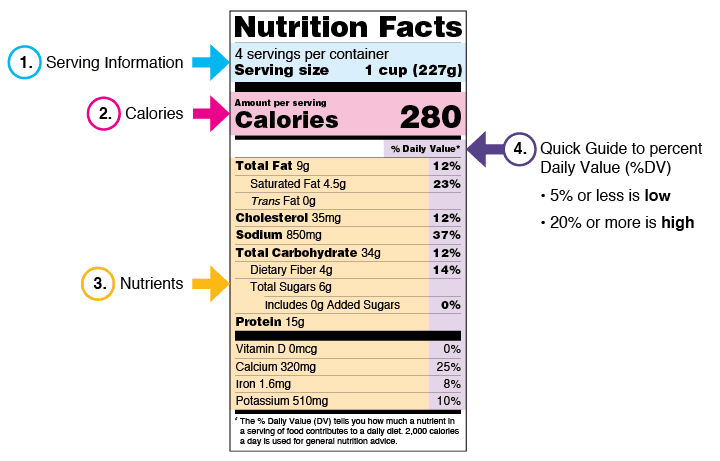
It also explains that % Daily Value (%DV) can be a fast way to judge whether a nutrient is relatively low or high in a serving. The guide uses the common shortcut that around 5% DV or less is low and 20% DV or more is high, which helps you compare similar products more efficiently.
| Label element | Why it matters |
|---|---|
| Serving size | Sets the context for all numbers on the label |
| Servings per container | Shows whether the package contains more than one serving |
| Calories | Useful for context, especially when comparing similar foods |
| % Daily Value | Helps you quickly see whether a nutrient is relatively low or high |
| Added sugars | Often more useful than total sugar alone when comparing products |
| Fiber and protein | Can support fullness and better product comparisons |
| Sodium and saturated fat | Often worth keeping lower in many packaged foods |
The guide also highlights a practical “higher vs lower” pattern: choose foods lower in sodium, saturated fat, and added sugar, and often higher in dietary fiber, vitamin D, calcium, potassium, and, in some categories, protein. If you want a broader nutrition refresher alongside this guide, read essential vitamins and minerals for a simple overview of key nutrients people often see on labels.
Why ingredient lists often reveal more than the front label
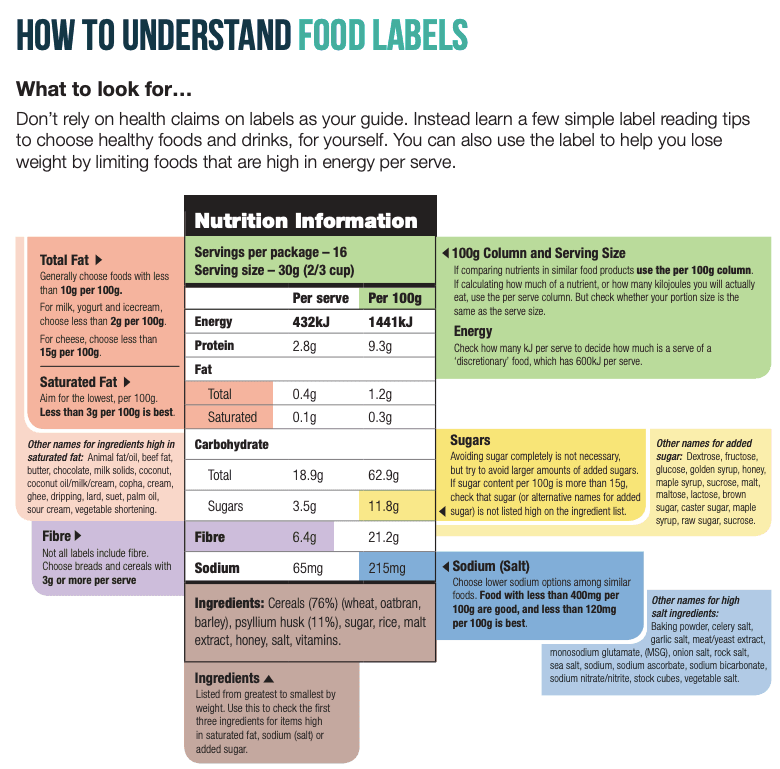
One of the most valuable parts of the guide is the ingredient-list section. Ingredients are listed in descending order by weight, which means the first few ingredients usually make up most of the product. That one fact can change how you shop, because it helps you look past vague “healthy” language and see what is actually dominating the food.
If sugar, corn syrup, refined flour, cheap oils, or fillers appear near the top of the list, that tells you a lot about the product’s overall quality. On the other hand, if the first ingredients are whole foods like oats, nuts, seeds, beans, or other recognisable ingredients, that usually gives you a better starting point. The guide even includes a side-by-side example showing how a healthier product tends to lead with more recognisable whole-food ingredients, while a weaker product starts with sugar, syrups, refined flour, and additives.
A helpful rule from the guide is to focus on the first three to five ingredients and the overall pattern of the list. You do not need to recognise every ingredient to make a better choice. You just need to learn how to spot the dominant ingredients and compare them more calmly.
A simpler way to compare similar food products
The guide offers a practical 4-step process for comparing food labels:
- Check added sugar, not just total sugar
- Scan the first ingredients to see what dominates the product
- Look at fiber and protein for better fullness and steadier energy
- Watch oils and additives to understand how processed the product is
That framework is especially useful because it keeps label reading practical. Instead of trying to judge a product based on one single number, you look at a few key indicators together. The guide reinforces this with a granola bar comparison in which the strongest option had lower added sugar, higher fiber and protein, a better top-three ingredient pattern, and fewer questionable additives.
Common food label terms and what they really mean
Another strong part of the guide is the terminology cheat sheet. Many people see words like “low sodium,” “sugar-free,” “no added sugar,” “reduced fat,” “gluten-free,” or “plant-based” and assume they all mean the same thing: healthier. In reality, each claim has limits, definitions, or marketing caveats.
For example, the guide points out that:
- No added sugar does not mean sugar-free
- Gluten-free can be essential for some people but is not automatically healthier
- Low fat may still come with added sugar or starch
- Plant-based tells you the source, not necessarily the quality
- Low sodium and very low sodium have clearer practical thresholds than vague claims like “healthy”
That distinction matters because much label confusion arises from treating claims as conclusions rather than clues. The guide’s framing is more useful: treat claims as prompts to check the full label, not as proof that a product deserves a place in your basket.
Food additives: what to notice without becoming obsessive
The food additives section makes the guide feel more complete. It covers common additives and preservatives such as MSG, sodium nitrite/nitrate, high-fructose corn syrup, aspartame, carrageenan, BHA, artificial colours, and guar gum. It explains what they are generally used for and why some people may want to pay closer attention to them in certain products.
This is useful because online discussions about additives often swing between two extremes: either pretending additives never matter or acting as if every additive is equally dangerous. The guide takes a more practical path. It helps readers notice patterns, understand what common additives do, and make more informed comparisons between similar products without panic-based thinking.
Nutri-Score and the UK food label system
The guide also explains two front-of-pack systems that can help shoppers make quicker comparisons: Nutri-Score and the food label system. Nutri-Score uses a colour-coded scale from A to E to reflect the overall nutritional quality of a packaged food, while the UK food system uses red, amber, and green coding for calories, fat, saturated fat, sugar, and salt.
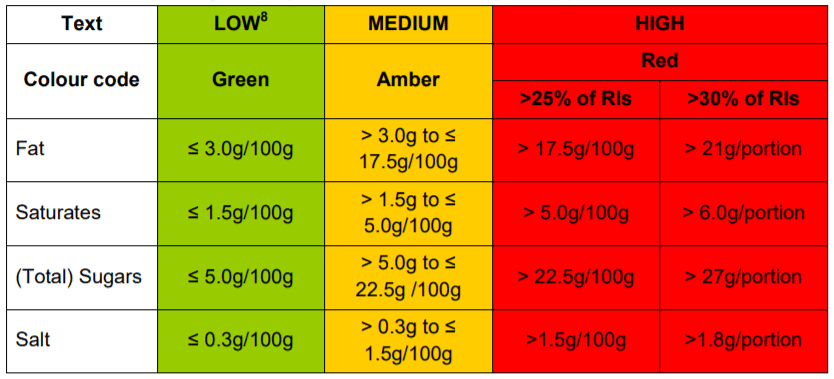
Both systems can be helpful at a glance, but neither should replace reading the full label when you want a better decision. They work best as shortcuts layered on top of understanding Nutrition Facts and ingredient lists, not as stand-alone verdicts. That is one of the reasons this guide is useful: it helps you place these systems in the right context.
How to decode food label claims based on your goals
One of the strongest sections in the guide is the part on decoding claims for specific goals. Instead of pretending every shopper has the same priority, it breaks label-reading into practical goal areas:
- Weight management: look more closely at calories, fiber, protein, and small serving sizes
- Heart health: pay attention to saturated fat, sodium, and the type of fats used
- Energy and performance: focus more on complex carbohydrates, adequate protein, and not just flashy energy claims
- Gut health and digestion: look at fiber, possible prebiotics, cultures, and vague “digestive health” claims more critically
This section is especially valuable because it reminds readers that the best label is not always the one with the loudest claim. It is the one that fits your actual goal and holds up when you read beyond the front of the package. For example, if you are trying to understand why nutrients like vitamin D and K2 show up so often on labels and product packaging, this guide pairs well with why you need vitamin D3 and K2.
Common food labeling myths worth unlearning
The guide closes many of the most common food-label misunderstandings, including the ideas that “natural” automatically means healthy, “low calorie” automatically means better, “gluten-free” is always healthier, “no added sugar” means sugar-free, “fat-free” means good for you, and “whole grain” always means 100% whole grain. It also points out that plant-based products can still be high in sodium, sugar, or additives, and that cholesterol-free does not automatically mean heart-healthy.
This myth-busting section is important because it pulls together the guide’s overall message: better choices usually come from slower, more informed reading, not from trusting a single buzzword on the front of a pack.
Who this guide is for
- People who feel overwhelmed by food packaging and marketing claims
- Beginners who want to learn how to read labels step by step
- Shoppers trying to compare snacks, cereals, bars, sauces, and convenience foods more clearly
- Parents and families who want more confidence when choosing packaged foods
- Readers interested in better ingredient awareness, label transparency, and practical everyday wellness education
It is not a medical guide, and it is not meant to replace professional advice. It is an educational resource built to make everyday label reading more practical and less overwhelming.
Get access to The Complete Food Label Guide
If you want your copy of The Complete Food Label Guide, enter your email in the form on this page and I will send it to your inbox.
This guide can help you:
- Read Nutrition Facts panels more confidently
- Understand ingredient lists more clearly
- Spot hidden sugars and weaker product patterns faster
- Compare similar foods more practically
- Look past misleading claims with less guesswork
The Complete Food Label Guide: Shop With More Clarity
A simple educational guide to help you understand Nutrition Facts panels, serving sizes, ingredient lists, label claims, additives, hidden sugars, and everyday food packaging language.
- Learn how to read serving sizes, calories, nutrients, and daily values
- Understand ingredient order, hidden sugars, oils, and additives
- Decode common label terms like low sugar, gluten-free, plant-based, and no added sugar
- Use comparison tips, Nutri-Score, and traffic light labels for smarter shopping
For general education only. This is not medical advice and is not intended to diagnose, treat, cure, or prevent any condition. Always review labels carefully and speak with a qualified professional about personal nutrition or health questions.
Frequently asked questions
What is a food label guide?
A food label guide is an educational resource that helps you understand how to read food packaging more clearly, including Nutrition Facts panels, ingredient lists, serving sizes, added sugars, label claims, and comparison points between similar products.
Why is the ingredient list so important?
The ingredient list shows what the product is actually made of, in descending order by weight. That means the first ingredients usually make up the largest portion of the food, which can reveal more than the front-of-pack claims.
What should I look at first on a nutrition label?
Start with serving size and servings per container, then look at calories, added sugars, fiber, protein, sodium, saturated fat, and the ingredient list. Labels make more sense when you read them in that order rather than starting with marketing claims.
Are food label claims always reliable?
Not always. Claims like natural, low fat, no added sugar, plant-based, or high protein may be useful clues, but they do not tell the full story by themselves. It is better to use them as prompts to check the full label.
Is this guide medical advice?
No. This guide is for educational purposes only and is not intended as medical advice. It is not intended to diagnose, treat, cure, or prevent any disease.
What should I do after reading the guide?
After reading the guide, a useful next step is to continue building your understanding of ingredient quality and label transparency through how to read supplement labels and spot fairy dusting and related nutrition resources, such as essential vitamins and minerals. The guide itself also points readers toward a free health assessment for a more personalised next step.
Final note
Reading food labels is not about perfection. It is about building better awareness, asking better questions, and making more informed everyday choices. The more often you read labels with structure and context, the easier it becomes to spot marketing noise, compare products more realistically, and choose foods that better match your goals.
Written by Daniel Popa, founder of LiveGoodForLife.com. I create practical educational content focused on supplement transparency, ingredient comparison, wellness tools, and clearer ways to evaluate labels and everyday products.
Disclaimer
This content is for educational purposes only and is not intended as medical advice. It is not intended to diagnose, treat, cure, or prevent any disease. Always consult a qualified healthcare professional for personal medical advice.