Prostate Wellness Supplements: Saw Palmetto and What Else Helps?
Prostate concerns send many men directly to the supplement aisle. Most quickly discover shelves filled with formulas built around saw palmetto, beta-sitosterol, pygeum, zinc and several other familiar ingredients.
However, the honest picture is more complicated than the front of the bottle suggests.
Saw palmetto may be the best-known prostate supplement ingredient, but current evidence indicates that saw palmetto taken by itself provides little or no improvement in urinary symptoms associated with benign prostatic hyperplasia, commonly called BPH.
That does not mean every prostate formula is identical or that every ingredient has been studied to the same degree. It means the label needs to be treated as information—not proof that the product will work.
This guide explains what commonly appears inside prostate wellness supplements, what the available research can and cannot tell us, and the checks I recommend making before spending money.
This article is for educational purposes and does not diagnose or treat prostate conditions. Discuss urinary symptoms with a qualified healthcare professional.

The short answer: are prostate supplements worth taking?
Some prostate supplement ingredients have limited or mixed research behind them, but no over-the-counter supplement should be expected to diagnose, prevent or treat an enlarged prostate or prostate cancer.
The strongest practical approach is to have urinary symptoms evaluated first. After that, you and your healthcare professional can decide whether a carefully selected supplement has an appropriate supporting role.
If you are reviewing your wider routine—not only prostate products—my men’s wellness supplements guide explains how different supplement categories fit into a more complete plan.
What is actually inside a prostate wellness supplement?
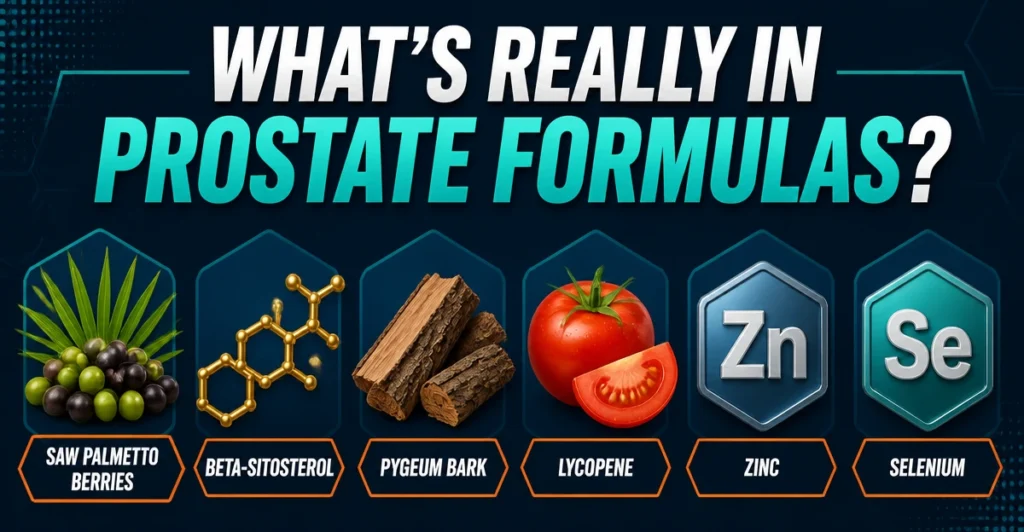
Most prostate formulas draw from a relatively short list of plant extracts, carotenoids, vitamins and minerals. Saw palmetto is usually the headline ingredient, while beta-sitosterol, pygeum, lycopene, nettle root, zinc and selenium often appear beside it.
Some products contain one ingredient. Others combine six, eight or even ten ingredients in a single serving.
A longer ingredient list does not automatically make a formula more effective. It can make the product more difficult to evaluate and increase the likelihood of duplicating nutrients found in another supplement.
| Ingredient | Why it appears in formulas | What to remember |
|---|---|---|
| Saw palmetto | Widely marketed for urinary symptoms associated with an enlarged prostate | Current reviews find little or no benefit when it is used alone for BPH symptoms |
| Beta-sitosterol | A plant sterol included in many combination formulas | Some older studies reported symptom improvements, but long-term evidence remains limited |
| Pygeum | A tree-bark extract traditionally used in prostate products | Research is limited, and products may differ in extract quality and strength |
| Lycopene | A tomato-derived carotenoid promoted for prostate wellness | Its presence on a label does not establish a clinical benefit |
| Zinc | An essential mineral frequently included in men’s formulas | Check the dose across every supplement you use to avoid unnecessary duplication |
| Selenium | An essential trace mineral used in some prostate blends | Selenium supplements have not been shown to prevent prostate cancer |
| Vitamin D | Added to some formulas as a general nutritional ingredient | It should not be treated as a prostate treatment; consider your total intake and individual needs |
| Nettle root | Sold alone and included in multi-ingredient blends | Availability and traditional use are not the same as reliable evidence |
| Flower pollen or rye grass pollen | Used in some formulas aimed at urinary comfort | The evidence is limited and does not establish that every extract or product works |
Important: Formulas and serving sizes can change. Always check the latest Supplement Facts panel on the physical bottle or manufacturer’s current website.
Saw palmetto: the headline ingredient
Saw palmetto is an extract made from the berries of Serenoa repens, a small palm native to the southeastern United States. It is widely promoted for urinary symptoms associated with prostate enlargement.
Although saw palmetto has been studied extensively, recognition should not be confused with effectiveness.
The National Center for Complementary and Integrative Health reports that a 2023 review of 27 studies found that saw palmetto used alone provided little or no benefit for BPH symptoms. Two NIH-funded clinical trials also found that it did not improve symptoms, including when higher-than-usual doses were evaluated.
This is an important correction to a common marketing message. Saw palmetto is not currently supported as a dependable treatment for an enlarged prostate.
Research on combination formulas is harder to interpret because several ingredients are taken together. If a combination appears to produce a result, it may not be clear which ingredient was responsible.
What about saw palmetto safety?
Saw palmetto is generally reported as well tolerated in research. Possible side effects include digestive discomfort, dizziness and headache.
According to the NCCIH, saw palmetto does not appear to change prostate-specific antigen, or PSA, readings. Nevertheless, you should tell your healthcare professional about every supplement you use, especially before tests, procedures or medication changes.
“Generally well tolerated” does not mean appropriate for every person. Health conditions, prescription medicines and other supplements can change the risk.
Beta-sitosterol and pygeum: the supporting ingredients
Beta-sitosterol
Beta-sitosterol is a plant sterol naturally present in foods such as vegetable oils, nuts and seeds. Concentrated forms are also used in prostate supplements.
Some older, relatively short studies suggest that beta-sitosterol preparations may improve certain urinary symptom scores or flow measurements. However, there is limited information about long-term effectiveness, disease progression and differences between commercial products.
I would therefore describe beta-sitosterol as an ingredient with limited preliminary support—not a proven solution.
Pygeum
Pygeum is made from the bark of the African cherry tree. It frequently appears beside saw palmetto and beta-sitosterol in larger prostate blends.
Older trials have reported possible improvements in some urinary symptoms, but many of the studies were small, short or used extracts that may not match products currently sold.
Finding pygeum on a Supplement Facts panel does not tell you whether the product contains the same extract, strength or preparation studied in research.
Lycopene, zinc, selenium and vitamin D
This group can make a prostate label look comprehensive, but each ingredient needs to be considered separately.
Lycopene
Lycopene is the red carotenoid found in tomatoes and several other fruits. It is often associated with prostate health in marketing, but an association between a food component and health outcomes does not prove that a concentrated supplement will produce the same result.
Lycopene should not be presented as a treatment or as a reliable way to prevent prostate cancer.
Zinc
Zinc is an essential mineral involved in many normal processes throughout the body. Its essential role does not mean that taking more zinc provides additional prostate benefits.
Check whether your multivitamin, immune-support product or other men’s supplement already contains it. Long-term high intake can create nutritional imbalances and may cause adverse effects.
My LiveGood multivitamin for men review can help you identify potential ingredient overlap before adding another formula.
Selenium
Selenium is another essential nutrient that is frequently associated with prostate products. However, selenium supplements have not been shown to prevent prostate cancer.
The National Cancer Institute’s SELECT trial studied selenium and vitamin E in more than 35,000 men. Selenium did not reduce prostate cancer risk. The trial also found a 17% relative increase in prostate cancer cases among participants assigned to vitamin E alone at 400 IU per day compared with placebo.
This finding should not be misrepresented as proof that all prostate supplements increase cancer risk. It relates to specific ingredients, doses and study conditions. It does show why taking high-dose nutrients “just in case” is not automatically harmless.
Vitamin D
Vitamin D appears in some prostate formulas and is absent from others. It has important functions in the body, but its inclusion does not turn a supplement into a prostate treatment.
Personal factors, dietary intake, sun exposure, blood-test results and medical guidance can all influence whether separate vitamin D supplementation is appropriate.
Nettle root, flower pollen and green tea
Nettle root is sold as a standalone supplement and included in multi-ingredient prostate blends. Flower pollen or rye grass pollen extracts also appear in this category, while green tea extract is sometimes added to broader antioxidant formulas.
These ingredients demonstrate why shelf space is not a measure of evidence. A retailer may offer numerous products containing an ingredient because it is popular, familiar or commercially successful—not because it has consistently produced meaningful results in high-quality trials.
Extracts can also vary significantly. The plant species, plant part, extraction method, concentration and final dose may all affect whether two products are genuinely comparable.
How I compare prostate supplement labels
I do not judge these formulas by the front label or by the number of ingredients. I work through the Supplement Facts panel and ask a series of practical questions.
- Are all ingredient amounts disclosed? A long proprietary blend may hide how much of each ingredient is actually present.
- Is the extract clearly identified? Look for the plant part, extraction details and standardization information where applicable.
- Does it duplicate another supplement? Pay particular attention to zinc, selenium and vitamin D.
- Are the claims realistic? Claims that a supplement can cure BPH, shrink the prostate or prevent cancer should be treated as warning signs.
- Is independent quality testing mentioned? Quality testing cannot prove effectiveness, but it may provide useful information about identity and manufacturing.
- Can you explain why you are taking every ingredient? If not, the formula may be more complicated than you need.
For a more detailed label-reading process, use my guide on how to compare supplement ingredients before buying.
Check your complete supplement routine
A prostate formula should never be evaluated in isolation. Write down every supplement and medication you take, including the dose and serving frequency.
This makes it easier to identify repeated minerals, overlapping herbal extracts and ingredients that may interact with medicines or planned procedures.
If you are combining several LiveGood products, the guide to taking LiveGood supplements together explains the same overlap-checking principle in more detail.
When urinary symptoms need medical attention

Frequent urination, a weak stream, difficulty starting, incomplete emptying and waking repeatedly during the night are often associated with BPH. However, similar symptoms can have other causes.
That is why it is better to obtain an evaluation than to assume the prostate is responsible and begin taking supplements on your own.
According to the National Institute of Diabetes and Digestive and Kidney Diseases, you should discuss urinary symptoms with a healthcare professional.
Seek prompt medical care if you:
- Cannot urinate at all
- See blood in your urine
- Have painful, frequent or urgent urination accompanied by fever and chills
- Experience significant pain or discomfort in the lower abdomen or urinary tract
These signs should not be managed by waiting for a supplement to work.
The basics matter more than the bottle
Prostate supplements can seem like the easiest place to begin, but they are not a substitute for understanding the cause of your symptoms.
A practical prostate wellness plan starts with:
- Discussing new or changing urinary symptoms with a healthcare professional
- Following recommended health checks and screening conversations
- Reviewing prescription medicines that may affect urination
- Maintaining regular physical activity
- Supporting a balanced diet and healthy body weight
- Limiting habits that worsen your individual urinary symptoms
- Reviewing supplements and medications together
If you and your healthcare professional decide that a supplement is reasonable, set realistic expectations. Keep track of what you take, why you take it and whether you notice a meaningful change.
Do not continue paying for a complicated formula simply because its label contains many popular ingredients.
My bottom line
Saw palmetto remains the most recognizable name in prostate wellness supplements, but current evidence indicates that it provides little or no benefit when taken alone for BPH symptoms.
Beta-sitosterol, pygeum and pollen extracts have some limited or older research, but the evidence is not strong enough to treat them as proven solutions. Lycopene, zinc, selenium and vitamin D may have legitimate nutritional roles, yet their appearance in a prostate formula does not demonstrate that the finished product improves prostate health.
The most useful step is to investigate urinary symptoms before shopping for a supplement. If you later decide to try one, compare the exact ingredient amounts, check for duplication and review the product with a qualified healthcare professional.
Above all, check the latest product label before buying because ingredients, serving sizes and warnings can change.
Frequently asked questions
Do prostate wellness supplements actually work?
The answer depends on the ingredient and the outcome being measured. Overall evidence is mixed or limited. Current evidence indicates that saw palmetto used alone provides little or no improvement in urinary symptoms caused by BPH.
Is saw palmetto good for an enlarged prostate?
Saw palmetto is widely promoted for enlarged-prostate symptoms, but a 2023 evidence review found little or no benefit when the ingredient was used alone. It should not replace medical evaluation or established treatment.
Is saw palmetto safe to take every day?
It has generally been well tolerated in studies, with reported effects including digestive symptoms, dizziness and headache. Individual suitability depends on health conditions, medications and other supplements, so daily use should be discussed with a healthcare professional.
Does saw palmetto affect a PSA test?
The NCCIH reports that saw palmetto does not appear to affect PSA readings, even at higher-than-usual amounts. You should still tell the clinician ordering or interpreting the test about every supplement you take.
What ingredients commonly appear beside saw palmetto?
Common additions include beta-sitosterol, pygeum, nettle root, lycopene, zinc, selenium, vitamin D and flower or rye grass pollen extracts. Their inclusion does not guarantee that the combination is effective.
Can prostate supplements prevent prostate cancer?
No prostate supplement should be relied upon to prevent cancer. Selenium did not prevent prostate cancer in the SELECT trial, while the specific high-dose vitamin E regimen studied was associated with an increased risk.
Can I take a prostate supplement with a multivitamin?
Possibly, but compare both labels first. Zinc, selenium and vitamin D are common sources of overlap. A pharmacist or healthcare professional can help review the full combination.
When should I see a doctor about prostate symptoms?
Discuss persistent urinary changes with a healthcare professional. Seek prompt care if you cannot urinate, notice blood in your urine, or have painful and urgent urination with fever and chills.
Sources and further reading
- National Center for Complementary and Integrative Health: Saw Palmetto—Usefulness and Safety
- NIDDK: Enlarged Prostate, or Benign Prostatic Hyperplasia
- National Cancer Institute: SELECT Trial Questions and Answers
Affiliate disclosure: Some links on LiveGoodForLife.com may be affiliate links. If you make a qualifying purchase through one of these links, I may earn a commission at no additional cost to you. This does not influence the educational information or conclusions presented in this article.
Medical disclaimer: This content is for general educational and informational purposes only. It is not medical advice and should not be used to diagnose, prevent or treat any condition. Prostate and urinary symptoms can have multiple causes. Speak with a qualified healthcare professional before starting, stopping or combining supplements, particularly if you take medication, have a medical condition, are preparing for surgery or are undergoing prostate testing or treatment. Seek prompt medical attention for an inability to urinate, blood in the urine, severe pain, or urinary symptoms accompanied by fever and chills.