How to Read Food Labels: A Simple Beginner’s Guide
Food labels can help you compare products and understand what is in the amount you actually eat. You do not need to memorise every number: start with the quantity the figures refer to, then look at the nutrients that matter for your comparison.
This guide accompanies our short Reading Food Labels video and explains how to use its examples when shopping. It also highlights differences between UK and US labels.
Quick Answer: How Do You Read Food Labels?
To read food labels, first check whether the nutrition figures are per serving, per 100g or per 100ml. Then check the calories, saturated fat, sugars, salt, fibre and protein. Compare similar products using the same quantity, and adjust the figures for the amount you actually eat. Read the ingredients and allergen information too.
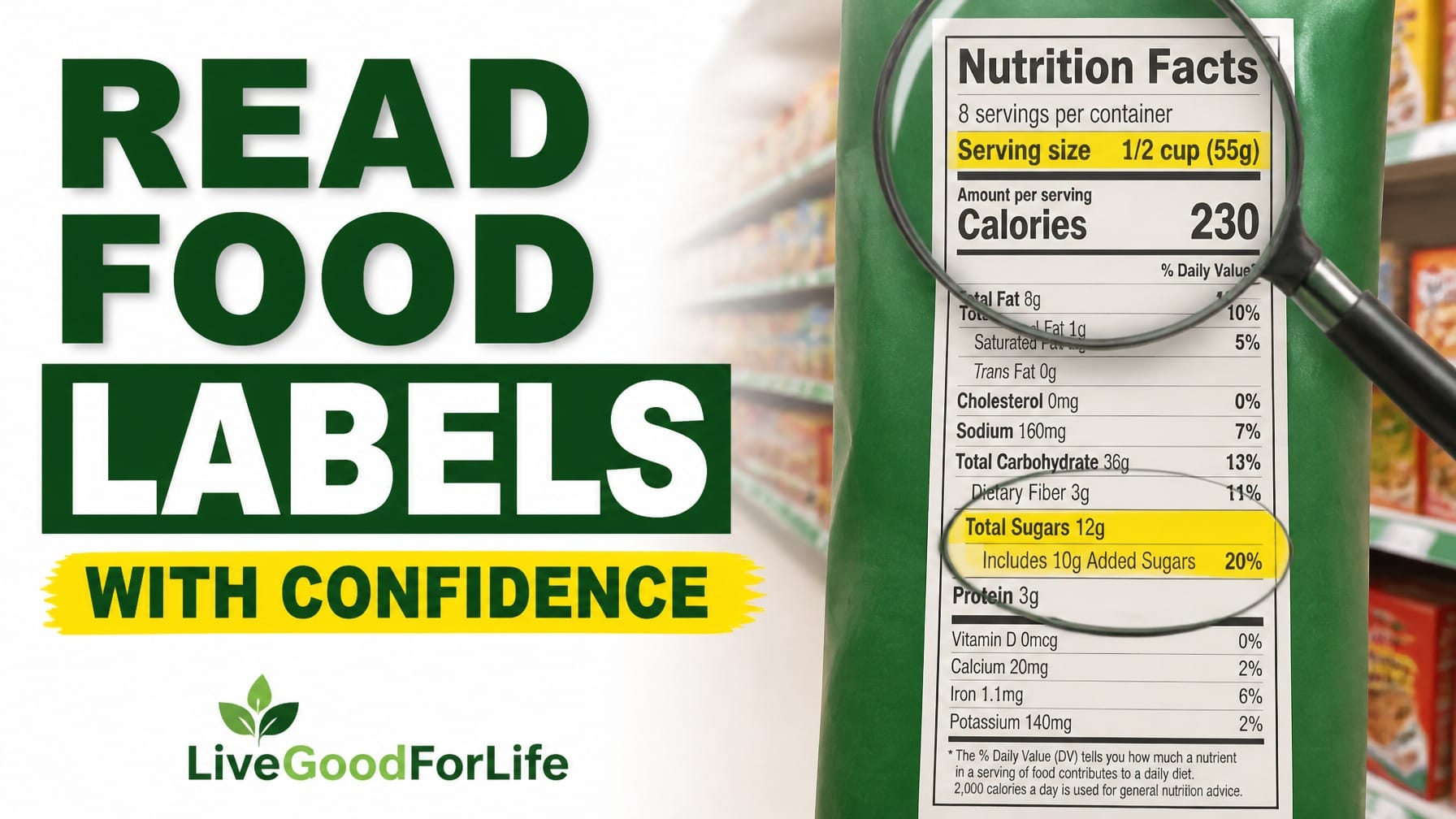
Serving size is the amount the nutrition figures refer to—not a recommendation of how much you should eat. UK labels commonly show values per 100g or 100ml, while US Nutrition Facts labels generally show values per serving.
Watch: Reading Food Labels
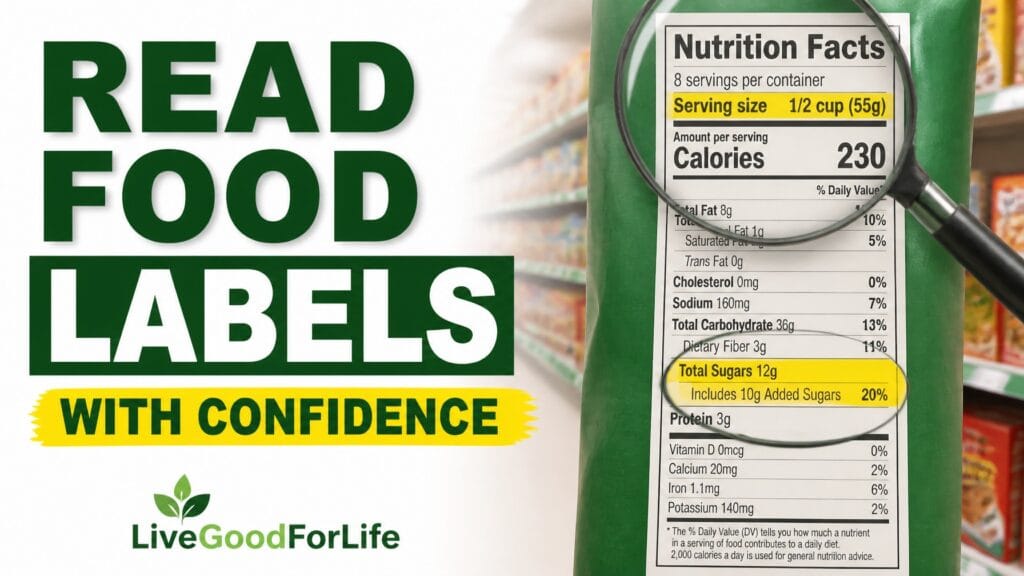
A note about the examples: The video mainly shows older US Nutrition Facts labels. Modern US labels include added sugars and an updated layout. Serving size describes the amount used for the nutrition figures; it is not a recommendation of how much you should eat. Label formats vary by country, so use the explanations below alongside the video.
1. Check the amount first
Before comparing calories or nutrients, establish whether the figures are per serving, per package, per 100g or per 100ml. A packet can contain several servings, even when it looks small enough to eat at once.
For example, imagine a snack lists 120 calories and 6g of sugars per 30g serving. Eating 60g means eating two servings: 240 calories and 12g of sugars. This is an illustrative example, not a suggested portion.
On UK labels, the per-100g or per-100ml column provides a common basis for comparing similar products. The portion column helps you work out what you consume. Check both, including whether values apply to food as sold or after preparation.
2. Understand the main numbers
Calories
Calories describe energy. Our calories guide explains energy balance in more detail. They are useful information, but do not tell you everything about a food. A lower-calorie product is not automatically the more nutritious choice. Consider its ingredients and other nutrients too.
Carbohydrates and sugars
Sugars form part of the carbohydrate figure; do not add the two numbers together. UK labels commonly show “carbohydrate, of which sugars”, while modern US labels distinguish total sugars from added sugars.
Total sugars can include naturally occurring sugars as well as those added during production. Read the ingredients alongside the nutrition panel when you want more context. Our carbohydrates guide explains the different types and food sources.
Fibre and protein
Fibre and protein provide additional context when comparing products such as cereals, breads and snacks. Compare equivalent quantities rather than assuming a prominent front-of-pack claim tells the whole story. Fibre is not always displayed on UK nutrition panels, so a missing figure does not necessarily mean zero.
Fat and saturated fat
Look at both the total fat and saturated fat lines. Older US labels in the video display “Calories from Fat”; that line is no longer required on the current US label. Use the nutrient amounts on the actual package you are considering.
Salt and sodium
UK labels commonly show salt, while US labels show sodium. These are not interchangeable figures. Check the heading and units before comparing imported and locally labelled foods.
Vitamins and minerals
These may appear near the bottom of a US Nutrition Facts panel or elsewhere on packaging. They add useful information, but a vitamin claim does not replace checking serving size, sugars, saturated fat and the rest of the label.
3. Compare like with like
The following fictional cereal example shows why using the same quantity matters.
| Nutrient per 100g | Cereal A | Cereal B |
|---|---|---|
| Energy | 380 kcal | 370 kcal |
| Total sugars | 22g | 8g |
| Fibre | 4g | 9g |
| Protein | 7g | 10g |
The calorie difference is small, while the sugars and fibre figures differ more. If you want a cereal with less total sugar and more fibre, B better matches those criteria. You would still consider taste, ingredients, allergies, cost and the amount you plan to eat.
For a 40g bowl, multiply each per-100g value by 0.4. Cereal B would provide 148 calories, 3.2g of sugars, 3.6g of fibre and 4g of protein, before milk or toppings.
4. Read the ingredients and allergen information
The nutrition panel and ingredients list answer different questions. One gives nutrient amounts; the other identifies what the product contains. If you have an allergy, check allergen information every time, including any relevant precautionary statements. A nutrition comparison can’t tell you whether a food is safe for your specific allergy.
Also check preparation instructions. Adding milk, oil or a sauce can change what is in the finished meal.
5. Try a quick label-reading exercise
Imagine a pot contains two servings. Each serving provides 150 calories, 7g of total sugars and 5g of protein. What would the whole pot provide?
Answer: 300 calories, 14g of total sugars and 10g of protein. Multiply all the per-serving figures by two—not just the calories.
Frequently Asked Questions About Food Labels
Is serving size the amount I should eat?
No. It tells you the quantity the label refers to. Your portion may differ. US serving sizes reflect typical consumption, rather than prescribing an ideal amount.
Does “no added sugar” mean sugar-free?
No. A product may still contain naturally occurring sugars. Check the total sugars figure as well as the ingredients.
Should I always choose the lowest-calorie option?
Use calories as one part of the comparison. Consider the food’s other nutrients, your needs and how it fits into your meals.
Why does my label look different from the video?
Current US labels and UK labels have different layouts and headings. Apply the same basic method: check the quantity, read the nutrient amounts and compare equivalent portions.
What should I look at first on a food label?
Check the quantity the nutrition figures refer to: per serving, per 100g, per 100ml or per package. Then consider how much you will actually eat.
What is the difference between serving size and portion size?
Serving size is the quantity used for the nutrition information on the label. Portion size is the amount you choose to eat. They may be different.
Are carbohydrates and sugars separate amounts?
Sugars are included within the carbohydrate total. Do not add the sugars figure to the carbohydrate figure.
Is the lowest-calorie food always the healthiest choice?
No. Calories measure energy, but do not describe a food’s overall nutritional value. Consider fibre, protein, fats, sugars, salt and ingredients alongside calories.
What if I eat more than one serving?
Multiply the per-serving figures by the number of servings you eat. For example, two servings provide twice the listed calories and nutrients.
A simple shopping routine
Start with two similar products. Find the common comparison quantity, check the nutrients you want to compare, then calculate your actual portion if needed. Finish with the ingredients and allergen information. With practice, this becomes a quick shopping habit rather than a calculation for every meal.
Educational note: This article provides general information, not personalised dietary or medical advice. If you need a specific diet for a health condition, ask a registered dietitian or your healthcare team how to apply label information to your needs.
Sources and further reading
- NHS: Food labels
- FDA: What’s on the Nutrition Facts Label
- FDA: Serving Size on the Nutrition Facts Label
Editorial source check: 1 November 2026.