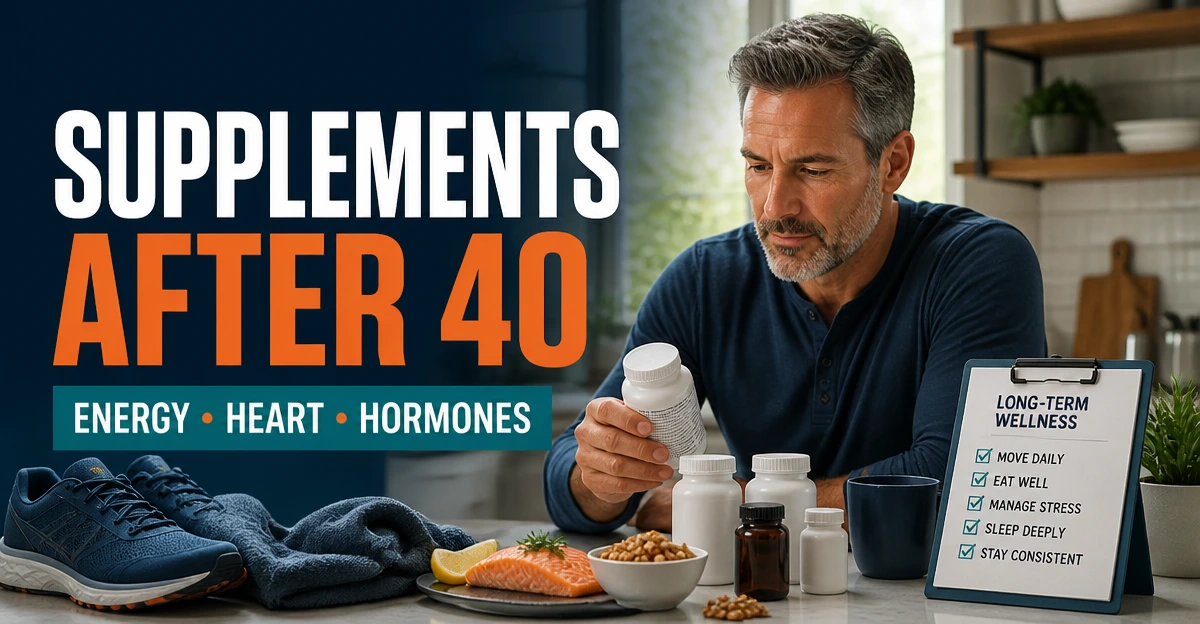
Male Wellness Supplements After 40: Energy, Heart, and Hormones
Turning 40 does not mean your body suddenly stops working. It often means that inconsistent sleep, rushed meals and poor recovery become harder to ignore.
A workout that once felt routine may leave you sore for longer. Afternoon energy can become less predictable. Blood pressure, cholesterol, blood sugar and other health markers may also receive more attention during routine appointments.
This is when many men begin investigating supplements for energy, heart health, recovery and hormone support. Unfortunately, it is also when they encounter some of the biggest promises in the supplement industry.
My practical view is simple: supplements can help fill identifiable nutritional gaps, but they cannot reverse aging, replace sleep or correct a medical problem that has not been properly evaluated.
If you want an overview covering the wider category first, start with my complete men’s wellness supplements guide. This article focuses specifically on how priorities may change after 40.
This article is educational and does not replace personalized medical advice. Persistent fatigue, sexual changes, urinary symptoms or other new health concerns should be discussed with a qualified healthcare professional.
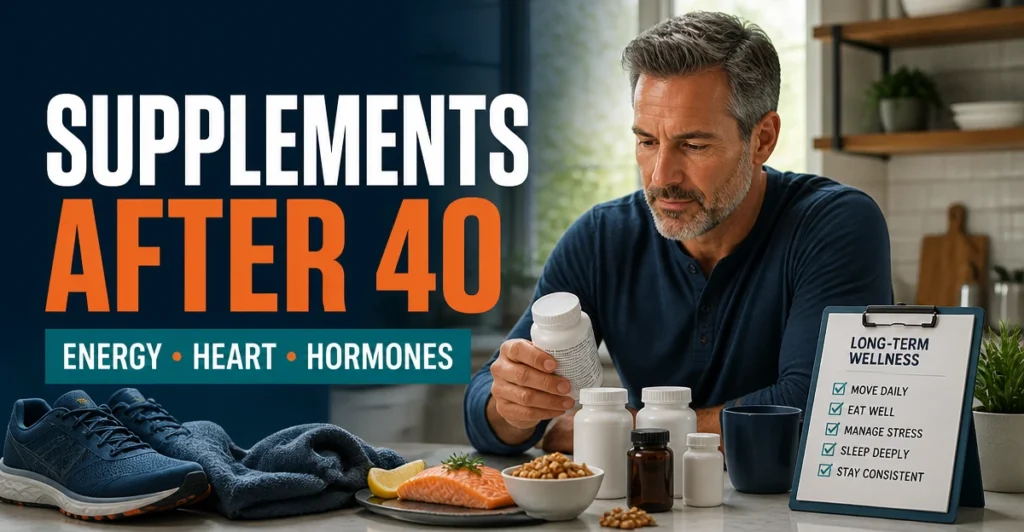
What are the best supplements for men over 40?
No universal supplement list applies to every man after 40.
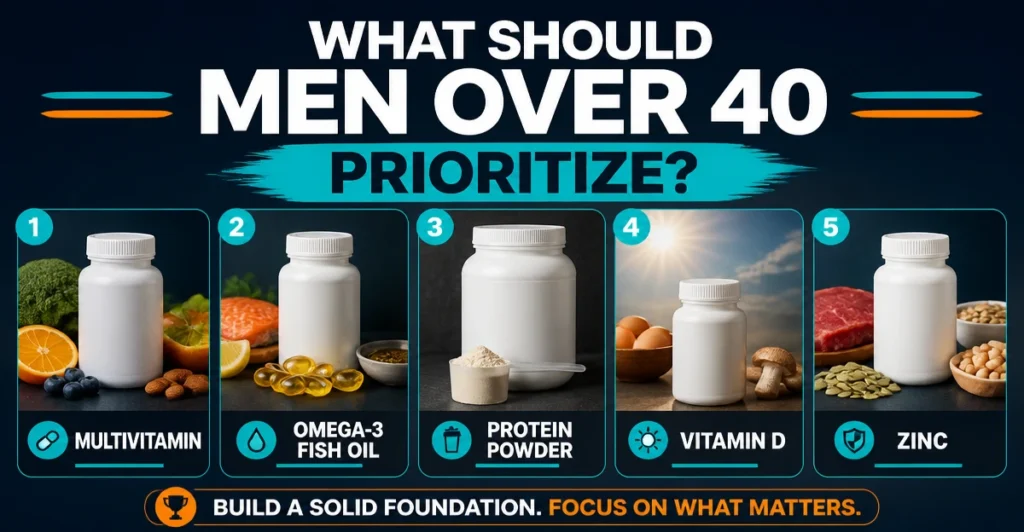
A practical routine may include a multivitamin when food intake is inconsistent, omega-3 when fatty fish intake is low, or protein powder when meeting protein needs through meals is difficult. Individual nutrients such as vitamin D make more sense when diet, lifestyle, bloodwork or professional guidance identifies a reason for taking them.
Supplements promoted for testosterone, libido or dramatic energy increases deserve greater caution because the marketing is often stronger than the supporting evidence.
What changes for men after 40?
Energy, cardiovascular health, muscle recovery, body composition, sleep and sexual health are often discussed separately, but they can affect one another.
Poor sleep can reduce daytime energy and make exercise less appealing. Less movement can influence cardiovascular fitness and body composition. Stress, medication, alcohol intake and underlying health conditions can also affect energy, mood and sexual function.
This overlap matters because a symptom does not identify its own cause. Feeling tired does not automatically mean low testosterone, just as reduced exercise performance does not automatically mean you need a pre-workout supplement.
Does testosterone automatically become low after 40?
Testosterone levels can change with age, but age alone does not diagnose testosterone deficiency.
The Endocrine Society recommends diagnosing hypogonadism only when a man has relevant symptoms and consistently low testosterone levels confirmed with accurate blood testing. A single symptom or one unconfirmed result is not enough.
That is why I would not treat a “testosterone support” bottle as the automatic answer to fatigue, reduced libido or slower recovery.
Start by separating foundations from optional extras
The easiest way to avoid an unnecessarily complicated routine is to divide supplements into two groups.
Foundation products
These products address ordinary nutritional or practical needs:
- A men’s multivitamin when meals are inconsistent
- Protein powder when food alone does not meet your protein target
- Omega-3 supplements when fatty fish intake is low
- A specific nutrient recommended after dietary review or testing
Targeted products
These are selected for a particular goal and should be considered individually:
- Pre-workout and energy formulas
- Sleep or stress-management products
- Probiotics for a defined digestive goal
- Prostate wellness formulas
- Herbal vitality or libido blends
A foundation product can still be inappropriate for a particular person, and a targeted supplement is not automatically ineffective. The distinction simply helps you decide what deserves priority.
Energy support after 40
Low energy is one of the most common reasons men begin shopping for supplements. However, energy rarely comes from a single capsule.
Sleep duration and quality, calorie intake, hydration, physical activity, stress, alcohol use, medication and medical conditions can all influence how energetic you feel.
Men’s multivitamins
A broad multivitamin can provide baseline micronutrient coverage when your diet is inconsistent, restricted or frequently disrupted by travel.
It should not be treated as an energy stimulant. Vitamins and minerals participate in normal energy metabolism, but consuming more than you need does not automatically make you feel more energetic.
Check the complete Supplement Facts panel because men’s formulas often contain zinc, selenium, vitamin D and several B vitamins that may also appear in other products.
You can see a real label-based example in my LiveGood Bio-Active Complete Multivitamin for Men review.
Protein powder
Protein supplies amino acids the body uses to maintain and repair tissues. A powder can be a convenient way to increase protein intake when meals fall short.
It is most useful as food support—not as a replacement for a varied diet or as a guarantee of muscle gain.
When comparing products, look at:
- Protein per serving
- Serving size
- Added sugar
- Total calories
- Protein source
- Allergens and digestive tolerance
Strength training, adequate total protein and recovery habits matter more than whether the powder has an aggressive fitness label.
Pre-workout supplements
Many pre-workout formulas rely on caffeine or other stimulating ingredients. These can temporarily increase alertness, but they can also affect sleep, heart rate, blood pressure or digestive comfort.
Read the full label instead of relying on the phrase “energy blend.” Avoid stacking a pre-workout with energy drinks, coffee and separate stimulant products without calculating the combined intake.
If poor sleep is causing fatigue, taking a strong stimulant late in the day can continue the same cycle.
Stress and mood formulas
Botanical products are frequently marketed for calm, resilience, mood and energy. The evidence and safety profile depend on the exact ingredient—not the general category.
Do not assume that “natural” means non-sedating, stimulant-free or compatible with medication. Introduce only one new formula at a time and record the product, serving size and reason for taking it.
When fatigue deserves medical attention
Don’t cover up persistent or worsening fatigue indefinitely with caffeine or pre-workout products.
Fatigue can be related to sleep disorders, anemia, thyroid problems, medication effects, depression, infection, blood-sugar problems and numerous other causes. A healthcare professional can decide which possibilities to investigate.
Heart health and omega-3 supplements
Cardiovascular health becomes an increasingly important part of a man’s wellness plan after 40.
The biggest priorities remain blood pressure, cholesterol, blood sugar, smoking status, body weight, physical activity and dietary pattern. A supplement cannot cancel out poorly managed risk factors.
What omega-3 supplements can and cannot do
Omega-3 fatty acids include EPA and DHA from fish, seafood and marine or algal supplements, along with ALA from plant foods.
Research indicates that eating fish and seafood as part of a balanced diet supports heart health. Fish-oil supplements can lower triglyceride levels, but evidence that ordinary supplements prevent cardiovascular events in otherwise healthy people is not conclusive.
This is more precise than saying that every fish-oil product “protects the heart.” The outcome, formulation, dose and individual’s existing health all matter.
When I compare omega-3 labels, I look past the large “fish oil” number on the front. The useful comparison is the amount of EPA and DHA per serving because products with the same total fish-oil amount can supply very different quantities.
What to check on an omega-3 label
- EPA per serving
- DHA per serving
- Number of capsules required
- Fish, krill or algal source
- Added vitamins, especially in cod liver oil
- Storage instructions
- Quality or contaminant-testing information
High-dose omega-3 products are not the same as an ordinary food supplement. The NIH Office of Dietary Supplements notes that omega-3 supplements can interact with medication and that high-dose products may require monitoring with anticoagulants.
Two large clinical trials also observed a small increase in atrial fibrillation with 4 grams per day of omega-3 supplements among people with cardiovascular disease or a high cardiovascular risk. This does not mean normal dietary fish intake is unsafe. It shows why therapeutic doses belong under professional guidance.
Hormone support: zinc, vitamin D and realistic expectations
Hormone-related marketing often takes a normal concern and turns it into an oversized promise.
Zinc and vitamin D are legitimate nutrients. Correcting a genuine deficiency or insufficient intake may support normal body functions. That is different from claiming that extra zinc or vitamin D will produce a dramatic testosterone increase in a man whose intake is already adequate.
Zinc
Zinc contributes to numerous normal processes, including immune function, protein synthesis and cell division.
Adult men need zinc, but more is not always better. The established tolerable upper intake level for adults is 40 mg per day from food, supplements and other sources unless a clinician is supervising a different intake.
Consuming excessive supplemental zinc over time can interfere with copper absorption. This is one reason to calculate the total from your multivitamin, immune product, prostate formula and standalone zinc supplement.
Vitamin D
Vitamin D supports normal bone, muscle and immune functions. Sun exposure, skin pigmentation, age, diet, location, health conditions and other factors can influence vitamin D status.
A blood test can help a clinician determine whether an individual has a deficiency and whether a targeted dose is appropriate. Taking a high dose based only on age or vague symptoms is not a reliable strategy.
Always compare your multivitamin with any standalone vitamin D product. The adult upper limit is generally 4,000 IU, or 100 micrograms, per day unless a healthcare professional recommends a different amount for medical reasons.
Maca and tribulus terrestris
Maca and tribulus are commonly included in vitality and libido formulas. They have histories of traditional use, but traditional use does not establish a predictable result.
Research on tribulus has produced inconsistent findings. The NCCIH notes that one trial did not find it more effective than placebo for erectile-dysfunction symptoms or serum testosterone, while another trial reported an improvement in sexual-function measures.
That is mixed evidence—not confirmation that tribulus raises testosterone.
Research on maca also does not justify describing it as a proven testosterone booster. Men considering these products should treat them as optional ingredients and check for interactions, product quality and realistic claims.
When to request a medical assessment
Symptoms such as persistent fatigue, reduced libido, erectile difficulties, reduced strength or changes in mood can have multiple explanations.
According to the Endocrine Society, testosterone deficiency should be diagnosed using both appropriate symptoms and consistently low levels measured with accurate testing. It should not be self-diagnosed from an online checklist or a supplement advertisement.
Prostate and urinary comfort
Prostate and urinary concerns become more common topics as men age, and saw palmetto is the most recognizable ingredient in this category.
However, being the most familiar ingredient does not make saw palmetto a proven solution. Current evidence indicates that saw palmetto used alone provides little or no benefit for urinary symptoms associated with benign prostatic hyperplasia.
My detailed guide to prostate wellness supplements and saw palmetto compares the common ingredients, explains the evidence limitations and covers the urinary symptoms that need medical attention.
Do not use a prostate supplement to diagnose the cause of frequent urination, weak flow, difficulty starting or repeated night waking. Mention new or changing urinary symptoms at a medical appointment.
Comparing the main supplement categories
| Category | Possible role | What to check | Main limitation |
|---|---|---|---|
| Men’s multivitamin | Baseline micronutrient coverage | Amounts of zinc, vitamin D, selenium and other repeated nutrients | Does not replace a balanced diet or automatically increase energy |
| Omega-3 | EPA and DHA intake when fish consumption is low | Actual EPA and DHA per serving, source and quality testing | General supplements are not a guaranteed way to prevent heart disease |
| Protein powder | Convenient support for total protein intake | Protein per serving, source, calories, sugar and allergens | Does not replace resistance training or a balanced diet |
| Vitamin D | Addressing inadequate intake or a confirmed deficiency | Total intake, dose and whether testing indicates a need | More is not automatically better |
| Zinc | Meeting normal nutritional requirements | Total intake across every supplement | Excessive long-term intake can interfere with copper absorption |
| Probiotic | Strain-specific digestive support in selected situations | Full strain names, storage information and viable count through shelf life | Benefits cannot be generalized across every strain or condition |
| Prostate formula | Optional support after symptoms have been evaluated | Exact ingredient doses, standardization and nutrient overlap | Does not diagnose or treat the cause of urinary symptoms |
| Herbal vitality blend | Optional product for a specific wellness goal | Full quantities, stimulant content and potential interactions | Evidence is often limited or mixed |
Do men over 40 need probiotics?
Probiotics are live microorganisms, and their effects can depend on the precise genus, species and strain.
A product containing one strain should not be assumed to provide the same effect as another probiotic. The NCCIH explains that strong evidence is still lacking for many uses and that researchers often do not know which probiotics are most helpful, how much is needed or who is most likely to benefit.
Instead of buying a probiotic because it has the largest colony count, look for:
- The complete strain designation
- The viable count through the end of shelf life
- Storage requirements
- A clearly defined reason for taking it
- Evidence connected to that strain and intended use
People with serious illnesses or compromised immune systems should obtain professional advice before using probiotics because the risk profile can be different.
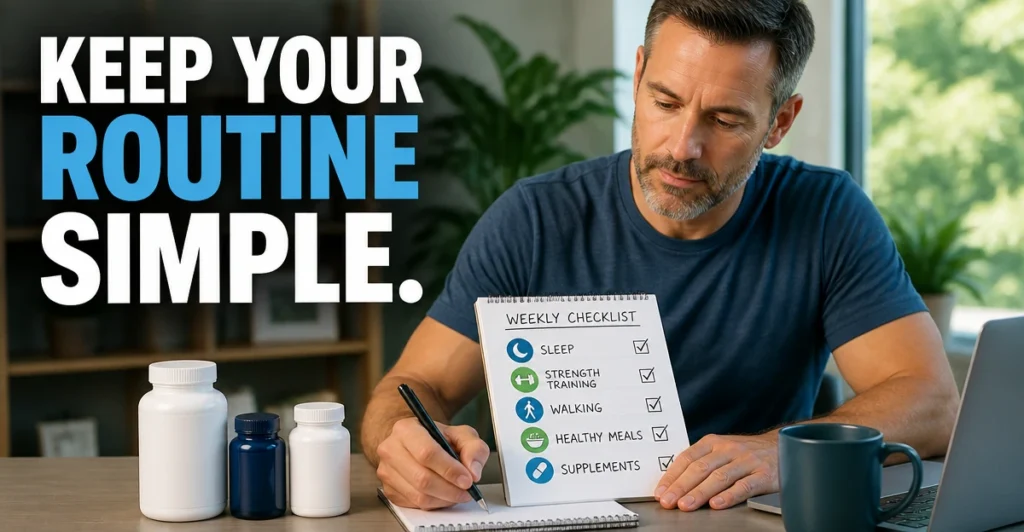
How to build a routine that lasts
A small routine you follow consistently is usually more useful than an ambitious stack you abandon after three weeks.
Step 1: Review the basics
Look honestly at your sleep, meals, alcohol intake, physical activity, stress and recovery. A supplement cannot correct a routine that continually works against your goal.
Step 2: List everything you already take
Include prescriptions, over-the-counter medicines, vitamins, minerals, powders, gummies, herbal products and occasional workout supplements.
Step 3: Define one specific goal
“Feel healthier” is difficult to evaluate. A goal such as meeting a protein target, correcting a clinician-identified deficiency or increasing dietary EPA and DHA is clearer.
Step 4: Add only one product at a time
Introducing several supplements together makes it difficult to identify which one caused a benefit, side effect or interaction.
Step 5: Choose an appropriate review point
Do not assume that every supplement needs the same trial period. Some effects or adverse reactions may appear quickly, while nutritional changes can take longer. Use professional guidance, the product directions and the evidence for that particular ingredient.
Step 6: Stop products that do not justify their place
If a supplement has no clear purpose, duplicates another product, causes unwanted effects or makes claims you cannot verify, reconsider it.
How I compare supplement labels without overpaying
Price does not reliably establish quality, and an expensive bottle is not automatically supported by better evidence.
When I evaluate a supplement, I check:
- Whether every active ingredient has a disclosed quantity
- How many capsules or scoops make one serving
- Whether the headline ingredient is supplied in a meaningful form
- Whether independent quality or contaminant testing is explained
- Whether it duplicates my existing routine
- Whether the claims are realistic and legally appropriate
- What the product costs per daily serving—not only per container
The FDA does not routinely test dietary supplements before they reach the market. Independent certification can provide information about manufacturing and whether a product contains its stated ingredients, but it does not prove that the supplement will deliver a particular health benefit.
My guide to comparing supplement ingredients before buying provides a more detailed label-reading process.
Where LiveGood may fit into the routine
LiveGood offers products across several categories discussed in this guide, including multivitamins and other everyday wellness supplements.
The membership model may appeal to people who use products consistently and find that the total savings exceed the membership cost. It may be less suitable for someone who purchases supplements occasionally or wants only one product.
I recommend comparing the current member price, non-member price, serving count and full label rather than assuming membership automatically creates the best value.
Products, formulas and prices can change. Always check the latest official product page and physical label before ordering.
Safety checks before starting
Supplements can interact with prescription medicines, over-the-counter products and medical conditions.
Before adding a new product:
- Show your complete list to a doctor or pharmacist
- Mention herbal ingredients rather than saying only “vitamins”
- Check the combined intake from every product
- Look for caffeine and other stimulants
- Follow the current label directions
- Do not double the serving because results feel slow
- Stop and seek advice if you experience a concerning reaction
This review is particularly important if you use anticoagulants, blood-pressure medicine, diabetes medication, prostate treatment or prescription hormone therapy.
If you plan to combine several LiveGood products, read my guide explaining how to check whether LiveGood supplements can be taken together.
My practical conclusion
The best supplement plan for a man over 40 is usually simpler than supplement advertising suggests.
A multivitamin may help cover gaps in an inconsistent diet. Protein powder can make a protein target more convenient. An omega-3 product may help increase EPA and DHA intake when fish consumption is low. Vitamin D, zinc and other individual nutrients are more convincing when there is an identifiable need.
Prostate formulas, probiotics, pre-workouts and herbal vitality products belong in the targeted category. They should be chosen for a clear reason, evaluated individually and kept in perspective.
Sleep, resistance training, walking, a balanced diet and appropriate medical checks remain the foundation. Supplements should make that foundation easier to maintain—not distract you from it.
Always check the latest product label because formulations, serving sizes, warnings and directions can change.
Frequently asked questions
What supplements should a man over 40 take?
There is no mandatory supplement list for every man over 40. A multivitamin, protein powder or omega-3 may be useful when it addresses an identifiable dietary gap. Individual nutrients are best selected using diet, health history, medication and relevant test results.
What is the best supplement for energy after 40?
No single supplement reliably solves low energy. Start by reviewing sleep, food intake, physical activity, stress, alcohol and medication. A multivitamin can cover some nutritional gaps, while protein powder may support recovery by making adequate protein intake more convenient. Persistent fatigue should be medically evaluated.
Should men over 40 take a multivitamin?
A multivitamin may be useful when diet is inconsistent or limited, but it is not compulsory for every healthy man. Compare the formula with your normal food intake and other supplements, paying particular attention to zinc, vitamin D and selenium.
Does fish oil prevent heart disease?
Eating fish as part of a balanced diet is associated with cardiovascular benefits. Fish-oil supplements can lower triglycerides, but evidence that ordinary supplements prevent cardiovascular events in healthy people is not conclusive. High-dose products should be used with professional guidance.
Can zinc or vitamin D raise testosterone?
Correcting a deficiency can support normal body function, but taking extra zinc or vitamin D does not guarantee a testosterone increase when your intake is already adequate. Suspected testosterone deficiency requires symptoms plus consistently low levels confirmed through appropriate testing.
Do testosterone booster supplements work?
Evidence for many herbal testosterone and vitality products is limited or inconsistent. Tribulus, for example, has not consistently increased testosterone in human research. Avoid products promising dramatic hormonal changes without medical testing.
Are prostate supplements necessary after 40?
No. Age alone does not make a prostate supplement necessary. Urinary symptoms should be evaluated before adding saw palmetto or another prostate formula because supplements cannot determine the underlying cause.
Can I take all my supplements together?
Not automatically. Products may duplicate vitamins and minerals, contain stimulants or interact with medication. Compare every Supplement Facts panel and have the complete combination reviewed when you take prescriptions or manage a medical condition.
How do I know whether a supplement is working?
Define the reason for taking it before you begin. Track the relevant outcome, follow the label and use an appropriate review period for that ingredient. Stop and reassess products that lack a clear purpose, cause adverse effects or do not justify their cost.
Sources and further reading
- NIH Office of Dietary Supplements: Omega-3 Fatty Acids
- NIH Office of Dietary Supplements: Vitamin D
- NIH Office of Dietary Supplements: Zinc
- NCCIH: Probiotics—Usefulness and Safety
- NCCIH: Supplements Marketed for Bodybuilding and Sexual Enhancement
- Endocrine Society: Testosterone Therapy Guideline Resources
- FDA: Questions and Answers on Dietary Supplements
Affiliate disclosure: Some links on LiveGoodForLife.com may be affiliate links. If you make a qualifying purchase through one of these links, I may earn a commission at no additional cost to you. This does not change the standards I use when discussing product labels, evidence, limitations or value.
Medical disclaimer: This article is provided for general educational purposes only and is not medical advice. It is not intended to diagnose, prevent, treat or cure any condition. Speak with a qualified doctor, pharmacist or other healthcare professional before starting, stopping or combining supplements, especially if you take prescription medication, have a medical condition, are preparing for surgery or are receiving treatment for cardiovascular, hormonal, urinary or prostate concerns. Seek appropriate medical care for persistent fatigue, chest symptoms, significant changes in sexual function, new urinary symptoms or any other concerning health change.