Are Proprietary Blends Ever Acceptable? A Science-First Breakdown
“Proprietary blend” is one of the most controversial phrases on supplement labels.
Some people assume proprietary blends are automatically deceptive. Others believe they protect valuable formulations. The truth sits somewhere in between.
This science-first guide explains when proprietary blends may be acceptable, when they’re a red flag, and how to evaluate them calmly using transparency, dosing logic, and real-world evidence.
If you’re new to label analysis, this article builds on our foundational guide to reading supplement labels and spotting fairy dusting.
In this article, you’ll learn:
- What proprietary blends are (and why brands use them)
- The fastest way to spot “label decoration” dosing
- the rare cases where blends may be acceptable
- a 60-second test you can use on any label
Proprietary blends can be harmless — or they can hide tiny doses. The difference is transparency.
What Is a Proprietary Blend?
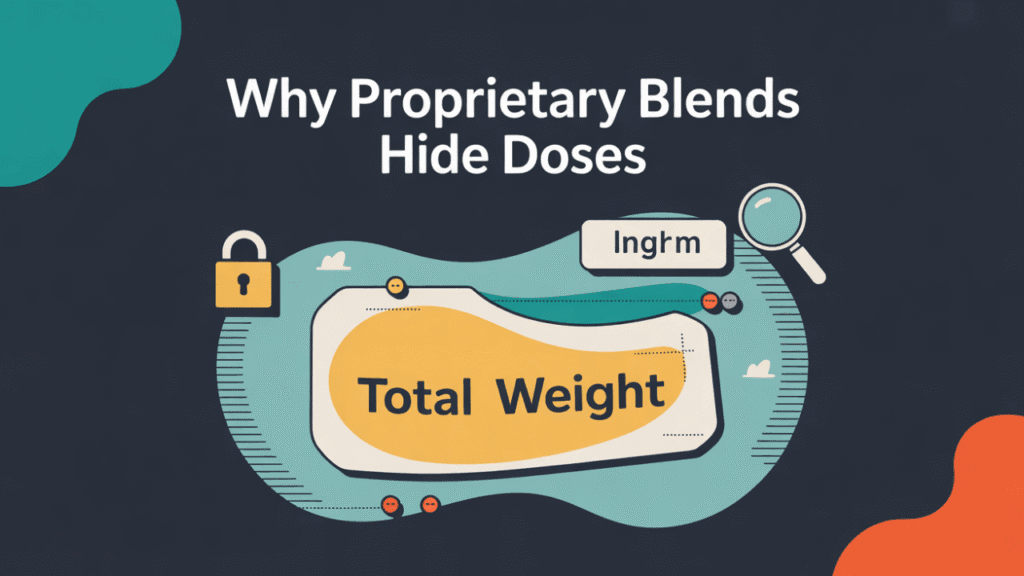
A proprietary blend is a group of ingredients listed together under a single combined weight rather than individual doses.
Instead of seeing how much of each ingredient you’re getting, the label only shows the total weight of the blend. This makes it harder to determine whether the formula contains meaningful doses or “symbolic” amounts intended primarily for marketing.
Key takeaway: A proprietary blend isn’t automatically “bad” — but it removes your ability to verify doses, which is where effectiveness and value are decided.
The NIH Office of Dietary Supplements explains that supplement products are not required to prove effectiveness before being sold, and labeling can leave important context unclear. This overview is explained in the NIH guidance on dietary supplements for consumers.
Why Proprietary Blends Exist
Proprietary blends are not automatically created to deceive. Brands typically cite two main reasons for using them:
- Formula protection: preventing competitors from copying exact ingredient ratios
- Marketing flexibility: allowing ingredient adjustments without redesigning the label
These reasons explain why blends exist — but they don’t change the consumer problem: without disclosed amounts, you can’t compare the formula to how ingredients are typically used in research or real-world dosing.
From a business perspective, these reasons are understandable. From a consumer perspective, the trade-off is simple: less transparency means less ability to evaluate the formula you’re paying for.
Are Proprietary Blends Ever Acceptable? The Short Answer
Yes, sometimes — but only when the blend doesn’t prevent informed evaluation. If doses are hidden and the category relies on precise amounts (fat burners, pre-workouts, stimulant blends), proprietary blends are usually a disadvantage for consumers.
A proprietary blend becomes more “acceptable” when the lack of individual dosing does not prevent a consumer from making an informed decision. In practice, that usually means the blend is used in a way that still provides clear safety boundaries, logical formulation, and real-world transparency signals.
This is similar to another common label phrase that sounds stronger than it is — “clinically studied ingredients” explained in plain English shows how brands can reference research without testing the finished product.
Healthline’s guide on how to read supplement labels highlights why dosage, form, and clear disclosure matter when judging whether claims are meaningful.
This is also why supplement pricing can be misleading — if you can’t verify dosing, it’s harder to justify premium costs. See our breakdown of why most people overpay for supplements.
Quick Comparison Table: Transparent Dosing vs Proprietary Blends
| Feature | Transparent Dosing | Proprietary Blend |
|---|---|---|
| Ingredient doses | Listed clearly for each ingredient | Hidden inside a combined total weight |
| Fairy dusting risk | Lower (you can verify amounts) | Higher (trace amounts are easy to hide) |
| Consumer evaluation | Possible: compare dose and form to research | Limited: you can’t confirm what you’re actually getting |
| Quality signal | Transparency supports trust | Trust is requested without full evidence |
| Best use case | Most vitamins, minerals, and goal-specific formulas | Occasionally in complex blends — but only with strong transparency elsewhere |
How to read this table: the main advantage of transparent dosing is simple — you can verify whether the formula is plausible. With proprietary blends, you’re often forced to trust the marketing instead of evaluating the math.
When Proprietary Blends Are a Red Flag
In practice, proprietary blends are most concerning when they’re used to create the appearance of a powerful formula without revealing whether any ingredient is present at a meaningful dose.
- Very long blends (10–40+ ingredients) with one combined weight
- High-claim categories (fat burners, “metabolism boosters,” “testosterone support,” pre-workouts)
- Jargon-heavy marketing (“matrix,” “thermogenic complex,” “bio-optimized system”) without dose details
- Unverifiable testing claims (no COA, no batch info, no lab disclosure)
- Front-label “headline ingredients” that aren’t dosed separately (so you can’t verify meaningful amounts)
These patterns overlap strongly with what many people call “fairy dusting” — where ingredients are included in tiny amounts just to be listed on the label. For a deeper explanation of how this works, revisit our fairy dusting label guide.
If you want to see how this plays out in real products, our review of independent testing on best-selling Amazon supplements shows how labels and real contents can diverge.
When Proprietary Blends Might Be Acceptable
There are a few scenarios where a proprietary blend may be less problematic — not because it’s ideal, but because the risk of “hidden useless dosing” is lower or other transparency signals are strong.
1) The blend total is large enough to be meaningful
If a blend weighs 50–150 mg and contains 12 ingredients, the odds of meaningful doses are low. If a blend weighs 3,000–10,000 mg and contains fewer ingredients, the odds improve. This doesn’t prove effectiveness — it simply makes “trace dosing” harder.
2) The label discloses key actives separately
Sometimes brands list the most important ingredients with exact doses, while using a proprietary blend only for flavor systems, minor botanicals, or supporting components. This is still not perfect, but it allows more meaningful evaluation.
3) The company provides strong verification elsewhere
A brand that publishes consistent batch testing information (like a COA tied to lot numbers) provides more trust than a brand that only claims “lab tested” without evidence. While a COA doesn’t prove effectiveness, it supports identity, purity, and basic quality control.
4) The blend is not “dose-sensitive” (and the label is otherwise clean)
Some blends are less dose-sensitive than others (for example, flavor systems or minor supportive botanicals). Even then, the best versions still disclose key actives separately, avoid exaggerated claims, and keep the ingredient list short and logical.
A Practical 60-Second Test for Any Proprietary Blend
- Look at the total blend weight. Is it realistically enough to support the number of ingredients listed?
- Check the ingredient order. Ingredients are typically listed from highest to lowest amount inside the blend.
- Scan for “headline ingredients.” Are the ingredients being marketed likely to be present in meaningful amounts?
- Look for transparency signals. Any batch/lot testing info, COA access, or lab disclosure?
- Compare cost to clarity. If the price is premium but dosing is hidden, value is harder to justify.
If this test leaves you unable to estimate what you’re actually taking, treat the blend claim as marketing, not evidence. Example: How to judge a 2,000 mg blend with 12 ingredients
If a proprietary blend totals 2,000 mg and contains 12 ingredients, the average amount per ingredient would be about 166 mg if evenly split — but it won’t be evenly split. A few ingredients may take most of the weight, leaving the rest at “sprinkle” levels.
That doesn’t prove it’s useless — but it means you cannot verify whether the marketed ingredients are dosed meaningfully. In high-claim categories, that uncertainty is usually a value and trust problem.
Pros & Cons of Proprietary Blends
Pros
- May protect a unique ratio from being copied
- Allows brands to adjust minor components without constant label redesign
- Occasionally used for flavor systems or non-critical support ingredients
Cons
- Prevents consumers from verifying meaningful doses
- Makes “fairy dusting” easier to hide behind long ingredient lists
- Complicates research comparison because form and dose are unknown
- Often relies on trust rather than transparent evidence
If You Want Transparency, What Should You Look For Instead?
- Fully disclosed ingredient doses (no hidden totals)
- Fewer ingredients with clearer purpose
- Reasonable serving size you can actually take daily
- Modest claims (“supports”) instead of guaranteed outcomes
- Verification signals like batch/lot documentation or accessible quality info
For real-world examples of transparent labels and dosing discussions, browse our LiveGood Supplement Reviews.
Scientific & Regulatory Context
In the U.S., supplements are regulated differently than prescription drugs, and manufacturers can sell products without proving effectiveness beforehand. The NIH Office of Dietary Supplements provides a consumer overview of what supplement labels can and can’t guarantee in its guidance on dietary supplements.
From a consumer standpoint, the most important point is simple: research on an ingredient does not automatically validate a formula — especially when doses are hidden. PubMed also includes studies that examine supplement labeling and accuracy; for one example, see this paper on label accuracy and consumer perception.
For another strong example of why label transparency matters, see the findings summarized in our weight-loss supplement label accuracy study review.
When evaluating claims, it helps to focus on what can be verified: dose clarity, form clarity, and basic quality controls (like batch testing documentation). That’s why transparent labels are usually the best “trust signal” a supplement can offer.
Personal Insight and Research Context
After reviewing a wide range of supplement labels, one pattern is consistent: proprietary blends are rarely used for the consumer’s benefit. They are usually used to protect marketing flexibility — and that often reduces clarity for the buyer.
My approach on LiveGoodForLife is simple: translate label language into decision tools. When a formula hides the most important information (dose and form), you lose the ability to evaluate value and relevance. That’s why transparent dosing and calm, realistic expectations tend to produce better supplement decisions over time.
This article is part of an ongoing series on supplement label accuracy and marketing claims, where we compare labels across categories and show how to spot patterns that lead to wasted money.
FAQ: Proprietary Blends
Are proprietary blends always bad?
No, but they are often a transparency problem. When you can’t see doses, you can’t evaluate whether the formula is likely meaningful or just label decoration.
Can you tell the amounts inside a proprietary blend?
Not precisely. You can only infer rough priorities using ingredient order and total blend weight, but you still can’t verify meaningful dosing for each ingredient.
Do proprietary blends make supplements unsafe?
Not automatically. The bigger issue is that they reduce your ability to judge dose, interactions, and relevance. Safety depends on ingredients, doses, and individual factors.
How do proprietary blends relate to fairy dusting?
They make fairy dusting easier because trace amounts can be hidden while the label still looks “complex.” Our fairy dusting guide explains the pattern in detail.
What’s better than a proprietary blend?
Transparent dosing: individual ingredient amounts clearly listed, with a reasonable serving size and fewer “headline ingredients” that can’t be verified.
Are proprietary blends FDA-approved?
Supplements are not “FDA-approved” the same way prescription drugs are. Brands are responsible for safety and labeling, so consumers should focus on dose transparency, realistic claims, and verification signals.

Quick Recap: Proprietary Blends in Plain English
If you want the entire article in 30 seconds, this recap table summarizes what to watch for when you see “proprietary blend” on a label.
| What You See | What It Often Means | What to Do |
|---|---|---|
| Common “Proprietary blend” | Doses are hidden, so you can’t verify meaningful amounts | Prefer transparent dosing when possible; treat blend claims as a starting point |
| Red flag Many ingredients + small total weight | High chance of fairy dusting or “label decoration” dosing | Be skeptical; compare total weight to ingredient count and category claims |
| Better Few ingredients + large total weight | Lower chance of trace dosing (still not proof) | Look for serving size logic, modest claims, and any testing transparency |
| Trust gap “Lab tested” without evidence | Marketing claim that can’t be verified | Look for COA/batch information or clearer transparency signals |
Final Thoughts
Are proprietary blends ever acceptable? Sometimes — but only when they don’t prevent informed evaluation.
In most cases, transparent dosing is the better consumer choice because it allows you to assess value, compare research relevance, and avoid fairy-dust patterns.
Disclaimer: This article is for educational purposes only and does not provide medical advice. Always consult a qualified healthcare professional for personal guidance. This post may contain affiliate links.
Want a starting point?
Take the free health assessment.
It is educational only and not medical advice.
Why Take the Health Assessment?
- Personalized Health Insights: Get a deep dive into your current health, covering heart health, immune strength, stress levels, and more.
- Discover Your Hidden Potential: Uncover health risks you may not even be aware of and learn how to tackle them effectively.
- Actionable Expert Advice: Receive simple, customized tips that fit your lifestyle—whether you want to build muscle, lose weight, or improve your well-being overall.
- Quick & Easy: It only takes a few minutes, but the impact could last a lifetime.
- Absolutely Free: No hidden fees, no catch. Just a commitment to your better health.
Take the Quiz, Unlock Your Potential
Curious about what your body needs? Don’t let uncertainty hold you back any longer. Thousands have already taken their first step towards better health; now it’s your turn. This isn’t just a questionnaire—it’s your gateway to a healthier, more vibrant life.
Start Your Free Health Assessment Now