
Do Men Need a Multivitamin? Read the Label Before You Buy
A multivitamin is one of the easiest supplements to buy—and one of the easiest to buy badly.
The front of the bottle tells you how the product is marketed. The back tells you what you are actually buying: the serving size, nutrients, quantities, Percent Daily Values and additional ingredients.
Not all men need the same multivitamin. Some may find one helpful when their diet is inconsistent or restricted, while others may already obtain sufficient nutrients from food.
The better question is not simply, “Should every man take a multivitamin?” It is, “Does this particular formula fill a genuine gap without unnecessarily duplicating what I already consume?”
If you are comparing supplements as part of a wider routine, my men’s wellness supplements guide explains where multivitamins fit alongside protein, omega-3s and targeted products.
This article is for educational purposes and does not provide personalized medical or nutritional advice. If you take medication, have a medical condition, or suspect a nutrient deficiency, check with a qualified healthcare professional.

Do men actually need a multivitamin?
No, not every man automatically needs one.
A multivitamin contains a combination of vitamins, minerals and sometimes other ingredients. Its main purpose is to increase nutrient intake when food doesn’t consistently provide enough—not to replace a varied diet or prevent future health problems.
According to the NIH Office of Dietary Supplements, multivitamins can help people get recommended amounts of vitamins and minerals when they don’t get enough from food. However, they can also increase the likelihood of consuming too much of certain nutrients, particularly when combined with other supplements.
A multivitamin may be worth discussing when:
- Your meals are regularly inconsistent or limited in variety
- You follow a restrictive diet that excludes major food groups
- You have a poor appetite or consume a low-calorie diet
- A healthcare professional identifies a potential dietary gap
- You want a simple baseline product instead of several overlapping bottles
A multivitamin may add less value when your diet is already varied, your nutrient needs are being met and you have no identified reason for additional supplementation.
It is also important to understand what a multivitamin cannot reliably do. Most research has found that ordinary multivitamins have little or no effect on overall cardiovascular-disease risk. They should not be sold as a substitute for medical care, a heart treatment or a guaranteed method of preventing disease.
What makes a men’s multivitamin different?
There is no standard legal formula that every men’s multivitamin must follow. Manufacturers decide which nutrients to include and how much of each to provide.
Men’s formulas are commonly positioned around energy metabolism, muscle function, heart health and healthy aging. These are marketing categories built around nutrients that perform normal functions throughout the body.
For example:
- B vitamins participate in normal energy metabolism, but they are not stimulants
- Vitamin D contributes to normal bone and muscle function
- Zinc contributes to normal immune function and numerous cellular processes
- Vitamin C and vitamin E have antioxidant functions
These normal nutrient functions do not prove that the finished multivitamin will create a noticeable effect or prevent a medical condition.
A men’s formula may also contain little or no iron compared with some women’s products. That does not mean that no man ever needs iron. It means iron intake should reflect individual needs rather than assumptions based only on gender.
Men’s multivitamins after 40
Turning 40 does not automatically create a need for a multivitamin. However, it is a useful time to review diet quality, medication, activity, sleep and results from routine health checks.
Men over 40 may also be taking more than one wellness product, which makes label comparison increasingly important. A multivitamin can overlap with separate vitamin D, zinc, magnesium, immune-support or prostate formulas.
My guide to male wellness supplements after 40 explains how multivitamins fit into a broader routine for energy, cardiovascular wellness, recovery and hormone-related concerns.
Men’s formulas versus men’s 50+ formulas
Products labelled “50+” are usually formulated or positioned differently from standard adult men’s products, but the age printed on the front does not tell you exactly what changed.
The NIH Office of Dietary Supplements notes that multivitamins for older adults often contain little or no iron and may provide more vitamin D, calcium or vitamin B12 than products intended for younger adults.
That does not mean every 50+ formula follows the same pattern.
Place a standard men’s label beside the 50+ version and compare:
- Serving size
- Vitamin D
- Vitamin B12
- Calcium
- Iron
- Zinc
- Vitamin K
- Additional blends or botanical ingredients
- Number of servings per container
Sometimes the age-specific product is meaningfully different. Sometimes the biggest difference is the marketing.
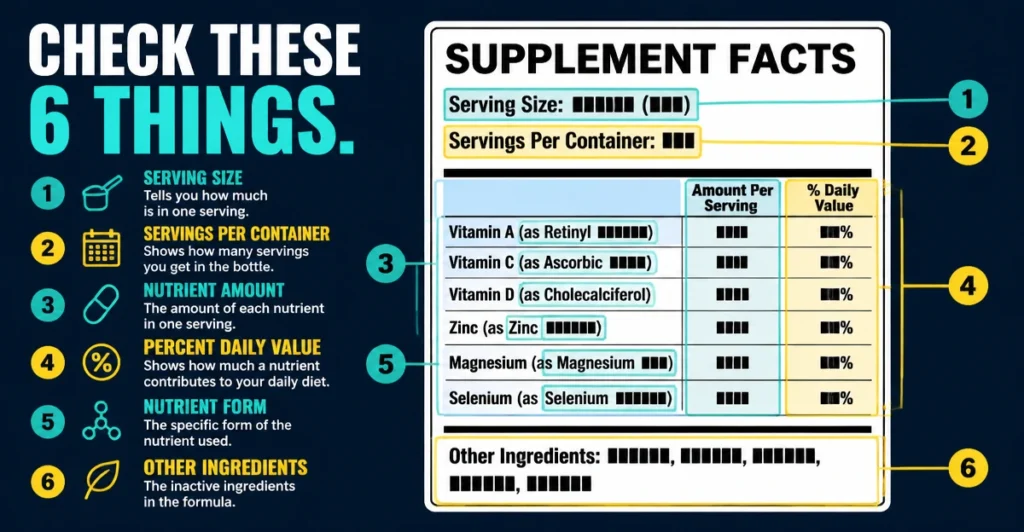
The six label details that matter
1. Serving size
The first number I check is the serving size at the top of the Supplement Facts panel.
A bottle may contain 120 capsules, but that does not mean it provides 120 days of use. If one serving requires four capsules, the bottle provides only 30 servings.
The FDA defines a supplement serving according to the maximum amount recommended on the label for one eating occasion. That is why all the nutrient quantities on the panel need to be interpreted using the printed serving size.
Ask:
- Does one serving require one tablet, two capsules or several gummies?
- Will I realistically take that serving every day?
- Are the nutrient amounts shown per capsule or per complete serving?
2. Servings per container
Servings per container tells you approximately how long the product will last when taken according to its directions.
A 200-count bottle could provide:
- 200 servings at one tablet per serving
- 100 servings at two tablets per serving
- About 66 servings at three tablets per serving
- 50 servings at four tablets per serving
This one number can completely change the apparent value of a product.
3. Amount per serving
The amount column tells you the actual quantity of each nutrient in one complete serving. Depending on the nutrient, this may be shown in milligrams, micrograms or another appropriate unit.
Do not compare two products using ingredient names alone. Both may contain vitamin D or zinc while providing substantially different quantities.
Units also matter. One milligram equals 1,000 micrograms, so numbers should only be compared after confirming that the units match.
4. Percent Daily Value
Percent Daily Value, written as %DV, shows how much a serving contributes toward the established Daily Value for that nutrient.
It is a comparison tool, not a personalized prescription. Your individual requirement may vary with age, sex, diet, health and life stage.
A value above 100% does not automatically make a formula superior. Some multivitamins supply several times the Daily Value of selected nutrients. This can increase the risk of unnecessary overlap when you also use fortified foods or separate supplements.
5. Nutrient form
The nutrient name tells only part of the story. The label or ingredient list may also identify the compound used to provide it.
For example, vitamin B12, folate, magnesium and other nutrients can appear in different forms. Those forms may vary in stability, absorption, capsule size, cost and suitability for particular people.
A more complicated or fashionable form is not automatically better for every buyer. Compare the complete labels and look for reliable evidence instead of relying on words such as “advanced,” “premium” or “bioactive.”
6. Other ingredients and allergen information
The “other ingredients” section can identify capsule materials, coatings, colours, flavours, sweeteners, binders and processing ingredients.
This section matters if you:
- Have a food allergy
- Avoid animal-derived capsules
- Follow a vegan or vegetarian diet
- Want to avoid particular sweeteners or colours
- Have previously reacted to a supplement ingredient
Do not rely only on a “free from” statement on the front. Confirm the current ingredient and allergen information on the complete label.
What does a typical men’s multivitamin contain?
There is no required ingredient list, but a broad men’s formula commonly includes several of the following nutrients:
| Nutrient | Normal role | What to check |
|---|---|---|
| Vitamin A | Contributes to normal vision and immune function | Form, amount and overlap with other products |
| Vitamin C | Contributes to antioxidant protection and normal immune function | Total intake from supplements and fortified products |
| Vitamin D | Contributes to normal bone, muscle and immune function | Amount, separate vitamin D use and professional advice |
| Vitamin E | Functions as an antioxidant nutrient | Dose and medication considerations |
| Vitamin K | Contributes to normal blood clotting | Particularly important for people using warfarin |
| B vitamins | Participate in normal energy metabolism and other cellular processes | Individual amounts and unnecessarily high doses |
| Folate | Contributes to normal cell division and blood formation | Form, amount and other folic-acid sources |
| Vitamin B12 | Contributes to normal nerve function and red-blood-cell formation | Form and quantity |
| Zinc | Contributes to normal immune function and numerous enzyme processes | Total intake across multivitamin, immune and prostate products |
| Selenium | Functions as an essential trace mineral | Combined intake from every supplement |
| Calcium and magnesium | Contribute to normal bone, muscle and nerve functions | Multivitamins often contain smaller amounts because these minerals take up space |
The presence of every nutrient on this list is not automatically necessary. A good formula is one that fits the person taking it—not simply the one with the longest panel.
Check for proprietary blends and added ingredients
Some men’s multivitamins include plant extracts, carotenoids, amino acids or “men’s wellness” blends in addition to standard nutrients.
These extras require the same scrutiny as the vitamins and minerals.
Check whether:
- The quantity of each added ingredient is disclosed
- A Daily Value has been established
- The ingredient has a clear purpose
- The dose resembles quantities studied in relevant research
- It duplicates another supplement
- It introduces medication or allergy concerns
The phrase “Daily Value not established” does not mean an ingredient is ineffective or dangerous. It means that the FDA has not established a Daily Value for that ingredient.
For a complete comparison method, read my guide explaining how to compare supplement ingredients before buying.
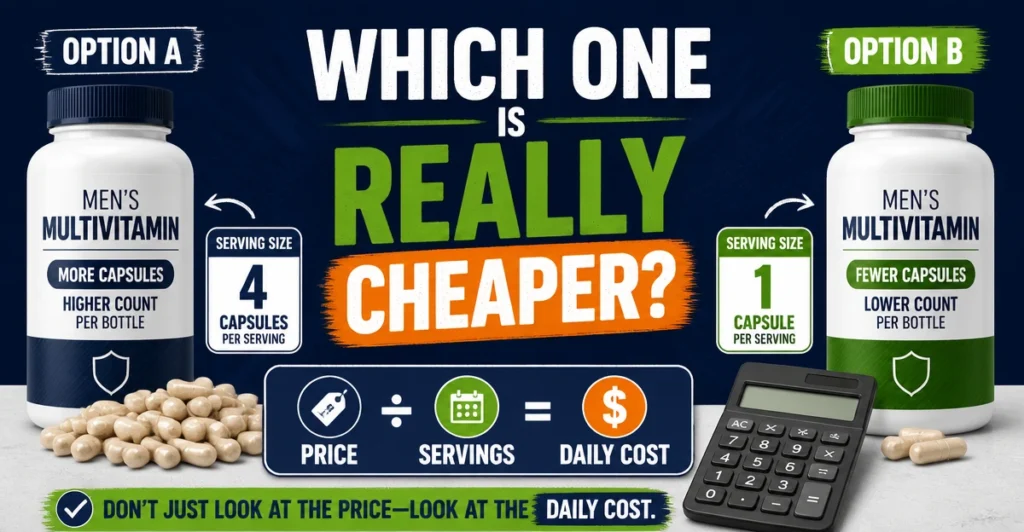
Calculate price per serving—not price per bottle
Bottle price is one of the least reliable ways to compare multivitamins.
A larger bottle may require more capsules per day. A smaller bottle may contain more complete servings. One product may also include nutrients or added ingredients that you do not need.
Use this calculation:
Price per serving = current bottle price ÷ number of servings
For example, if a bottle currently costs $20 and provides 60 servings:
$20 ÷ 60 = approximately $0.33 per serving
This is only a mathematical illustration—not the price of a specific product.
When comparing value, record:
- Current price
- Serving size
- Servings per container
- Daily cost
- Nutrients you genuinely want
- Ingredients you would rather avoid
- Membership or subscription requirements
- Shipping and applicable taxes
Prices and promotions can change. Calculate using the amount displayed at checkout rather than relying on an old article or screenshot.
Tablets, capsules, softgels and gummies
Format affects convenience, serving size and the available space for nutrients.
Tablets
Tablets can contain many nutrients in a compact form, but some are large or difficult for certain people to swallow.
Capsules
Capsules may be easier to swallow, although a complete serving sometimes requires more than one capsule.
Softgels
Softgels are commonly used for oil-based ingredients. Check whether the capsule material fits your dietary preferences.
Gummies
Gummies can be convenient for people who dislike pills, but they may require several pieces per serving and can contain added sugar or sweeteners. Their nutrient coverage may also differ from a tablet or capsule formula.
The best format is the one you can take consistently, as long as the label lists appropriate ingredients and amounts.
A practical men’s multivitamin checklist
Before buying, ask these questions:
- Why am I considering a multivitamin?
- Does my diet suggest a general gap or a specific concern?
- How many capsules, tablets or gummies make one serving?
- How many complete servings are in the container?
- Are any nutrients provided at several times the Daily Value?
- Does the formula duplicate vitamin D, zinc, selenium or other nutrients I already take?
- Does it include iron, and is that appropriate for me?
- Are all additional blends and ingredients clearly disclosed?
- Does the product fit my allergies and dietary preferences?
- What is the current cost per serving?
- Does membership or subscription affect the price?
- Have I checked the latest label rather than an old product image?
How the LiveGood men’s multivitamin compares
LiveGood Bio-Active Complete Multivitamin for Men is a broad men’s formula for everyday nutrient coverage.
Before buying it, check the current product label for:
- Serving size
- Vitamin and mineral quantities
- Percent Daily Values
- Proprietary or additional blend ingredients
- Capsule information
- Current directions and warnings
For my educational label analysis, see the Bio-Active Complete Multivitamin for Men review.
If you are ready to compare current pricing and purchase options, visit the LiveGood Multivitamin for Men sales page.
Commercial note: Check the price shown on the current page and confirm whether it is a member or retail price. Membership, subscription, shipping and tax can affect the final cost.
Compare other LiveGood vitamins
Review a multivitamin alongside every separate nutrient you use. Adding vitamin D, magnesium or another supplement may create overlap or change the suitability of the routine.
You can browse the LiveGood vitamins collection and comparison guide before deciding whether you need a multivitamin alone or another targeted product.
The wider LiveGoodForLife supplement shop lists current product pages and available buying options. Use the latest individual product page to confirm prices, stock, serving information and directions.
Can you combine a multivitamin with other supplements?
Possibly, but do not assume that two individually reasonable products automatically create a sensible combination.
Common sources of overlap include:
- Vitamin D
- Vitamin A
- Vitamin E
- Zinc
- Selenium
- Magnesium
- B vitamins
Compare the amounts per complete serving—not just the ingredient names. If you use several LiveGood products, my guide to taking LiveGood supplements together explains how to perform an overlap check.
Who should ask a healthcare professional first?
Professional advice is particularly important if you:
- Take warfarin or another prescription medication
- Have kidney, liver or digestive conditions
- Have been told to limit or supplement a particular nutrient
- Use several supplements with overlapping ingredients
- Are preparing for surgery
- Have unexplained fatigue or other persistent symptoms
- Need testing for a suspected deficiency
Vitamin K can affect warfarin therapy, while minerals can interfere with the absorption of certain medicines when taken at the same time. A doctor or pharmacist can help determine whether ingredients need to be avoided or separated from medication.
My bottom line
Men do not automatically need a multivitamin simply because they are men, reach a particular age or experience a busy week.
A well-chosen multivitamin can be a convenient way to increase vitamin and mineral intake when food does not consistently meet your needs. It cannot replace dietary variety, sleep, exercise, medical evaluation or targeted treatment for a confirmed deficiency.
The best buying decision begins on the back of the bottle:
- Read the serving size
- Confirm the number of servings
- Compare actual amounts and Percent Daily Values
- Check nutrient forms and other ingredients
- Look for overlap
- Calculate the current price per serving
Take two minutes to read the panel before buying. It is usually more informative than everything printed on the front.
Always check the latest product label because formulas, nutrient quantities, serving sizes, directions and warnings can change.
Frequently asked questions
Do healthy men need a daily multivitamin?
Not necessarily. A healthy man who eats a varied diet may already obtain sufficient vitamins and minerals from food. A multivitamin may be helpful when meals are inconsistent, calorie intake is low, food choices are restricted or a healthcare professional identifies a possible gap.
What should men look for in a multivitamin?
Start with serving size, servings per container, nutrient quantities and Percent Daily Values. Then check nutrient forms, iron content, other ingredients, allergens, dietary suitability and overlap with existing supplements.
Should men’s multivitamins contain iron?
There is no single answer for every man. Many men’s formulas contain little or no iron, but individual needs vary. Do not add iron solely because it is absent from a multivitamin. A suspected iron deficiency should be evaluated properly because fatigue and other symptoms can have multiple causes.
Is a 50+ multivitamin better for men over 50?
Not automatically. A 50+ formula may contain different quantities of vitamin D, vitamin B12, calcium or iron, but formulas vary. Compare its Supplement Facts panel with a standard men’s product and choose according to your needs—not only the age printed on the front.
Is 100% Daily Value enough?
Percent Daily Value is a general comparison tool, not an individualized requirement. You also obtain nutrients from food and fortified drinks. More than 100% is not automatically better, and some nutrients have established upper intake limits.
Are high-potency multivitamins better?
No. “High potency” describes larger quantities; it does not prove better results. Large doses can increase the risk of unnecessary duplication or excessive intake.
Are gummies as effective as tablets?
The format alone does not determine effectiveness. Compare the complete serving and nutrient quantities. Gummies may require several pieces per serving and can provide different nutrient coverage from tablets or capsules.
How much should a men’s multivitamin cost?
There is no universal correct price. Divide the current price by the number of servings to calculate daily cost. Then compare that cost with the nutrient panel, quality information, serving convenience and whether you need the included ingredients.
Can I take a men’s multivitamin with vitamin D or zinc?
Possibly, but calculate the combined intake first. Multivitamins commonly contain vitamin D and zinc, so a separate product may create unnecessary overlap. Ask a healthcare professional when using high doses, managing a condition or taking medication.
Sources and further reading
- NIH Office of Dietary Supplements: Multivitamin and Mineral Supplements
- NIH Office of Dietary Supplements: Multivitamin and Mineral Supplements for Health Professionals
- FDA: Dietary Supplements and Supplement Facts Requirements
- FDA: Dietary Supplement Nutrition Labeling Guide
Affiliate disclosure: Some links on LiveGoodForLife.com are affiliate links. If you make a qualifying purchase through one of these links, I may earn a commission at no additional cost to you. This does not affect the educational standards used to evaluate serving sizes, labels, nutrient amounts, limitations or product value.
Medical disclaimer: This article provides general educational information and is not medical advice. It is not intended to diagnose, prevent, treat or cure any condition. Speak with a qualified doctor, pharmacist or registered dietitian before beginning or combining supplements, especially if you take medication, have a medical condition, are preparing for surgery or suspect a nutrient deficiency. Do not use a multivitamin as a substitute for medical evaluation of fatigue or other persistent symptoms.