Mental Wellness Supplements: What Helps Focus, Mood and Stress?
Most people researching mental wellness supplements are not looking for a miracle. They want to concentrate more consistently, feel less overwhelmed by everyday pressure or understand whether a nutrient could be contributing to low energy or mood.
The honest answer is that no supplement reliably improves focus, mood and stress for everyone.
Some nutrients matter greatly when a person has a deficiency. A few ingredients have limited or preliminary evidence for particular outcomes. Others are promoted far beyond what clinical research currently supports.
The most useful approach is to identify the problem first, rule out medical or medication-related causes and then choose the smallest, most specific intervention that makes sense.
This article is educational and does not replace mental-health care, medical advice, therapy or prescribed treatment. Persistent or severe symptoms deserve professional evaluation.
What are the best supplements for focus, mood and stress?
There is no single best mental wellness supplement. The appropriate choice depends on the concern and whether a nutritional deficiency, sleep problem, health condition or medication is contributing to it.
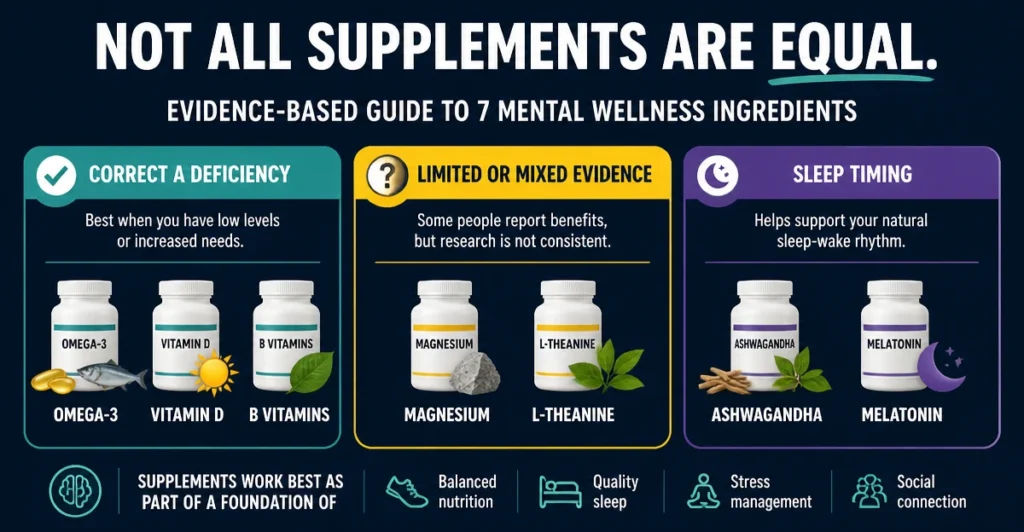
The current evidence can be summarized like this:
- B12, folate, iron and vitamin D: most relevant when intake or measured status is low
- Omega-3: important nutritionally, but evidence for treating depression is uncertain
- Magnesium: essential for normal nerve and muscle function, but not an established anxiety or insomnia treatment
- L-theanine: early evidence suggests possible effects on attention or stress, but clinical relevance remains uncertain
- Ashwagandha: some preparations may help with stress or sleep, but products differ and important safety cautions apply
- Melatonin: may help certain sleep-timing problems; it is not a general mood supplement
- Oral GABA and tryptophan: evidence is limited, and tryptophan can interact with medicines affecting serotonin
None of these should replace treatment for depression, an anxiety disorder, attention-deficit/hyperactivity disorder, chronic insomnia or another diagnosed condition.
How supplements fit into mental wellness
The brain depends on adequate nutrition, oxygen, sleep and energy. Vitamins, minerals, fatty acids and amino acids participate in processes throughout the nervous system.
That biological role does not mean that taking extra amounts will improve mood or concentration when intake is already sufficient.
A useful distinction is the difference between:
- Correcting a deficiency: restoring an inadequate nutrient level
- Supporting normal function: meeting ordinary nutritional requirements
- Treating a condition: attempting to improve diagnosed depression, anxiety, ADHD or insomnia
The evidence for the first two may be reasonable when an actual need exists. The third requires a much higher standard of proof and professional oversight.
Symptoms do not identify a deficiency
Low energy, poor concentration, irritability and disturbed sleep can occur with nutrient deficiencies. They can also be related to stress, depression, anxiety, thyroid conditions, sleep disorders, medication effects, alcohol use and many other factors.
This is why I avoid recommending a nutrient based only on a general symptom checklist.
Supplements for focus and mental clarity
Focus is influenced by sleep, workload, stress, food intake, hydration, medication and physical or mental-health conditions.
A supplement may help if it corrects a genuine nutritional problem, but it should not be used to conceal persistent cognitive changes or severe fatigue.
Vitamin B12
Vitamin B12 is needed for normal red-blood-cell formation, DNA synthesis and nervous-system function.
A B12 deficiency can cause fatigue and neurological changes. Some studies have also found associations between low B12 status and depression, but an association does not prove that B12 supplements improve mood in people who already have adequate levels.
People at greater risk of inadequate B12 include some older adults, people who eat little or no animal-derived food, and those with certain digestive conditions or medications that affect absorption.
B12 deficiency can cause neurological problems even without anaemia. Suspected deficiency is therefore a reason for proper evaluation rather than casual high-dose supplementation.
Folate and vitamin B6
Folate and vitamin B6 participate in normal metabolism and processes involved in neurotransmitter synthesis.
Low folate status has been associated with depression in some research, but findings are not consistent. High-dose folic acid has not been established as a general mood supplement.
Vitamin B6 also requires dose awareness. Long-term excessive supplemental intake can cause nerve damage, so more is not automatically better.
Are methylated B vitamins better?
Methylcobalamin and methylfolate are forms of vitamin B12 and folate used in some supplements. They are frequently marketed as universally superior or necessary for people with particular genetic variants.
That claim is too broad.
Some people may use a particular form following professional guidance, but most buyers should not assume that the word “methylated” guarantees better absorption, better mood or better focus.
Compare the form, amount, reason for taking it and supporting evidence—not the marketing term alone.
Iron
Iron deficiency can cause fatigue and difficulty concentrating, but iron is not a general focus supplement.
Too much iron can be harmful. It should not be added simply because you feel tired or unfocused, particularly when your multivitamin already contains it.
Testing and professional guidance are preferable when iron deficiency is suspected.
L-theanine
L-theanine is an amino acid naturally present in tea. It is marketed for calm attention and is sometimes combined with caffeine.
A 2026 systematic review and meta-analysis found possible acute effects on some attention measures, but the researchers stated that the clinical relevance remains uncertain.
This means L-theanine is promising—not proven as a treatment for poor concentration, anxiety or ADHD.
A caffeine and L-theanine combination should still be evaluated for its caffeine content. It may not suit people who experience palpitations, anxiety, elevated blood pressure or disrupted sleep after stimulants.
Supplements marketed for mood support
Mood-support products often combine omega-3, vitamin D, B vitamins, magnesium and several botanicals. Putting these ingredients in one bottle does not establish that the combination will improve mood.
Omega-3 fatty acids
EPA and DHA are long-chain omega-3 fatty acids found in fish, seafood and marine or algal supplements. They are important components of cell membranes and have several normal functions in the body.
Omega-3 supplements have been studied extensively for depression, but the results remain uncertain.
The National Center for Complementary and Integrative Health reports that if omega-3 supplements have an effect on depressive symptoms, it may be too small to be clinically meaningful. Evidence for using omega-3 by itself as a depression treatment is inconclusive.
Omega-3 should therefore be viewed as a nutritional ingredient—not a replacement for therapy or antidepressant treatment.
When comparing a fish-oil or algal-oil product, check:
- EPA per serving
- DHA per serving
- Number of capsules required
- Source of the oil
- Storage directions
- Independent purity or contaminant testing
People taking anticoagulants or using high-dose omega-3 products should discuss the combination with a healthcare professional.
Vitamin D
Vitamin D is essential for normal bone, muscle and immune functions. Low vitamin D status has also been associated with depression in observational research.
However, clinical trials have not shown that vitamin D supplements prevent depression or reliably treat depressive symptoms.
This distinction is important. Testing and correcting a confirmed deficiency can be appropriate, but vitamin D should not be presented as a proven antidepressant.
Vitamin D requirements and status can be affected by sun exposure, season, skin pigmentation, age, diet, location and health conditions. A blood test can help a healthcare professional determine whether supplementation is needed.
B12 and folate
B12 and folate participate in processes involved in the nervous system and normal blood formation. Deficiencies can affect physical and neurological health.
That does not make a high-dose B-complex an automatic treatment for low mood.
The sensible sequence is to assess diet and risk factors, test when appropriate and correct an identified problem.
Supplements for everyday stress and calm
Occasional stress from deadlines, travel or a difficult week is not the same as an anxiety disorder.
Supplement labels often blur that boundary by using words such as “calm,” “balance” and “resilience.” Those terms do not prove that a formula treats clinically significant anxiety.
Magnesium
Magnesium is an essential mineral involved in muscle and nerve function, blood-pressure regulation, blood-sugar control and many other processes.
Although observational research has suggested possible connections with sleep or mood, clinical trials have not established magnesium as a reliable treatment for anxiety or insomnia in people without a deficiency.
Magnesium supplements can also cause diarrhoea, nausea or abdominal cramping. They can interfere with the absorption of certain antibiotics and osteoporosis medicines.
When I compare magnesium products, I check:
- The specific magnesium compound
- Elemental magnesium per serving
- Number of capsules required
- Other magnesium products already being used
- Medication-timing instructions
The compound’s total weight is not the same as the amount of elemental magnesium. The Supplement Facts panel should be the main reference.
Ashwagandha
Ashwagandha is an herb used in traditional Ayurvedic practice and now widely marketed for stress, sleep and energy.
According to the NCCIH, some ashwagandha preparations may help with stress or insomnia. Evidence for anxiety remains unclear, and there is insufficient evidence for claims about cognitive function or most other promoted uses.
Different studies have used different root, leaf and root-and-leaf extracts. A positive result from one preparation cannot automatically be transferred to every ashwagandha product.
Ashwagandha also has meaningful cautions:
- Long-term safety is not well established
- It can cause drowsiness or digestive symptoms
- Rare cases of liver injury have been reported
- It should be avoided during pregnancy and breastfeeding
- It is not recommended before surgery
- It may be unsuitable for people with autoimmune or thyroid disorders
- It can interact with sedatives, anticonvulsants, thyroid medication and medicines for blood pressure or diabetes
This is not an ingredient I would add casually to a complicated supplement routine.
Oral GABA
GABA is an inhibitory neurotransmitter in the nervous system. Supplement marketing often implies that swallowing GABA will straightforwardly produce a calming effect in the brain.
The human evidence is much less certain.
A systematic review found limited evidence for stress-related benefits and very limited evidence for sleep benefits from oral GABA. More research is needed before reliable conclusions can be drawn.
Tryptophan and 5-HTP
Tryptophan is an amino acid involved in the body’s production of serotonin and melatonin. 5-HTP is another compound in that pathway.
That pathway is also why caution is necessary. Tryptophan and 5-HTP may interact with antidepressants and other products that affect serotonin, potentially creating dangerous serotonin-related effects.
NCCIH notes that data for tryptophan in insomnia are very limited, and a clinical guideline recommended against using it for chronic insomnia.
Do not combine serotonin-related supplements with medication without professional advice.
Mental wellness supplement evidence comparison
| Ingredient | Why people consider it | What the evidence supports | Main limitation |
|---|---|---|---|
| Vitamin B12 | Fatigue, focus and mood | Correcting deficiency supports normal blood and neurological function | Not proven to boost mood or focus when status is already adequate |
| Folate | Mood and neurotransmitter-related marketing | Low status is associated with depression in some studies | Association does not prove general mood benefits from supplements |
| Omega-3 | Mood, cognition and brain health | Nutritionally important; studied extensively | Evidence for treating depression remains uncertain |
| Vitamin D | Mood and seasonal wellness | Correcting deficiency supports established vitamin D functions | Trials have not shown that supplements reliably treat depression |
| Magnesium | Stress, relaxation and sleep | Essential mineral with normal nerve and muscle roles | Not established as a general anxiety or insomnia treatment |
| L-theanine | Calm attention | Early research suggests possible effects on selected attention or stress measures | Clinical relevance and long-term benefits remain uncertain |
| Ashwagandha | Everyday stress and sleep | Some preparations may help stress or insomnia | Products vary, long-term safety is unclear and interactions matter |
| Oral GABA | Relaxation and sleep | Limited evidence for stress | Very limited evidence for sleep and uncertain practical effects |
| Melatonin | Sleep timing and falling asleep | May help jet lag and certain circadian or sleep-onset problems | Not recommended as a general treatment for chronic insomnia |
Sleep is part of mental wellness
Poor sleep can affect concentration, irritability, energy and emotional regulation. Improving sleep may therefore improve how someone feels during the day without directly treating a mood disorder.
What melatonin actually does
Melatonin is a hormone involved in signalling the timing of the sleep-wake cycle. It is not a sedative that simply “knocks you out.”
Supplemental melatonin may help with jet lag, delayed sleep-wake phase disorder and certain difficulties with sleep onset. It is less consistently helpful for staying asleep or treating chronic insomnia.
Clinical guidelines have recommended against using melatonin as a general treatment for chronic insomnia because the evidence is not strong enough. Cognitive behavioural therapy for insomnia, commonly called CBT-I, is the recommended first-line treatment for chronic insomnia.
Short-term melatonin use appears relatively safe for many adults, but long-term safety has not been established. Possible side effects include:
- Daytime sleepiness
- Headache
- Dizziness
- Nausea
People with epilepsy or those taking blood-thinning medication need medical supervision when using melatonin. Product quality is another concern because testing has found that some products do not contain the amount shown on the label.
What about psychobiotics and the gut-brain connection?
“Psychobiotic” is a term used for probiotics or related interventions studied for possible effects on mood, stress or other aspects of mental wellness through the gut-brain relationship.
This is an active research area, but the term should not be treated as proof that an ordinary probiotic improves mental health.
Probiotic effects can be strain-specific. A result associated with one precisely identified strain cannot automatically be applied to another species, strain or multi-strain blend.
Before considering a probiotic for any purpose, check:
- The complete genus, species and strain
- The viable count through the end of shelf life
- Storage requirements
- The outcome studied for that exact strain
- Whether the research involved people similar to the intended user
People with serious illnesses or compromised immune systems should obtain professional advice before using probiotic supplements.
How to choose where to start
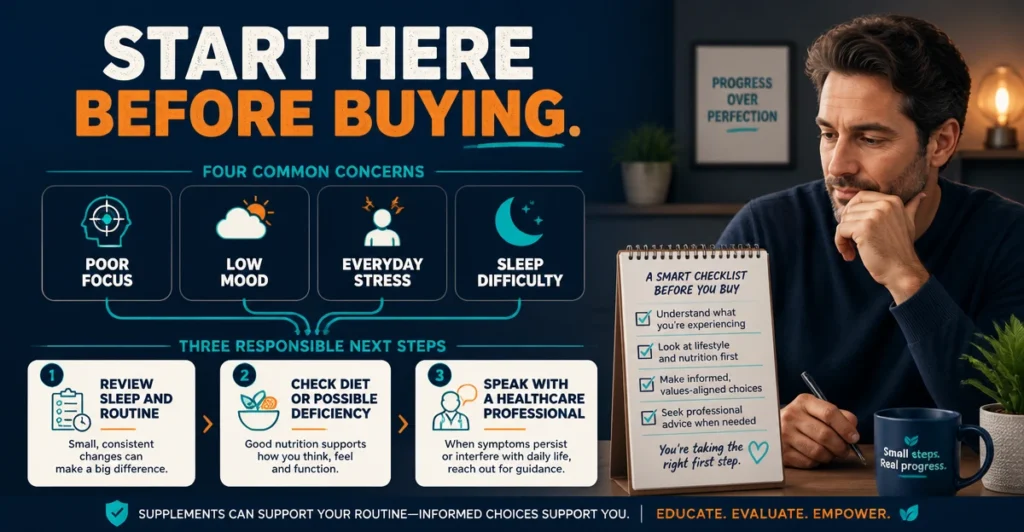
If your main concern is focus
Review sleep, food intake, hydration, caffeine use, workload and medication first. Consider evaluation when concentration problems are new, worsening or interfering with normal responsibilities.
B12, folate or iron are primarily relevant when diet, risk factors or testing suggests inadequate status. L-theanine has preliminary evidence but should not be presented as an ADHD treatment.
If your main concern is low mood
Consider how long the symptoms have lasted and whether they interfere with work, relationships, sleep or daily responsibilities.
Vitamin D, B12 and folate can be checked when clinically appropriate, but correcting a deficiency is different from treating depression. Omega-3 evidence remains uncertain.
If your main concern is everyday stress
Start with sleep, workload, boundaries, movement and practical stress-management habits. L-theanine and certain ashwagandha preparations have some supporting research, but neither is a replacement for treatment of an anxiety disorder.
If your main concern is sleep
Identify whether the problem is falling asleep, staying asleep, waking too early, shift work or an irregular schedule.
Melatonin may be more relevant to sleep timing or sleep onset than repeated waking. Persistent insomnia should be discussed with a healthcare professional, and CBT-I is the leading non-drug treatment.
How I compare mental wellness supplement labels
Mental wellness blends can combine vitamins, minerals, amino acids, stimulants and herbs in one serving. This makes label transparency particularly important.
I check:
- Every ingredient amount per complete serving
- The number of capsules, gummies or scoops required
- Whether caffeine or another stimulant is included
- The exact plant part and extract for herbal ingredients
- The precise strain for probiotic ingredients
- The elemental amount for minerals such as magnesium
- Possible overlap with multivitamins, sleep products and energy formulas
- Independent testing or quality information
- Medication and pregnancy warnings
- Whether the product makes unrealistic treatment claims
I am cautious with proprietary blends because they may hide the amount supplied for each ingredient.
My guide to comparing supplement ingredients before buying provides a complete label-reading process.
Can mental wellness supplements be combined?
Combining several calming, sleep or mood products can create more risk than the individual labels suggest.
Potential problems include:
- Duplicate magnesium, vitamin D or B vitamins
- Too much caffeine from several energy and focus products
- Excessive drowsiness from multiple calming ingredients
- Several products affecting serotonin
- Herb and medication interactions
- Difficulty identifying which product caused an adverse effect
Introduce no more than one new supplement at a time unless a healthcare professional recommends a specific combination.
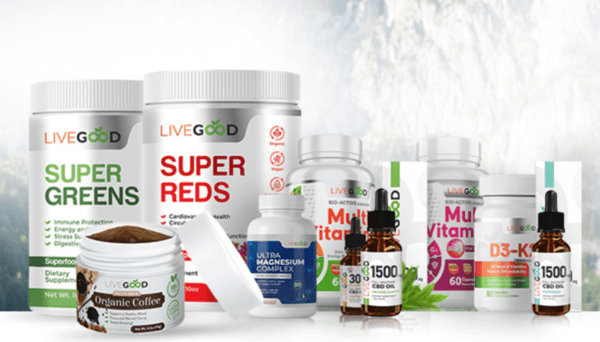
If you use LiveGood products, my guide to checking whether LiveGood supplements can be taken together explains how to identify overlapping ingredients.
When supplements are not the right next step
Supplements are not the right starting point when symptoms are severe, persistent, rapidly worsening or interfering with everyday life.
Seek qualified support if you experience:
- Low mood, hopelessness or loss of interest that persists
- Anxiety that prevents normal activities
- Severe or prolonged insomnia
- Sudden cognitive or personality changes
- Inability to complete ordinary responsibilities
- Increasing alcohol or substance use
- Thoughts of self-harm or suicide
According to the National Institute of Mental Health, severe symptoms lasting two weeks or more are a reason to seek professional help. Treatment options can include therapy, medication or both.
Immediate help: In the United States, call or text 988 for the Suicide & Crisis Lifeline. Call emergency services in a life-threatening situation. Outside the United States, contact your local emergency number or crisis service.
My practical conclusion
Mental wellness supplements work best as targeted tools—not broad promises.
Correcting a genuine B12, folate, iron, magnesium or vitamin D deficiency can matter. That does not mean high doses improve focus or mood in everyone.
Omega-3 is nutritionally important, but evidence for treating depression remains uncertain. L-theanine is promising for selected attention and stress outcomes, while evidence for oral GABA is limited. Some ashwagandha preparations may help with stress or sleep, but safety and product differences cannot be ignored.
Melatonin is best understood as a sleep-timing supplement rather than a mood product.
Start by defining the concern. Review sleep, food, movement, stress and medication. Test for deficiencies when appropriate, add only one product at a time and involve a professional when symptoms persist.
Always check the latest product label because ingredients, quantities, extracts, serving sizes and warnings can change.
Frequently asked questions
What supplements help with focus and concentration?
No supplement reliably improves concentration for everyone. B12, folate and iron may be relevant when a deficiency exists. L-theanine has preliminary evidence for selected attention measures, but it is not an established treatment for ADHD or persistent concentration problems.
Which supplements are best for mood?
No single mood supplement is universally effective. Correcting a nutrient deficiency can support normal function, but vitamin D, omega-3 and B vitamins have not been shown to work as general replacements for depression treatment.
Does vitamin D improve mood?
Low vitamin D status is associated with depression in observational research. However, clinical trials have not shown that vitamin D supplements reliably prevent depression or treat depressive symptoms. Correcting a diagnosed deficiency is a separate nutritional decision.
Does magnesium help with stress and anxiety?
Magnesium is essential for normal nerve and muscle function, but clinical evidence has not established it as a general treatment for anxiety or insomnia. It may be useful when intake or magnesium status is inadequate.
Does omega-3 help depression?
The evidence is uncertain. Reviews have found that any effect may be small and not clinically meaningful. Omega-3 should not replace therapy, prescribed medication or professional mental-health care.
Is L-theanine good for focus?
Recent research suggests L-theanine may affect some attention and reaction-time measures, but its clinical importance remains uncertain. Products combining it with caffeine should be judged partly by their total caffeine content.
Does ashwagandha reduce stress?
Some specific ashwagandha preparations may help with stress or insomnia. Results cannot automatically be applied to every product, and long-term safety is unclear. Ashwagandha can interact with medication and may be unsuitable during pregnancy or for people with certain thyroid, autoimmune or liver concerns.
Is melatonin good for anxiety or mood?
Melatonin is mainly involved in sleep timing. It may help certain circadian or sleep-onset problems, but it is not an established anxiety or mood treatment.
Can I combine magnesium, ashwagandha and melatonin?
Do not assume the combination is appropriate simply because each product is sold without a prescription. Combining calming ingredients may increase drowsiness or interact with medication. A pharmacist or healthcare professional can review the specific products and amounts.
When should I speak to a mental-health professional?
Seek professional support when low mood, anxiety, sleep disturbance or concentration problems persist, worsen or interfere with ordinary responsibilities. Obtain immediate help for thoughts of self-harm or suicide.
Sources and further reading
- NCCIH: Depression and Complementary Health Approaches
- NCCIH: Ashwagandha—Usefulness and Safety
- NCCIH: Melatonin—What You Need to Know
- NIH Office of Dietary Supplements: Vitamin D
- NIH Office of Dietary Supplements: Vitamin B12
- NIH Office of Dietary Supplements: Folate
- NIH Office of Dietary Supplements: Magnesium
- National Institute of Mental Health: Do I Need Help?
Affiliate disclosure: Some links on LiveGoodForLife.com may be affiliate links. If you make a qualifying purchase through one of these links, I may earn a commission at no additional cost to you. Affiliate relationships do not change how I discuss evidence, ingredient limitations, safety or label quality.
Medical and mental-health disclaimer: This article provides general educational information only. It is not medical advice and is not intended to diagnose, prevent, treat or cure depression, anxiety, ADHD, insomnia or another condition. Do not stop or change prescribed medication based on this article. Speak with a qualified doctor, pharmacist or mental-health professional before using supplements, particularly if you take medication, have a medical or psychiatric condition, are pregnant or breastfeeding, or are preparing for surgery. If you are in immediate danger or experiencing thoughts of suicide or self-harm, contact emergency services or a crisis service immediately.