Capsules vs Tablets: Which Is Better?
Last updated: August 9, 2026
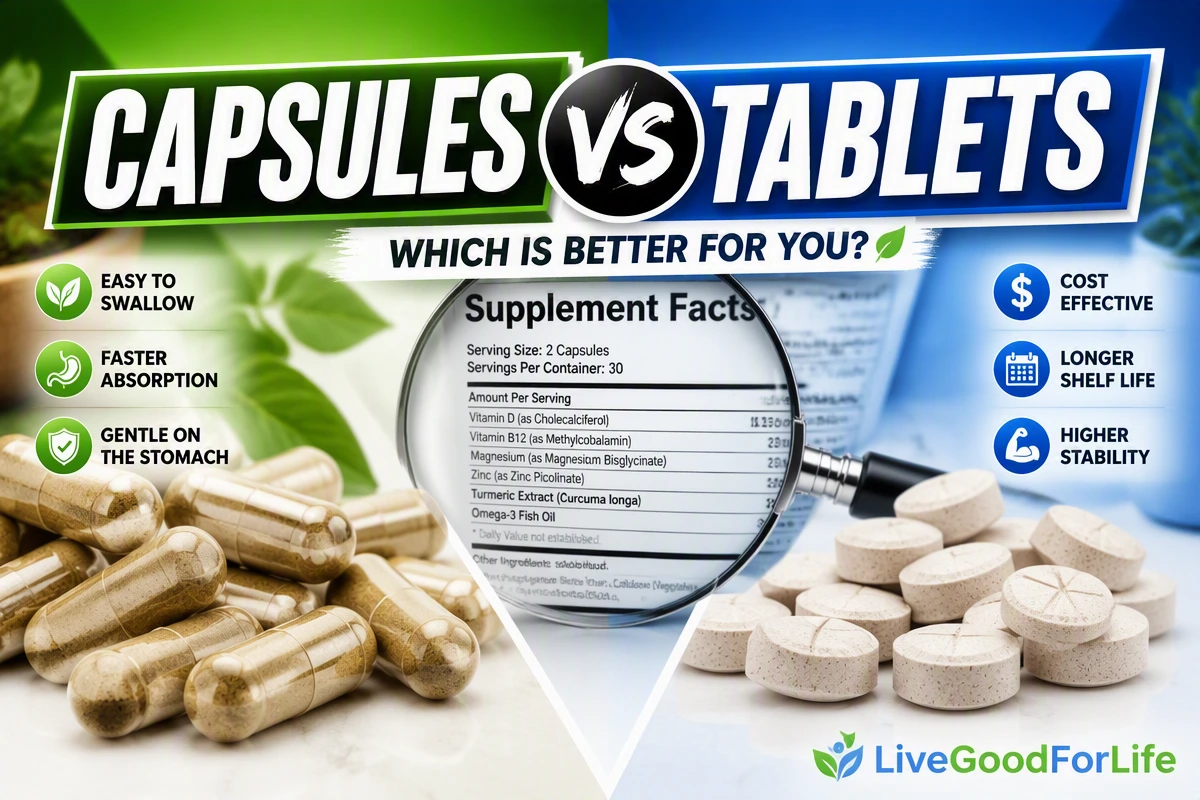
Capsules vs tablets is a simple-looking supplement question, but the answer can affect comfort, serving size, additives, convenience, and how easy the product is to take every day. One form is not automatically better for every person or every ingredient.
Quick answer: Capsules are usually easier to swallow, may break down faster, and often need fewer binders. Tablets can be compact, cost-effective, and stable, but they may use more binders, coatings, or compression ingredients. The best choice depends on the ingredient, dose, label quality, and your routine.
Important: This guide is educational only and is not medical advice. Supplements can interact with medications, health conditions, pregnancy, breastfeeding, surgery, and other supplements. Always read the current Supplement Facts label and ask a qualified healthcare professional if you are unsure.
Capsules vs Tablets: Quick Comparison
| Feature | Capsules | Tablets |
|---|---|---|
| Ease of swallowing | Often easier because of smooth shell | Can be harder if large or chalky |
| Added ingredients | May need fewer binders | Often needs binders, coatings, or compression aids |
| Serving size | May require more capsules for bulky ingredients | Can pack ingredients tightly into one tablet |
| Taste | Usually hides bitter ingredients well | May have taste if chewable or uncoated |
| Cost | Can cost more depending on formula | Can be more cost-effective to manufacture |
| Best use | Herbs, probiotics, enzymes, targeted formulas | Vitamins, minerals, compact daily formulas |
If you want the simplest rule, choose capsules when comfort and cleaner-looking labels matter most. Choose tablets when the label is strong, the serving size is practical, and you do not mind the tablet format.
What Is a Capsule?
A capsule is a supplement form where the active ingredients are placed inside a shell. Capsules may use gelatin or plant-based materials, depending on the product. They are common for vitamins, herbs, probiotics, enzymes, amino acids, and specialty wellness formulas.
Capsules are popular because they are usually smooth, easy to swallow, and good at hiding taste. They can also make sense when an ingredient does not compress well into a tablet.
What Is a Tablet?
A tablet is made by compressing ingredients into a solid shape. Tablets may be coated, scored, chewable, or uncoated depending on the product. Many multivitamins, minerals, and single-nutrient supplements are sold as tablets.
Tablets can be practical because they are compact and stable. A good tablet can be a smart choice when the formula is transparent, the serving size is realistic, and the added ingredients are clearly listed.
Absorption: Are Capsules Better Than Tablets?
Capsules are often thought of as easier to break down, but absorption is not decided by form alone. The ingredient, dose, nutrient form, product design, food timing, digestion, and individual health factors all matter. A high-quality tablet can be useful, and a poor-quality capsule can still be a weak product.
Instead of asking whether capsules always absorb better than tablets, ask a better question: does the product provide the right ingredient in a practical serving size, with clear directions, realistic claims, and a label you can understand?
Fillers, Binders, and Coatings
This is one of the biggest differences between capsules and tablets. Tablets usually need ingredients that help bind, compress, coat, or stabilize the product. Capsules may also contain added ingredients, but the list can sometimes be shorter.
| Label item | Why to check it |
|---|---|
| Other ingredients | Shows binders, fillers, coatings, colors, or capsule shell materials |
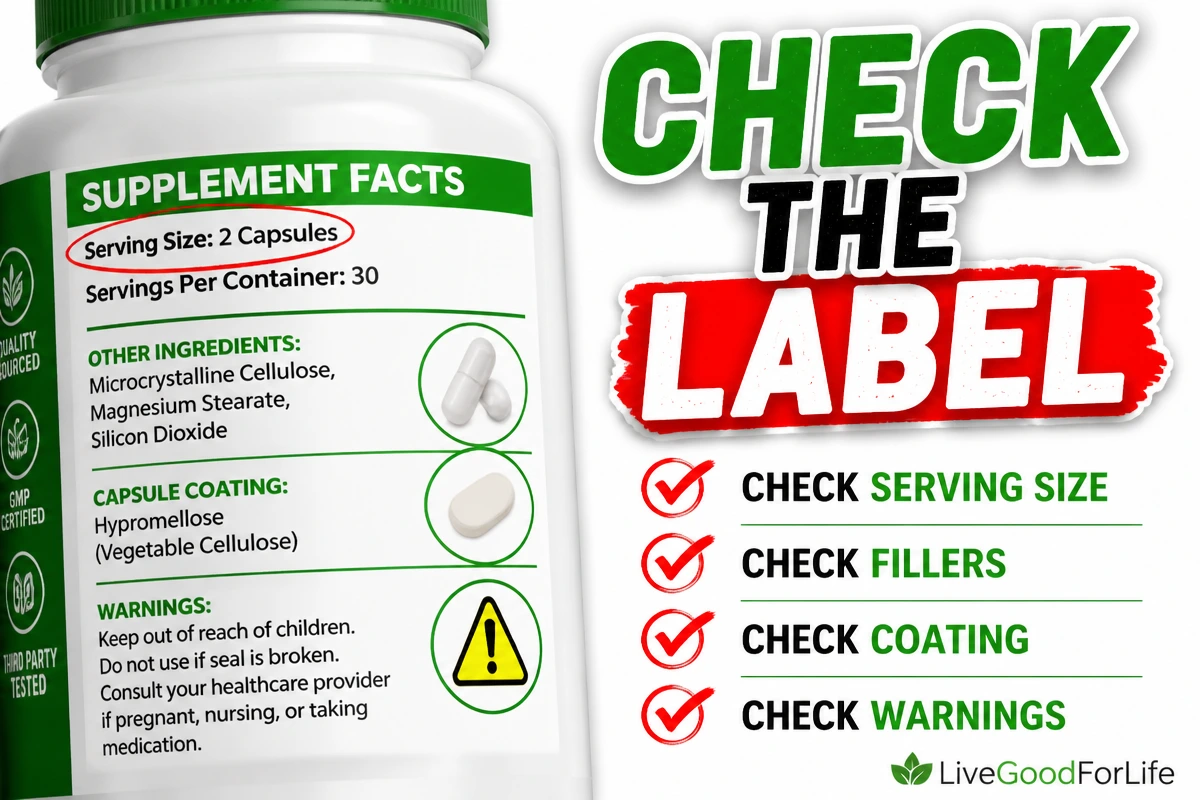
| Serving size | One serving may be one tablet, two tablets, or several capsules |
| Ingredient form | Minerals and vitamins can come in different forms |
| Allergens | Check gelatin, soy, dairy, gluten, fish, shellfish, and other warnings |
| Directions | Some products should be taken with food or spaced from medication |
| Claims | Avoid products promising to treat, cure, or prevent disease |
The FDA notes that dietary supplements can come in forms such as tablets, capsules, softgels, liquids, and powders. Whatever the form, a supplement should be labeled as a dietary supplement and should give you enough information to compare it responsibly.
When Capsules Make More Sense
- You dislike large, hard tablets.
- You want a smoother supplement to swallow.
- The ingredient has a strong taste or smell.
- You prefer formulas with fewer binders or coatings.
- The product is a probiotic, enzyme, herbal blend, or targeted formula.
- You are comparing a product where the label is clear and the dose makes sense.
Capsules are not perfect for every product. If the ingredient requires a large amount, you may need several capsules per serving. That can affect value, convenience, and consistency.
When Tablets Make More Sense
- You want a compact daily supplement.
- The tablet is easy for you to swallow.
- The serving size is realistic.
- The label clearly lists the active ingredients and other ingredients.
- The product has sensible directions and warnings.
- The cost per serving is better without sacrificing label quality.
Tablets can be a good option when the formula is well made and the label is transparent. The problem is not the word tablet. The problem is choosing a product without checking the serving size, coating, fillers, and actual ingredient amounts.
Best Choice by Supplement Goal
| Your goal | Compare first | Why |
|---|---|---|
| Simple daily vitamin routine | Capsules or tablets | Both can work if the label is clear |
| Mineral support | Tablets or capsules | Mineral form and tolerance matter more than format alone |
| Herbal formula | Capsules | Capsules can hide taste and work well for blends |
| Probiotics or enzymes | Capsules | Common format for targeted digestive formulas |
| Low-additive preference | Capsules | May use fewer binders or coatings |
| Budget comparison | Depends on label | Cost per serving matters more than bottle price |
| Trouble swallowing pills | Smaller capsules, powders, or liquids | Comfort and consistency matter |
Capsules vs Tablets vs Powders
Capsules and tablets are not the only options. Powders can be better for nutrients that need larger servings, such as protein, greens, fiber, collagen, or electrolytes. Gummies may help with taste, but they often come with added sugar and smaller active amounts.
For a wider comparison, read Capsules vs Powders vs Gummies. You can also compare value with How to Compare Supplement Price Per Serving and avoid overlap with Supplement Stack Builder.
Label Checklist Before You Buy
- Check the Supplement Facts label, not only the front claim.
- Look at serving size and servings per container.
- Compare active ingredient amount per serving.
- Read the other ingredients list.
- Check whether the capsule shell is gelatin or plant-based if that matters to you.
- Check tablet coatings, colors, sweeteners, and binders.
- Look for allergen statements and safety warnings.
- Avoid disease-treatment promises and unrealistic claims.
- Ask whether the form fits your daily routine.
Common Mistakes
- Assuming capsules are always better than tablets.
- Assuming tablets are lower quality just because they are tablets.
- Ignoring serving size when comparing prices.
- Skipping the other ingredients list.
- Choosing the cheapest bottle without checking dose strength.
- Taking multiple products with overlapping ingredients.
- Ignoring medication, surgery, pregnancy, breastfeeding, or health-condition cautions.
Where LiveGood Products Fit
LiveGood products use different formats depending on the type of supplement and the goal. Capsules can fit daily essentials and targeted wellness formulas. Powders can make sense for larger servings such as greens, reds, protein, collagen, or hydration. The best choice is the one that gives you a clear label, sensible serving size, fair value, and a routine you can actually follow.
Useful next reads: LiveGood Product Packs vs Single Products, Can You Take LiveGood Supplements Together?, and 7 Multivitamin Label Red Flags.
Explore LiveGood wellness products
Frequently Asked Questions
Are capsules better than tablets?
Capsules can be easier to swallow and may use fewer binders, but they are not always better. Ingredient quality, serving size, label transparency, and product design matter more than form alone.
Do capsules absorb faster than tablets?
Capsules may break down differently than tablets, but absorption depends on the ingredient, formula, dose, food timing, and personal digestion. No form is automatically best for every supplement.
Are tablets bad because they have fillers?
No. Many tablets use binders or coatings for practical reasons. The key is to read the other ingredients list and decide whether the formula, serving size, and label quality fit your needs.
Which is easier to swallow, capsules or tablets?
Many people find capsules easier because they are smooth. However, size matters. A very large capsule can still be difficult, and a small coated tablet may be easy for some people.
Are vegetarian capsules better?
Vegetarian capsules can be helpful for people avoiding gelatin, but they are not automatically higher quality. Check the full Supplement Facts label, active ingredients, and other ingredients.
Should I choose capsules or tablets for vitamins?
Either can work. Choose based on the nutrient form, dose, serving size, added ingredients, directions, safety warnings, and whether you can take it consistently.
Final Thoughts
The best choice between capsules vs tablets depends on the supplement, the label, and your daily routine. Capsules are often comfortable and simple. Tablets can be compact and practical. Neither form guarantees a better supplement by itself.
Before buying, compare serving size, active ingredients, other ingredients, warnings, cost per serving, and whether the form is easy enough for you to use consistently.