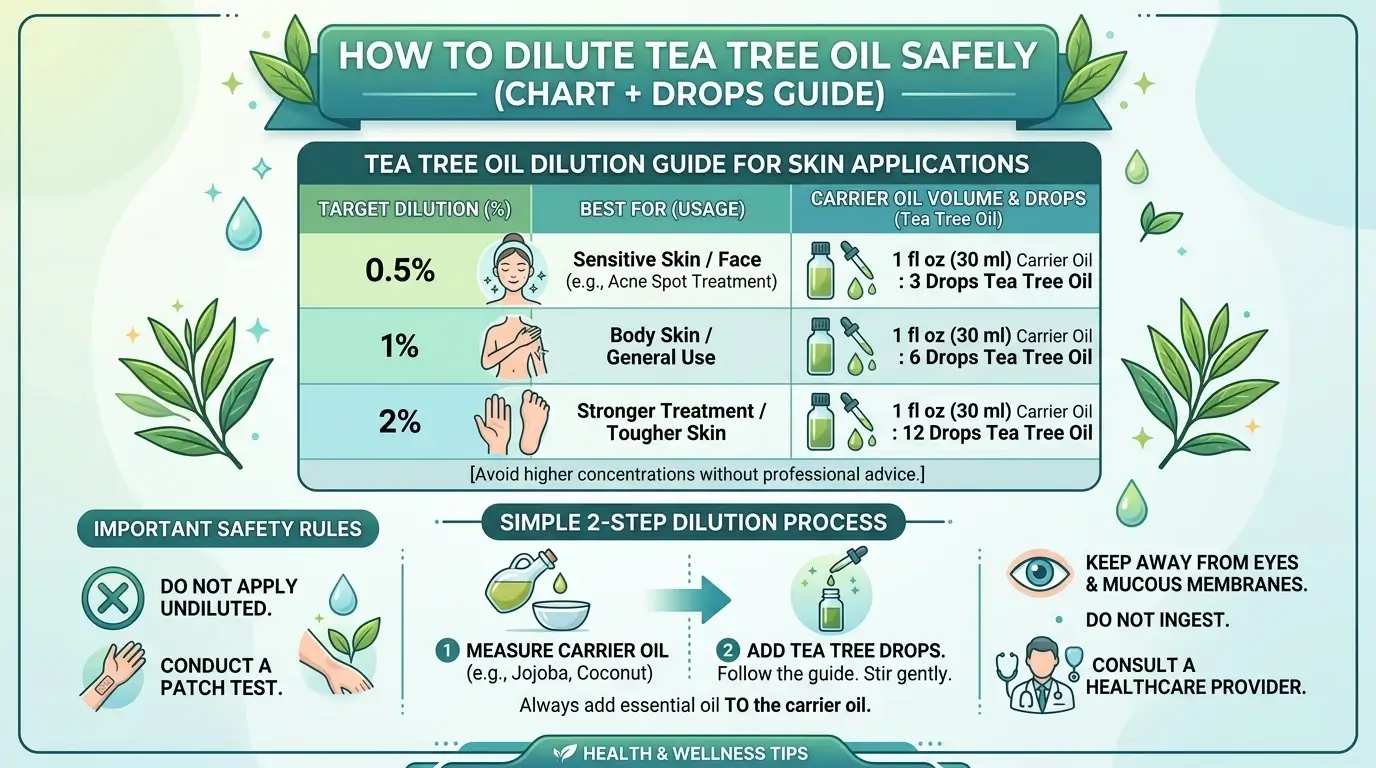
How to Dilute Tea Tree Oil Safely (Chart + Drops Guide)
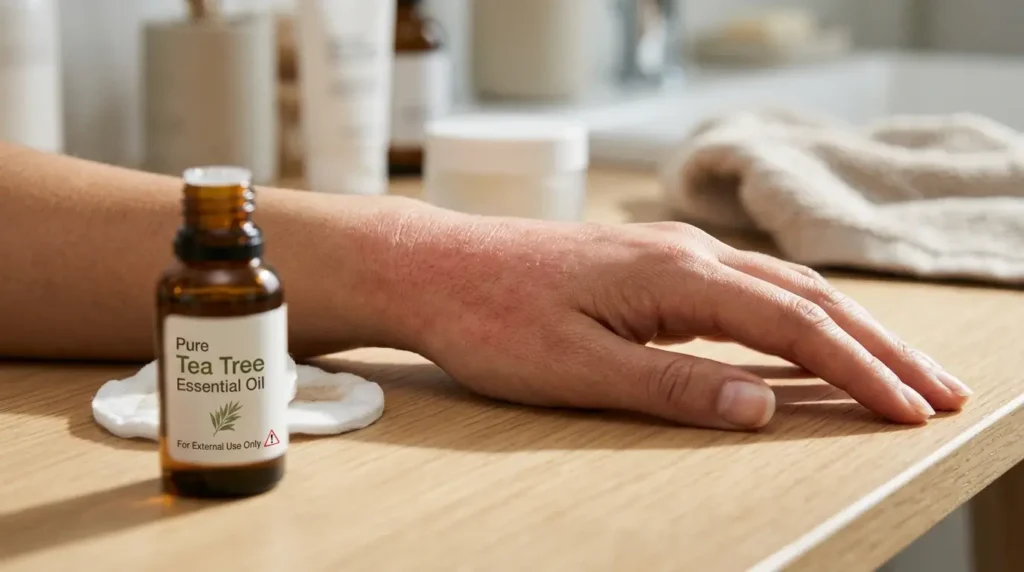
You bought the tea tree oil. You dabbed a drop on a pimple. Ten minutes later, your skin felt like it was on fire. 🔥
If that’s familiar — you’re not alone. Tea tree oil is one of the most useful natural oils you can own… and one of the most commonly misused. The problem is almost never the oil itself. It’s the dilution.
In this guide, I’ll show you exactly how to dilute tea tree oil for your face, body, scalp, and home — with specific drop counts, a printable ratio chart, and the five mistakes that cause 90% of irritation cases. No chemistry jargon. No vague “a few drops” advice. Just numbers that work.
By the end, you’ll know:
- ✅ How many drops of tea tree oil go into 1 teaspoon vs. 1 tablespoon of carrier oil
- ✅ Which carrier oil to start with (and which to avoid as a beginner)
- ✅ The exact percentages for face, scalp, body, and cleaning
- ✅ How to patch test the right way — most people do this wrong
- ✅ When tea tree oil isn’t safe (broken skin, kids, pets, pregnancy)
Let’s get into it.
Sources & References
- NCCIH, National Center for Complementary and Integrative Health. Tea Tree Oil. nccih.nih.gov
- Mayo Clinic. Tea Tree Oil. mayoclinic.org
- Poison Control, American Association of Poison Control Centers. Tea Tree Oil: Remedy and Poison. poison.org
- Kairey L, et al. Efficacy and safety of Melaleuca alternifolia (tea tree) oil for human health — A systematic review of randomized controlled trials. Frontiers in Pharmacology. 2023;14:1116077.
- Satchell AC, et al. Treatment of dandruff with 5% tea tree oil shampoo. Journal of the American Academy of Dermatology. 2002;47(6):852–855.
- Hammer KA. Treatment of acne with tea tree oil (melaleuca) products: A review of efficacy, tolerability and potential modes of action. International Journal of Antimicrobial Agents. 2015;45(2):106–110.
- ISO 4730:2017. Oil of Melaleuca, terpinen-4-ol type (Tea Tree Oil) — Requirements and test methods. International Organization for Standardization.
- MedlinePlus, U.S. National Library of Medicine. Tea Tree Oil. medlineplus.gov
📋 Quick Answer
For a 1% dilution — the safest starting point for skin:
👉 3 drops of tea tree oil per 1 tablespoon of carrier oil, or 1 drop per teaspoon.For most people, start at 0.5%–1%, patch test for 24 hours, and only increase if your skin tolerates it. Use jojoba oil as your beginner carrier — it’s the closest match to your skin’s natural sebum and the least likely to clog pores.
That’s the whole game. Everything below is the why and the how to do it without making the rookie mistakes.
📌 Key Facts at a Glance
- Primary active compound: terpinen-4-ol. It makes up 35–48% of tea tree oil by the ISO 4730 international quality standard and is responsible for most of the oil’s documented antimicrobial activity.
- Tea tree oil contains more than 100 components. Other notable ones include γ-terpinene (~17–18%) and α-terpinene (~8–13%). Quality oils are standardized to minimum terpinen-4-ol levels.
- Evidence for acne is limited and preliminary. NCCIH states: “A small amount of research suggests that tea tree oil might be helpful for acne, but more evidence is needed before definite conclusions can be reached.” The 2023 systematic review (Frontiers in Pharmacology) similarly concluded larger trials are still needed.
- The best-evidenced application is dandruff. One RCT (Satchell et al., 2002, 126 participants) found a 5% tea tree oil shampoo significantly reduced scalp involvement and severity of dandruff compared to placebo — the most clinically specific human trial for tea tree oil in a hair care context.
- Contact dermatitis is a documented risk from undiluted use. It is one of the most consistently reported adverse reactions in clinical literature and the main reason NCCIH and dermatologists emphasize proper dilution.
- Tea tree oil is toxic if swallowed. Confirmed by Mayo Clinic and Poison Control (800-222-1222). Symptoms of ingestion include ataxia, breathing difficulties, and in serious cases, coma. Seek immediate medical attention if ingested.
- Toxic to cats AND dogs, whether applied topically or ingested. Never apply to pets without veterinary guidance.
- No tea tree oil product is FDA-approved to treat, diagnose, cure, or prevent any skin condition or disease.
What “Diluting” Tea Tree Oil Actually Means
Let’s strip away the confusion.
Tea tree oil — Melaleuca alternifolia — is a highly concentrated essential oil steam-distilled from the leaves of an Australian tree. A single 15ml bottle can contain the active compounds of dozens of pounds of plant material. That’s why it works. That’s also why it bites.
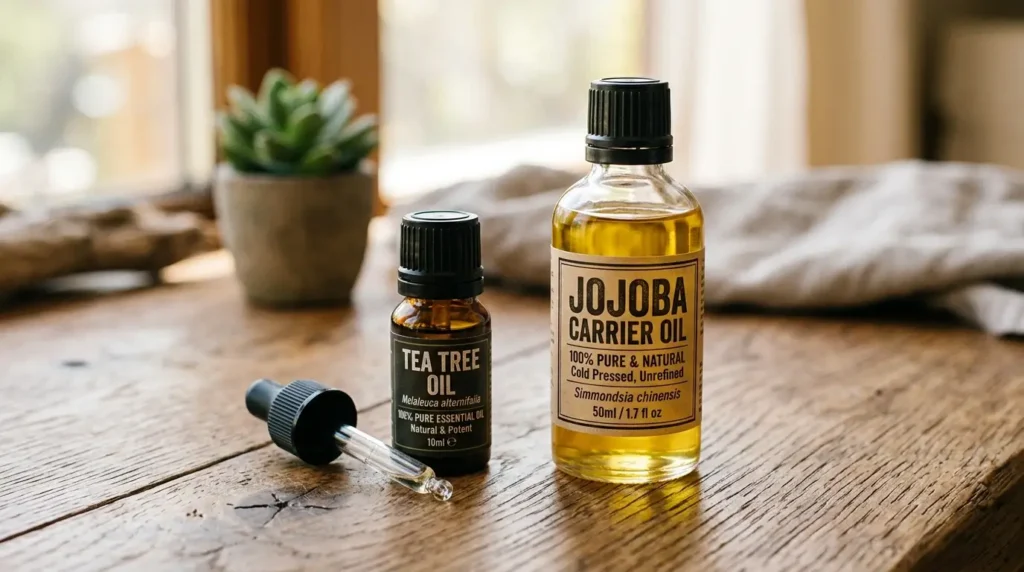
Diluting tea tree oil simply means mixing it with a “carrier oil” — a gentle, fatty oil like jojoba or fractionated coconut — so the active compounds spread evenly across your skin instead of slamming one tiny spot.
Think of it like espresso:
- A shot of espresso straight = intense, bitter, hard on your stomach
- The same shot in 8oz of water = a satisfying Americano
Same caffeine. Different experience. Dilution doesn’t weaken the benefit — it makes the benefit usable.
Why Dilution Matters (The Science, Simplified)
Research published in dermatology journals consistently shows that tea tree oil may support skin health — particularly for blemish-prone areas — when used at properly diluted concentrations. The two compounds doing most of the work, terpinen-4-ol and α-terpineol, are also the same compounds responsible for irritation when applied at full strength.
Here’s what skipping dilution actually does to your skin:
| Problem | Why It Happens |
|---|---|
| Burning, stinging | Concentrated terpenes overwhelm the skin barrier |
| Redness & inflammation | Capillary irritation from undiluted oil |
| Dryness & flaking | Disruption of the skin’s natural lipid layer |
| Long-term sensitization | Repeated exposure can permanently increase reactivity |
| Contact dermatitis | One of the most-reported reactions in clinical case studies |
That last one matters most: once you sensitize your skin to tea tree oil, you may not be able to use it ever again. That’s why the “more is better” mindset is so dangerous — you can burn yourself out of a tool that would have helped you for decades.
The good news? Done correctly, tea tree oil becomes one of the cheapest, most versatile additions to a natural routine. You can read more about its full range of uses in my deep dive on 10 incredible benefits of tea tree oil and how to use it.
#1: Your Beginner Toolkit
Before you measure a single drop, get these three things right.
1. Pick the Right Carrier Oil
Not all carrier oils are created equal. Some sit on top of your skin. Some clog pores. Some go rancid in a month.
Here’s a no-fluff comparison:
| Carrier Oil | Best For | Notes |
|---|---|---|
| Jojoba ⭐ | Face, acne-prone skin, beginners | Closest to skin’s natural sebum. Won’t clog pores. Long shelf life. |
| Fractionated coconut | Body, scalp, daily use | Lightweight, doesn’t solidify, no scent of its own |
| Sweet almond | Sensitive skin, body massage | Gentle and affordable, but shorter shelf life |
| Olive oil | Body only | Heavy. Not great for face. Fine in a pinch. |
| Regular (solid) coconut oil | Body, hair masks | Solidifies under 76°F. Comedogenic for some. |
| Argan oil | Scalp, hair ends, mature skin | Pricier but excellent for hair |
My recommendation for 95% of beginners: jojoba. It mimics your skin’s natural oil so well that it absorbs cleanly without leaving that “I just rubbed butter on my face” feeling.
2. Get a Glass Dropper Bottle
Tea tree oil degrades plastic over time. If your dilution is going to sit in a bottle for more than a few weeks, store it in amber or cobalt glass (the dark color blocks UV light, which oxidizes the active compounds). A 30ml dropper bottle with measurement markings is under $5 and changes everything.
3. Understand “% Dilution” — In Plain English
This is the part that scares people away. It shouldn’t.
A “percentage dilution” just means: how much of the bottle is tea tree oil vs. carrier oil.
- 0.5% = ultra gentle (sensitive areas, daily use, kids over 6 with supervision)
- 1% = standard for face and daily skin use
- 2% = body, occasional spot treatment, scalp
- 3% = scalp masks, deodorants, less frequent use
- 5%+ = rinse-off products only (shampoos, soaps), short-contact use
Rule of thumb: if you’re not 100% sure, default to 1%. You can always go up. Going down means starting over.
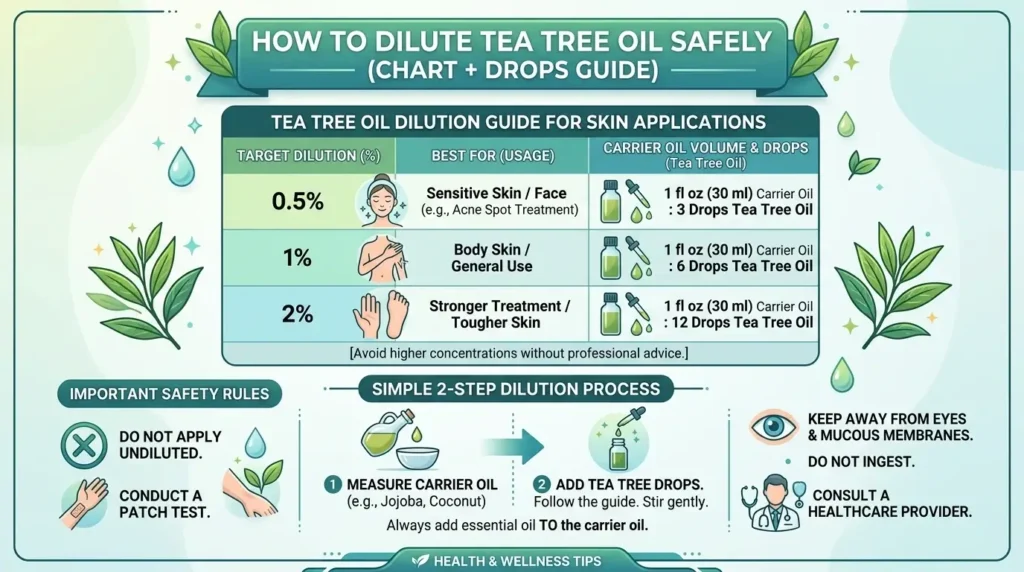
#2: The Exact Dilution Chart (Save This)
This is the section you came here for. Bookmark it, screenshot it, print it.
🧪 The Tea Tree Oil Dilution Chart
| Use Case | Dilution % | In 1 Teaspoon (5ml) | In 1 Tablespoon (15ml) | In 1 Ounce (30ml) |
|---|---|---|---|---|
| Face / spot treatment | 0.5%–1% | 1 drop | 3 drops | 6 drops |
| Body / general skin | 1%–2% | 1–2 drops | 3–6 drops | 6–12 drops |
| Scalp / hair mask | 2%–3% | 2–3 drops | 6–9 drops | 12–18 drops |
| DIY shampoo / wash | 3%–5% | 3–5 drops | 9–15 drops | 18–30 drops |
| Home cleaning spray | n/a | — | 10–15 drops | 20–30 drops in 8oz spray bottle |
How I Memorize It
3 drops per tablespoon = 1% dilution.
Want 2%? Double it. Want 0.5%? Halve it (round down).
That single sentence covers 90% of real-world use cases.
Volume Cheat Sheet
If you forget kitchen conversions:
- 1 teaspoon (tsp) = 5ml
- 1 tablespoon (tbsp) = 15ml = 3 teaspoons
- 1 fluid ounce (fl oz) = 30ml = 2 tablespoons
If Numbers Confuse You, Use This Quick Calculator.
Tea Tree Oil Dilution Calculator
Tea tree oil is powerful and easy to overuse. Choose your use case, enter your carrier/base amount, and this tool will show you a safer starting point.
Your exact mix
Tea Tree Oil Dilution Cheat Sheet
| Use Case | Beginner Strength | Normal Strength | Important Warning |
|---|---|---|---|
| Face / acne spot | 0.5% | 1% | Never apply undiluted to pimples |
| Sensitive skin | 0.25% | 0.5% | Avoid broken or inflamed skin |
| Body skin | 1% | 2% | Do not cover large areas at high strength |
| Underarm | 0.5% | 1–2% | Avoid right after shaving |
| Scalp | 1% | 2% | Wash out after 20–30 minutes |
| Shampoo | 1% | 2–5% | Rinse well and avoid eyes |
| Foot / nail care | 1% | 2–3% | Not a replacement for medical treatment |
| Bath | Do not use direct drops | Use proper dispersant | Oil does not mix with bathwater |
| Diffuser | 3 drops | 3–5 drops | Ventilate room; avoid pets |
| Cleaning spray | 10 drops | 10–15 drops | Never mix with bleach |
Pick your use case and the amount of carrier oil, and it will estimate a safer starting dilution.
Research & safety basis: Essential oils should not be applied undiluted to skin, and dilution is one of the key safety steps for reducing irritation risk. Tea tree oil has been studied in 5% formulations for acne and dandruff, but that does not mean pure oil should be applied directly. Tea tree oil can irritate skin at higher concentrations and is toxic if swallowed, so this calculator is for external, educational use only.
- Essential oil dilution guidance: Tisserand Institute
- Tea tree oil acne research: 5% tea tree oil gel studies
- Dandruff research: 5% tea tree oil shampoo study
- Safety: tea tree oil may irritate skin at higher concentrations and should not be ingested
#3: How to Use Tea Tree Oil on Face, Skin & Scalp
Theory is nice. Let’s get specific.
🧴 For Your Face (Most Sensitive — Treat Like Medicine)
Your face is not a canvas. It’s a sensitive organ with a barrier you absolutely do not want to damage.
The recipe:
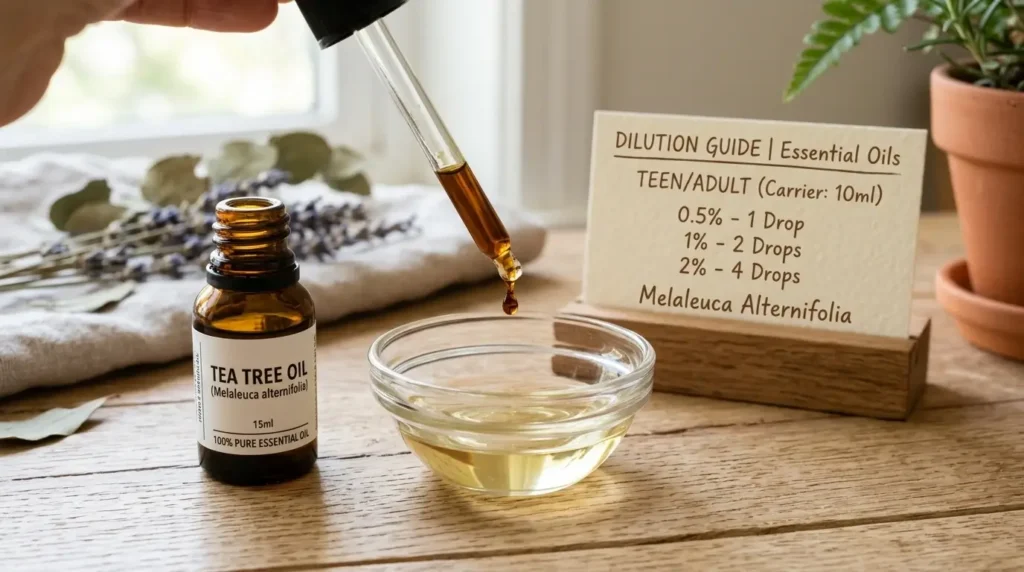
- Add 1 drop of tea tree oil to 1 teaspoon of jojoba oil in a small dish.
- Stir with a clean cotton swab or toothpick.
- Dip a fresh cotton swab and dab only on the blemish — not the surrounding skin.
- Leave on overnight. Rinse in the morning.
Don’t:
- ❌ Spread it across your whole face like a moisturizer
- ❌ Apply more than once per day at first
- ❌ Use it on top of strong actives (retinol, AHA/BHA, benzoyl peroxide) on the same night
Pro tip: if you’re already using a benzoyl peroxide or salicylic acid product, you don’t need tea tree oil too. Doubling up irritates the skin without doubling the benefit.
💆 For Your Scalp (Dryness, Flakes, Buildup)
Tea tree oil shines on the scalp. The scalp is sturdier than facial skin, and the rinse-off nature of hair routines makes higher concentrations safe.
The recipe:
- Mix 6–9 drops of tea tree oil with 1 tablespoon of jojoba or fractionated coconut oil (this gives you ~2–3%).
- Section damp hair and apply directly to the scalp with your fingertips.
- Massage gently for 1–2 minutes.
- Leave on for 20–30 minutes.
- Shampoo out thoroughly. Repeat 1–2x per week.
Easy hack: add 5 drops directly to a quarter-sized dollop of shampoo in your palm, then wash as usual. Lower commitment, still effective.
🧴 For Your Body
Most bodies fall in the 1%–2% range. Common applications include:
- After-shower spot care for backne or body breakouts
- Natural deodorant base (combined with magnesium or baking soda)
- Foot soak booster — 5 drops in a basin of warm water with Epsom salt
If you’re new to essential oils overall, my essential oils tips for beginners walks through how to layer them safely into a routine.
🧹 For Cleaning Around the House
Tea tree oil is one of the most effective natural cleaners — and home use lets you skip the dilution math entirely.
All-purpose spray:
- 8oz water
- 1oz white vinegar
- 10–15 drops tea tree oil
- (Optional) 5 drops lemon or eucalyptus oil
Shake before each use. Great for bathrooms, garbage areas, gym bags, and trash bins. Don’t use on natural stone (vinegar etches marble and granite).
#4: The Drops-Per-Spoon Math (Memorize This)
If you remember nothing else, remember this.
The Universal Conversion
Most essential oil bottles dispense roughly 20 drops per 1ml. So:
- 1 teaspoon (5ml) = 100 “drops worth” of liquid
- 1 tablespoon (15ml) = 300 “drops worth”
- 1% of 300 = 3 drops per tablespoon = 1% dilution ✅
The 3-Drop Rule
Every 3 drops of tea tree oil per 1 tablespoon of carrier = 1% increase in dilution.
So:
- 3 drops/tbsp = 1%
- 6 drops/tbsp = 2%
- 9 drops/tbsp = 3%
That’s it. That’s the math. Forget the calculator apps.
Quick Mental Recipe Builder
You want a 2% scalp oil in 2 tablespoons (30ml)?
- 2 tbsp = 6 doublings of “tablespoon × 1%” = 6 × 2 = 12 drops
- Pour 2 tbsp jojoba into a 30ml dropper bottle
- Add 12 drops tea tree oil
- Cap, shake, label with date
You just made a salon-grade scalp treatment for under a dollar per use.
#5: 5 Mistakes That Cause Burns & Breakouts
I’ve seen these five mistakes in every single “tea tree oil ruined my skin” post on Reddit, in DMs, and in beginner forums. Avoid them and you avoid 90% of bad outcomes.
❌ Mistake #1: Applying It “Neat” (Undiluted)
You’ll see this advice in old blogs: “Just dab a tiny bit straight on the pimple.”
It works… until it doesn’t. Direct application is the #1 cause of contact dermatitis from tea tree oil, and it’s the fastest way to develop a permanent sensitivity. Always dilute. No exceptions for “just one spot.”
❌ Mistake #2: Skipping the Patch Test
A patch test takes 24 hours. Skipping it can cost you weeks of recovery.
The right way:
- Mix at your intended dilution.
- Apply a small amount to the inside of your forearm.
- Cover with a bandage.
- Wait 24 hours. No itch, no redness, no bumps? You’re good.
If you react to a 1% dilution, drop to 0.5% or stop entirely.
❌ Mistake #3: “More = Faster Results”
This is the costliest mistake. Tea tree oil isn’t dose-dependent in the way that, say, caffeine is. Once you hit an effective concentration, going higher doesn’t speed anything up — it just damages your skin barrier. A blemish doesn’t care if it’s hit with 1% or 10%. The terpinen-4-ol works the same. The 10% just hurts.
❌ Mistake #4: Applying to Broken Skin
Open pimples, scabs, eczema flares, freshly shaved skin — all off-limits. Applying tea tree oil to broken skin bypasses your barrier entirely and delivers concentrated terpenes straight to inflamed tissue. Wait until the skin is intact, then proceed.
❌ Mistake #5: Using Old or Oxidized Oil
Tea tree oil oxidizes with light, heat, and air exposure. Oxidized tea tree oil is significantly more irritating than fresh oil — research has flagged it as the actual cause of many “tea tree allergies.” Symptoms: a sharper, almost paint-thinner-like smell, and a yellow-brown tint.
Rules:
- Buy small bottles (15ml is plenty for one person for ~6 months)
- Store in amber glass, away from heat
- Replace 6–12 months after opening
- Never store in plastic long-term
#6: Pro Tips for Long-Term Use
Once you’ve nailed the basics, these habits separate beginners from people who actually get results.
🔬 Start Low, Stay Low
Most people get the same results from 1% as they would from 3% — without the irritation. Don’t escalate unless you’ve used 1% consistently for 4–6 weeks and tolerated it perfectly.
⏰ Consistency > Intensity
A 1% dilution used three times a week beats a 5% dilution used once. Tea tree oil’s benefits compound over weeks, not hours.
🧪 Pre-Mix in Small Batches
Mix only what you’ll use in 4–6 weeks. Smaller batches = fresher actives = better results. Date your bottles.
🌿 Layer Strategically
Tea tree oil pairs beautifully with:
- Lavender (calming, helps reduce irritation potential)
- Fractionated coconut (lightweight everyday carrier)
- Aloe vera gel (water-based, great for face mists)
Pairings to avoid for sensitive skin: undiluted citrus oils (lemon, bergamot) — they’re photosensitizing.
📓 Track Your Skin
Keep a one-line note in your phone after each use: “April 12 — 1%, scalp, 30 min, no itch.” Over a month, you’ll see exactly what your skin tolerates.
Special Cases: Pregnancy, Kids, Pets & Sensitive Skin
This is the section most blogs skip. It matters most.
🤰 Pregnancy & Nursing
The research on tea tree oil during pregnancy is limited and mixed. Most aromatherapists recommend avoiding topical tea tree oil during the first trimester and using only very low dilutions (≤0.5%) afterward, on small areas. Always clear it with your OB-GYN first.
👶 Kids
- Under 2: Avoid entirely. Their skin barrier and respiratory systems are too sensitive.
- 2–6: Only with pediatric guidance. Maximum 0.25%–0.5% dilution. Never on the face.
- 6–12: 0.5%–1% on body. Patch test always.
🐱 Pets — Important Warning
Tea tree oil can be toxic to cats even at low concentrations because cats lack the liver enzymes to metabolize certain terpenes. Dogs tolerate it better but can still be poisoned by undiluted oil. Never apply tea tree oil to pets without veterinary guidance, and don’t diffuse it heavily in small rooms where cats live.
🌸 Sensitive or Reactive Skin
If you have rosacea, eczema, or known fragrance sensitivity:
- Start at 0.25% (one drop in 2 tablespoons of jojoba)
- Patch test for a full 48 hours, not 24
- If unsure, use a pre-formulated tea tree product instead of mixing your own
Choosing a Quality Tea Tree Oil & Carrier Oil
Here’s the dirty secret of the essential oil industry: a cheap tea tree oil isn’t a deal — it’s a different product. Many bargain-bin oils are diluted with fillers, harvested from the wrong species (Melaleuca cajuputi instead of alternifolia), or oxidized before they ever reach the shelf.
What to Look for on the Label
- ✅ Botanical name: Melaleuca alternifolia (not “tea tree blend”)
- ✅ Steam-distilled from leaves
- ✅ 100% pure essential oil — no carrier added
- ✅ Country of origin listed (Australia is the gold standard)
- ✅ Dark amber or cobalt glass bottle
- ✅ Batch number and expiration date
- ✅ Terpinen-4-ol content ideally listed (good oils are 30%+)
Red Flags
- ❌ Clear glass or plastic bottles
- ❌ “Fragrance oil” or “scented oil” anywhere on the label
- ❌ Suspiciously cheap (under $5 for 15ml of pure oil is almost always a fake)
- ❌ No country of origin
- ❌ “Aromatherapy use only” — usually code for “not pure enough for skin”
Why I Use LiveGood Essential Oils
Full transparency: I’m a LiveGood independent affiliate, and I personally use and recommend their tea tree oil.
Three reasons:
- Pure Melaleuca alternifolia — no blends, no fillers, in dark glass
- Member pricing — costs less than most “natural” brands at the grocery store
- The Essential Oil Box bundles tea tree with lavender, peppermint, eucalyptus, lemon, and frankincense — perfect if you’re building a starter collection
If you want to skip the label-reading homework, you can check the LiveGood essential oils lineup here — member pricing kicks in if you become a LiveGood member, and the savings usually pay for the membership in the first month.
For carrier oils, jojoba is widely available at health food stores, Amazon, or any decent natural-products retailer.
✅ Key Takeaways
- Tea tree oil is powerful — and that’s exactly why dilution matters. Concentrated oil isn’t “stronger medicine,” it’s just more irritation.
- 1% is the safe starting point for almost everyone. That’s 3 drops per tablespoon of carrier oil.
- Jojoba is the best carrier oil for beginners — closest to skin’s natural sebum, won’t clog pores, long shelf life.
- Always patch test for 24 hours at the dilution you intend to use.
- Consistency beats intensity — a 1% dilution used three times a week outperforms a 5% dilution used once.
- Avoid tea tree oil on broken skin, in the first trimester of pregnancy, on cats, and on children under 2.
- Buy small, store in dark glass, replace within 6–12 months. Oxidized oil is the hidden cause of most “tea tree allergies.”
Done correctly, tea tree oil is one of the cheapest, most useful natural tools in your cabinet. Done carelessly, it’s a fast track to ruined skin and permanent sensitization. Now you know the difference.
If you want to dig deeper into the rest of the LiveGood essential oils lineup, my full LiveGood essential oils review covers lavender, peppermint, frankincense, and the immunity blend in the same evidence-based depth. You can also browse the full essential oils content hub for ingredient-specific guides.
What the Research Actually Shows on Tea Tree Oil
Being honest about the evidence here matters more than sounding impressive. NCCIH describes research on tea tree oil as “limited.” Here’s what is and isn’t supported by real human clinical data.
- Antimicrobial activity — well-documented in lab settings. Terpinen-4-ol disrupts microbial cell membranes and has broad-spectrum antimicrobial activity confirmed across in vitro studies. This is a real and consistent finding. What remains limited is how well laboratory results translate into clinical outcomes for specific conditions in humans.
- Dandruff — the strongest clinical application. Satchell et al. (2002) conducted the most cited RCT: 126 participants were randomized to a 5% tea tree oil shampoo or placebo for 4 weeks. The tea tree oil group showed significantly greater reduction in the area of scalp involved and dandruff severity. Adverse events in the tea tree group were mild (scalp burning, stinging). This is one trial with a moderate sample size — promising, but not definitive.
- Acne — preliminary and limited. NCCIH’s official position: “a small amount of research suggests that tea tree oil might be helpful for acne, but more evidence is needed before definite conclusions can be reached.” A 2023 systematic review in Frontiers in Pharmacology (Kairey et al.) reviewed all available RCTs and concluded that “more evidence is needed to confirm the benefits for reducing acne lesions.” The American Academy of Dermatology lists “very limited data” for herbal therapies for acne. Do not use tea tree oil as a substitute for proven acne treatments without discussing with a dermatologist.
- Athlete’s foot — possible benefit, not confirmed. NCCIH: “A small amount of research suggests that tea tree oil may be helpful for athlete’s foot, but it may not work as well as some standard antifungal treatments.” Antifungal activity is documented in vitro; clinical trial evidence is limited.
- Contact dermatitis — documented adverse reaction. Allergic contact dermatitis from tea tree oil is among the most consistently reported adverse events in dermatology literature. Undiluted application, oxidized oil, and repeated exposure increase risk. This is not rare.
- Oxidized oil is significantly more irritating. Research has flagged oxidized tea tree oil (from improper storage) as responsible for many reported “tea tree allergies.” Fresh, properly stored oil at correct dilution carries substantially lower irritation risk.
- Oral toxicity — confirmed and serious. Mayo Clinic documents that ingested tea tree oil can cause ataxia, breathing problems, elevated white blood cell count, and coma. Poison Control classifies it as poisonous if swallowed. This is not a minor precaution.
Bottom line: tea tree oil has real laboratory evidence and a small number of promising human trials. The honest clinical picture is that evidence for most applications is preliminary. The safety rules around dilution and storage are not excessive caution — they’re grounded in documented adverse event reports.
🏛️ What Health Authorities Say
Here’s where NCCIH, Mayo Clinic, Poison Control, and dermatology bodies actually stand — verified from their official pages:
- NCCIH (NIH): “Research into the effects of topical tea tree oil on people is limited.” Acknowledges possible benefit for acne and athlete’s foot but states more evidence is needed for both. Confirms tea tree oil should not be swallowed.
- Mayo Clinic: lists tea tree oil as “possibly effective” for acne, dandruff, and some skin conditions. Explicitly states it is toxic when taken by mouth, with serious documented side effects including ataxia, breathing problems, and coma.
- Poison Control (poison.org): classifies tea tree oil as “poisonous if swallowed.” Emergency number: 800-222-1222 (U.S.).
- American Academy of Dermatology: notes “very limited data” on herbal and complementary therapies for acne, including tea tree oil — insufficient to make a clinical recommendation.
- ISO 4730: The international quality standard for tea tree oil specifies that terpinen-4-ol must comprise a minimum of 30% of the oil, with a maximum of 4% 1,8-cineole (higher cineole = more irritating). A certificate of analysis confirming these values is a meaningful quality indicator.
This is educational context. Tea tree oil is not a medicine. If you have an active skin condition, consult a dermatologist rather than relying on a dilution guide.
❓ Frequently Asked Questions
Can I apply tea tree oil directly to my skin?
No. Undiluted tea tree oil is a leading cause of contact dermatitis and long-term skin sensitization. Always dilute to at least 1% in a carrier oil — that’s roughly 3 drops per tablespoon of jojoba or fractionated coconut oil.
How many drops of tea tree oil per teaspoon?
For a 1% dilution (the standard starting point for skin), use 1 drop of tea tree oil per teaspoon of carrier oil. For a 2% dilution (body or scalp), use 2 drops per teaspoon.
What is the safest dilution for the face?
0.5% to 1% for facial use, applied only to spots — not all over. That’s 1 drop tea tree oil per 1–2 teaspoons of jojoba oil. Patch test for 24 hours before broader use.
What is the best carrier oil for tea tree oil?
Jojoba oil for face and acne-prone skin (closest match to skin’s natural sebum). Fractionated coconut oil for body and scalp (lightweight, daily use). Sweet almond for sensitive skin. Avoid heavy oils like olive on the face.
How often can I use diluted tea tree oil?
Once daily on the face when starting out. 2–3 times per week for scalp masks. Body use can be daily at 1%–2% dilution if your skin tolerates it. Stop if you notice any redness or stinging that lasts more than a few minutes.
Is tea tree oil safe to use during pregnancy?
The evidence is limited. Most aromatherapists recommend avoiding tea tree oil topically during the first trimester and only using ≤0.5% dilution after that, on small areas. Always check with your OB-GYN before using essential oils during pregnancy or while nursing.
Can I put tea tree oil in my shampoo?
Yes. Add 5–10 drops to a quarter-sized dollop of shampoo in your palm before washing. For a full bottle of shampoo (8oz / 240ml), you can add up to ~50 drops to reach a ~1% blend. Helps with scalp dryness and product buildup.
Why does my tea tree oil burn even when diluted?
Three likely causes: (1) the oil has oxidized — check the smell and color; (2) you’re applying to broken or freshly shaved skin; (3) you’re sensitized from past undiluted use. Stop, switch to a fresh bottle, drop your dilution, and patch test before continuing.
Can I use tea tree oil on my pets?
Cats: no. Tea tree oil can be toxic to cats even at low concentrations. Dogs: only with veterinary guidance and never undiluted. Heavy diffusion in small rooms can also affect pets — keep diffusion areas well-ventilated.
How long until I see results from tea tree oil?
Most people notice results within 2–6 weeks of consistent use. It’s not an overnight fix. Tea tree oil works gradually by supporting skin’s natural environment — not by dramatically killing bacteria like a prescription treatment.
How long does diluted tea tree oil last?
A fresh-mixed dilution stored in dark glass lasts 4–8 weeks. Pure tea tree oil itself lasts 6–12 months after opening if stored properly. Always check for changes in smell or color before applying.
What’s the difference between tea tree oil and melaleuca oil?
They’re the same thing. “Melaleuca” is the genus name (Melaleuca alternifolia), and “tea tree” is the common name. Some brands market it as “melaleuca oil” — it’s identical product.
📚 Further Reading
- 10 Incredible Benefits of Tea Tree Oil and How to Use It
- LiveGood Essential Oils Review: Full Lineup Breakdown
- Essential Oils Tips for Beginners
- Browse All Essential Oil Guides
- Supplement Education Hub
- Full LiveGood Product Catalog
⚠️ Medical & Safety Disclaimer (Read Before Using Tea Tree Oil)
This article is for educational and informational purposes only and is not intended as medical advice, diagnosis, or treatment.
Tea tree oil (Melaleuca alternifolia) is a highly concentrated essential oil, and while it is widely used in skincare, haircare, and home routines, it can also cause irritation, allergic reactions, or adverse effects if used incorrectly.
🩺 Always Consult a Professional First
Before using tea tree oil, especially if you:
- Are you pregnant or breastfeeding
- Have sensitive skin, eczema, psoriasis, or allergies
- Have a medical condition or compromised immune system
- Are taking prescription medications
- Are using it on children or elderly individuals
👉 Speak with a qualified healthcare provider, dermatologist, or licensed professional.
Tea tree oil should be considered a supportive option, not a replacement for medical care.
🚫 Important Safety Rules You Must Follow
- Never ingest tea tree oil
→ It is toxic if swallowed, even in small amounts. - Always dilute before applying to skin
→ Undiluted (neat) application can cause burning, redness, or dermatitis - Avoid sensitive areas
→ Eyes, mouth, inner nose, and mucous membranes - Patch test every time
→ Apply a small diluted amount to the inner forearm and wait 24 hours - Do not apply to broken or infected skin
→ This can worsen irritation or delay proper treatment
⚠️ Skin Reactions & Sensitivity
Even properly diluted tea tree oil can cause:
- Redness
- Itching
- Burning sensation
- Dryness or peeling
- Delayed allergic reactions
👉 If any of these occur, stop use immediately and wash the area with mild soap and water.
🧪 Quality & Storage Risks
Not all tea tree oils are the same.
- Low-quality or oxidized oils increase irritation risk
- Exposure to air, heat, or light can degrade the oil
- Always store in a cool, dark place in a sealed glass bottle
👉 Old or improperly stored oil is more likely to cause skin reactions
🐾 Children & Pets Warning
- Tea tree oil should be used with extreme caution around children
- Avoid routine use on prepubertal children
- Do NOT use on pets (especially cats and dogs)
- Avoid diffusing in closed spaces around animals
🏠 Household & DIY Use Disclaimer
Tea tree oil is often used in DIY cleaning and home blends, but:
- It is not a replacement for proper sanitation or disinfectants
- Never mix with bleach, ammonia, or harsh chemicals
- Always use in well-ventilated areas
💡 Realistic Expectations
Tea tree oil is often promoted as a “natural solution,” but:
- It is not a cure-all
- Results vary depending on:
- Skin type
- Concentration
- Consistency of use
- Scientific evidence supports some uses (like mild acne and dandruff) — but not all claims
👉 Think of it as a supportive tool, not a miracle fix.
📌 Personal Responsibility
By using tea tree oil, you agree that:
- You are using it at your own risk
- You understand proper dilution and safety guidelines
- You will seek medical advice when needed
✔️ Bottom Line
Tea tree oil can be helpful when used correctly, but it is still a potent chemical substance, not just a harmless natural product.
👉 Respect the dilution.
👉 Start low.
👉 Listen to your skin.
Found this guide useful? Share it with someone who’s about to make the same mistakes you almost did. And if you want a tested, member-priced tea tree oil that doesn’t require label detective work, you can check LiveGood’s essential oils here.