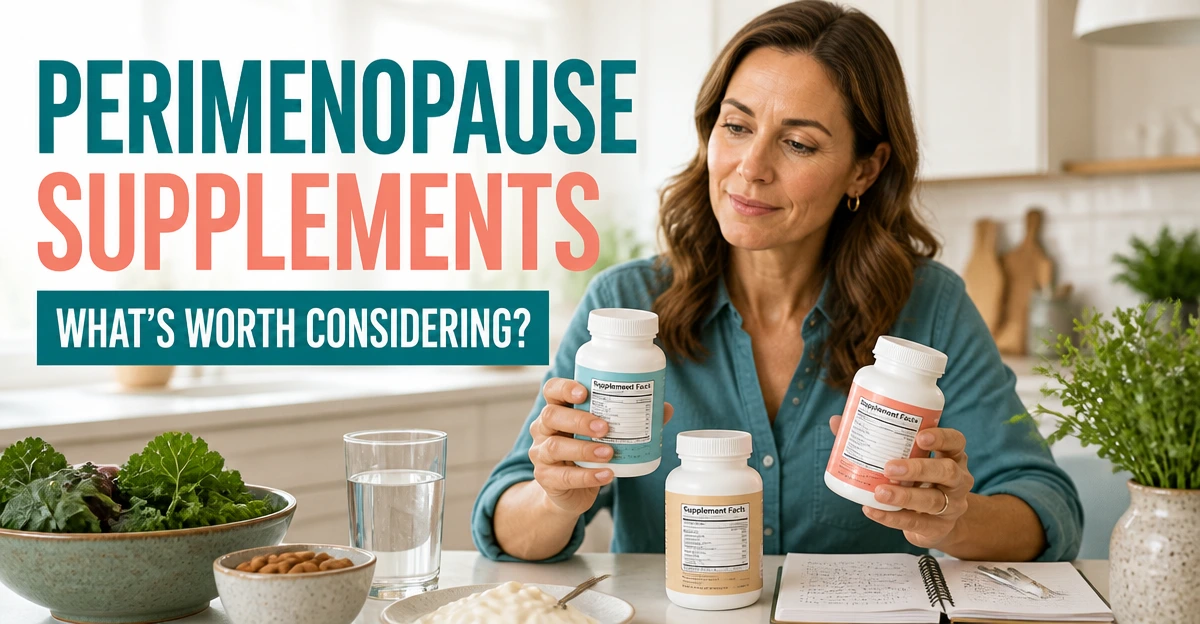
Perimenopause Supplements in 2026: What Is Worth Considering?
Written by DaniEli for LiveGoodForLife.com
Perimenopause supplements are heavily marketed for hot flashes, sleep, mood, energy and hormonal balance. The difficulty is separating nutritional support from promises that the evidence does not support.
The short answer: no over-the-counter supplement has been clearly proven to relieve perimenopause symptoms for everyone. Calcium, vitamin D, iron and other nutrients may deserve attention when diet or individual circumstances indicate a need, but they should not be confused with treatments for hot flashes, night sweats or other disruptive symptoms.
For a broader introduction to comparing formulas, start with my women’s wellness supplement buying guide. This article focuses specifically on perimenopause and the limits of products marketed for this stage.
Affiliate disclosure: This article may contain affiliate links. If you purchase through one of these links, I may earn a commission at no additional cost to you. This does not affect how I explain the evidence, safety concerns or product limitations.
Key Takeaways
- Perimenopause is the transition leading up to menopause.
- Supplements are not replacements for medical assessment or proven treatment.
- Calcium and vitamin D are nutritional considerations, not quick treatments for perimenopause symptoms.
- Iron should not be taken automatically, particularly as menstrual patterns change.
- Evidence for black cohosh, soy isoflavones, red clover and similar products is inconsistent.
- Herbal ingredients can cause side effects or interact with medicines.
- Introduce only one new product at a time and keep a simple symptom record.
What Is Perimenopause?
Answer: Perimenopause is the transition leading up to menopause, during which menstrual cycles and hormone levels can become less predictable.
Experiences vary considerably. Possible changes include:
- Irregular menstrual cycles
- Hot flashes or night sweats
- Changes in sleep
- Mood changes
- Vaginal dryness
- Changes in bleeding patterns
These symptoms can have causes other than perimenopause. New, severe or disruptive symptoms deserve proper assessment rather than self-diagnosis through supplement marketing.
My guide to women’s supplements through the 20s, 30s, 40s and beyond provides additional context on how nutritional considerations can change with life stage.
Can Supplements Treat Perimenopause Symptoms?
Answer: Current evidence does not show that over-the-counter supplements and herbal products consistently relieve hot flashes or other perimenopause symptoms.
The 2023 nonhormone therapy position statement from The Menopause Society concluded that over-the-counter supplements and herbal remedies are not recommended for managing vasomotor symptoms such as hot flashes and night sweats because rigorous evidence is lacking.
The National Center for Complementary and Integrative Health also reports that herbs, phytoestrogens and other dietary supplements have not been clearly shown to relieve menopause symptoms.
Verified fact: This does not prove that nobody will report an improvement. It means the research has not established reliable effectiveness across users or products.
My practical recommendation: Separate two questions:
- Do I have a nutritional gap that a supplement may help fill?
- Am I trying to treat a perimenopause symptom?
The second question belongs in a conversation with a qualified healthcare professional because effective medical and nonmedical options may be available.
Common Perimenopause Supplement Categories
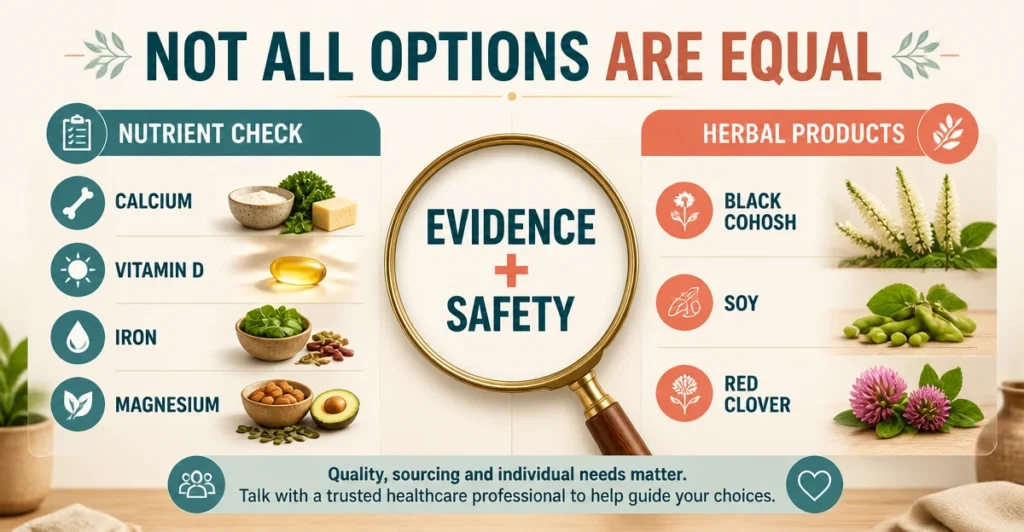
| Ingredient or category | Why it is considered | Important limitation |
|---|---|---|
| Calcium | Contributes to normal bone health | Assess total intake from food and supplements |
| Vitamin D | Helps the body absorb calcium | Need depends on diet, sun exposure and individual circumstances |
| Iron | May be relevant while menstrual bleeding continues | Should not be taken automatically or used to self-treat fatigue |
| Magnesium | Essential mineral often marketed for sleep or muscle comfort | Marketing claims are broader than the evidence for perimenopause symptoms |
| Vitamin B12 | May deserve attention with restricted diets or absorption concerns | Not a proven treatment for perimenopause fatigue |
| Black cohosh | Frequently marketed for hot flashes | Research is inconsistent; rare liver problems have been reported |
| Soy isoflavones | Plant compounds with estrogen-like properties | Results are inconsistent and any effect may be small |
| Red clover | Source of plant isoflavones | Research has not established conclusive benefits |
| Flaxseed | Nutritious food containing fibre and plant compounds | Trials have not consistently shown relief from hot flashes |
| Vitex or chaste tree | Marketed for menstrual and hormonal concerns | Evidence and safety for perimenopause symptoms remain uncertain |
Calcium and Vitamin D During Perimenopause
Answer: Calcium and vitamin D support normal bone health, but they should not be presented as treatments for hot flashes, sleep problems or mood changes.
Vitamin D helps the body absorb calcium. Food sources of calcium include dairy products, calcium-fortified alternatives, certain vegetables, tofu and canned fish with edible bones.
Vitamin D is available from fortified foods, fatty fish and supplements. Sun exposure also contributes, although production varies according to location, season, skin pigmentation and other factors.
ACOG advises obtaining calcium and vitamin D through food when possible and discussing supplements with a healthcare professional. Calcium supplementation can increase kidney-stone risk in some circumstances and can interfere with certain medicines.
Before buying calcium or vitamin D
- Estimate your normal food intake.
- Check whether your multivitamin already contains either nutrient.
- Review medication timing with a pharmacist.
- Ask whether testing is appropriate instead of guessing.
- Use the current label to calculate the complete serving.
For a detailed label-reading explanation, see my guide to iron, calcium and folate in women’s supplements.
Should You Take Iron During Perimenopause?
Answer: Iron may remain relevant while menstrual bleeding continues, but it should not be an automatic ingredient in every perimenopause routine.
Changing or heavy bleeding can affect iron status. However, fatigue also has many possible causes, and taking iron without knowing whether it is needed can be inappropriate.
ACOG notes that iron requirements generally fall after menopause. This is one reason some formulas aimed at older women contain little or no iron.
Discuss testing with a healthcare professional if you experience heavy bleeding, unexplained fatigue, weakness or other possible signs of low iron.
What About Magnesium and B Vitamins?
Answer: Magnesium and B vitamins are essential nutrients, but they are not established treatments for perimenopause symptoms.
Magnesium is frequently marketed for sleep and muscle comfort. B vitamins are often promoted for energy and mood. These messages can make a normal nutrient sound like a targeted hormonal treatment.
Check whether your diet and existing multivitamin already provide them before adding separate products.
High supplemental amounts can cause side effects or create unnecessary overlap. More is not automatically better.
Black Cohosh: What Does the Evidence Say?
Answer: Studies of black cohosh for menopause symptoms have produced inconsistent results, so it cannot be relied on as a proven remedy.
NCCIH reports that rare cases of liver damage have occurred in people using commercial black cohosh products, although it is uncertain whether black cohosh caused those cases.
People with liver disorders should seek professional advice before using it. Stop using the product and seek medical help if symptoms such as dark urine, jaundice or abdominal pain develop.
Safety is also uncertain for people with hormone-sensitive conditions.
Soy Isoflavones and Red Clover
Answer: Soy isoflavones and red clover contain phytoestrogens, but studies of their effects on hot flashes have been inconsistent.
NCCIH reports that soy products may have a small effect for some users, but results are not completely consistent. Research on red clover has not established conclusive benefits.
Products can differ in concentration and composition, so findings from one extract should not automatically be applied to every bottle.
Seek professional advice if you:
- Have a hormone-sensitive medical history
- Use hormonal treatment
- Take prescription medication
- Are preparing for surgery
Does Flaxseed Help With Hot Flashes?
Answer: Flaxseed is a nutritious food, but studies have not consistently shown that it relieves hot flashes better than a placebo.
Ground flaxseed can contribute fibre and other nutrients to meals. It can be added to yogurt, porridge or smoothies if it suits your diet.
That nutritional value should be kept separate from claims that flaxseed reliably treats perimenopause symptoms.
What About Vitex, Fenugreek and Other Herbs?
Answer: Evidence for vitex, fenugreek, Siberian rhubarb and many multi-herb perimenopause formulas is limited, product-specific or uncertain.
A claim that an herb “balances hormones” does not explain:
- Which hormone is affected
- Whether the effect was demonstrated in humans
- Whether the studied extract matches the product
- Which symptoms were measured
- How large the effect was
- What interactions or adverse effects occurred
Bring the exact label to a pharmacist or healthcare professional, particularly if the formula contains several botanical ingredients.
Does a Perimenopause Multivitamin Make Sense?
Answer: A perimenopause-specific multivitamin may be convenient, but the word “perimenopause” does not establish that the formula is better than a suitable general multivitamin.
Compare:
- Serving size
- Iron content
- Calcium and vitamin D amounts
- Magnesium amount and form
- Botanical ingredients
- Proprietary blends
- Warnings and interactions
- Cost per complete serving
A formula containing several herbs is not automatically more complete than a simpler multivitamin.
If you are comparing a standard women’s multivitamin containing iron, my LiveGood women’s multivitamin with iron review explains the label and the situations in which iron may or may not fit.
How to Choose Without Wasting Money
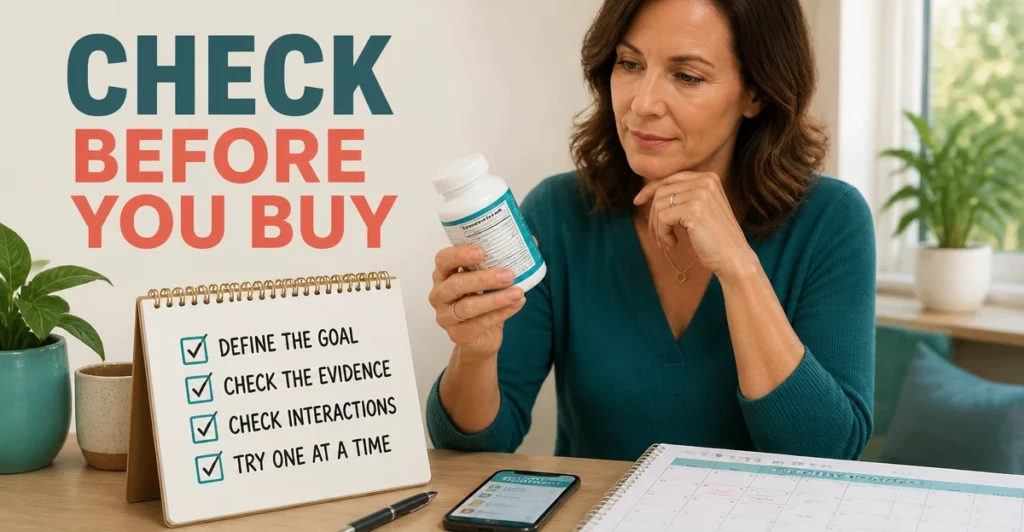
1. Define the goal
Decide whether you are addressing a confirmed nutritional gap or hoping to relieve a symptom. These are different goals.
2. Check the evidence
Look for guidance from recognised medical organisations rather than relying solely on a retailer, influencer or manufacturer.
3. Read the entire label
Record every ingredient, amount per serving and warning. My guide to comparing supplement ingredients before buying provides a complete process.
4. Avoid hidden proprietary blends
A combined blend weight does not tell you how much of each ingredient the product contains.
5. Check interactions
Discuss botanical products with a pharmacist if you take hormonal treatment, anticoagulants, thyroid medicine or other prescriptions.
6. Introduce one product at a time
Beginning several products together makes it difficult to identify which one caused an effect or unwanted reaction.
7. Reassess
Do not continue purchasing a product indefinitely simply because it has become part of your routine.
Track Symptoms Before Changing Your Routine
A simple record can make a medical conversation more useful.
Track:
- Cycle dates and bleeding patterns
- Hot flashes and night sweats
- Sleep quality
- Mood changes
- Headaches
- New supplements or medication
- Possible adverse reactions
Record information consistently without assuming every daily change was caused by a supplement. Perimenopause symptoms can fluctuate naturally.
When to Seek Medical Advice
Speak with a qualified healthcare professional when symptoms:
- Disrupt sleep, work or relationships
- Include very heavy or unusual bleeding
- Begin suddenly or feel severe
- Could be related to medication
- Continue despite self-care changes
- Cause concern for any other reason
Seek urgent care for symptoms such as chest pain, severe shortness of breath, fainting or other potentially serious changes.
My Practical Perimenopause Checklist
- What exact problem am I trying to address?
- Could the symptom have another cause?
- Have I reviewed my diet first?
- Does testing make sense?
- What is the complete serving size?
- Does the product contain iron?
- Does it contain several herbs?
- Are individual amounts disclosed?
- Could it interact with medication?
- Am I introducing only one new product?
- Am I using the latest label?
- When will I reassess whether it is worthwhile?
Final Answer
The perimenopause supplements most worth considering are those that address a genuine nutritional need—not products promising to balance hormones or reliably eliminate symptoms.
Calcium, vitamin D, iron, magnesium and B vitamins may deserve individual review, but the need for a supplement depends on diet, menstrual patterns, health history and existing products.
Evidence for black cohosh, soy isoflavones, red clover, flaxseed and other popular options remains inconsistent or insufficient for reliable symptom treatment.
Use food first, compare labels carefully and ask about interactions. If symptoms are affecting your quality of life, proper assessment offers more options than another supplement bottle.
Frequently Asked Questions
What is the best supplement for perimenopause?
There is no single best supplement. The most appropriate option depends on whether you have a nutritional gap, what symptoms you experience, your diet, medication and medical history.
Do calcium and vitamin D relieve perimenopause symptoms?
Calcium and vitamin D support bone health but aren’t established treatments for hot flashes, night sweats, sleep problems, or mood changes.
Should I take iron during perimenopause?
Not automatically. Iron may remain relevant while menstrual bleeding continues, but requirements vary. Discuss testing if you have heavy bleeding or possible symptoms of low iron.
Does black cohosh work for hot flashes?
Research results are inconsistent. Black cohosh is not a reliably proven treatment, and you should review safety precautions before use.
Are soy isoflavones effective?
Some studies suggest a small effect, but results are inconsistent. The Menopause Society does not recommend soy products for treating vasomotor symptoms based on the mixed evidence.
Is a perimenopause multivitamin better than a regular multivitamin?
Not necessarily. Compare the actual ingredients, serving sizes, warnings and cost. The life-stage wording on the bottle does not prove that the formula is more suitable.
Can supplements replace hormone therapy?
No. Supplements should not be presented as equivalents to hormone therapy or other evidence-based treatments. Discuss treatment choices, benefits and risks with a qualified clinician.
How long should I try a supplement?
There is no universal timeline. Agree on a review point, track relevant changes and stop if the product causes an unwanted reaction. Seek medical advice rather than extending an ineffective trial indefinitely.
How This Guide Was Prepared
This guide compares ingredients commonly marketed during perimenopause against guidance from established medical and public-health organizations.
It prioritizes:
- The Menopause Society position statements
- American College of Obstetricians and Gynecologists guidance
- National Center for Complementary and Integrative Health evidence reviews
- Current Supplement Facts panels
No personal supplement-testing results are claimed. Practical recommendations are identified separately from verified evidence.
Sources
- The Menopause Society: Position Statements
- NCCIH: Menopausal Symptoms and Complementary Health Approaches
- ACOG: The Menopause Years
- ACOG: Osteoporosis and Calcium and Vitamin D
- NCCIH: Red Clover Usefulness and Safety
Medical Disclaimer
This article is for general educational and informational purposes only. It is not medical advice and is not intended to diagnose, treat, cure or prevent any disease.
Speak with a physician, pharmacist, registered dietitian or another qualified healthcare professional before starting a supplement, especially if you take medication, use hormonal treatment, have a hormone-sensitive condition, have liver disease, are preparing for surgery or experience disruptive symptoms.
Stop using a product and seek appropriate medical advice if you experience an unwanted reaction. Always read and follow the latest product label.