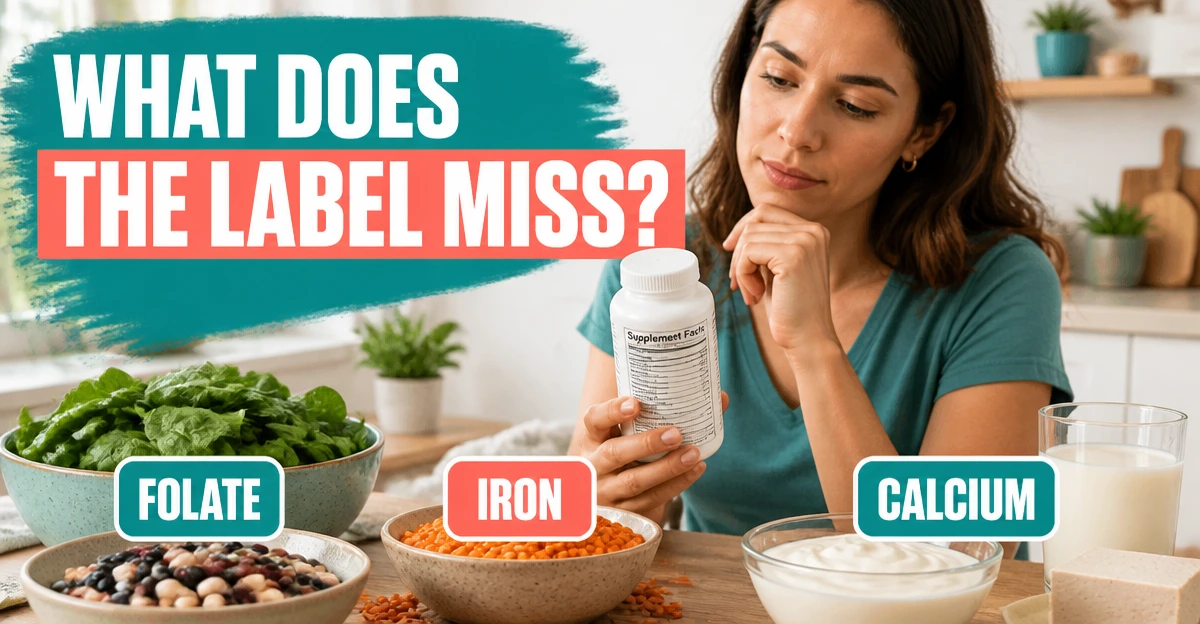
Iron, Calcium and Folate in Women’s Supplements: What to Check
Written by Daniel Popa for LiveGoodForLife.com
A women’s wellness formula can look comprehensive until you read the Supplement Facts panel closely.
The bottle may contain a long list of vitamins, minerals and botanical ingredients, yet provide only a modest amount of calcium, exclude iron or list folate in a way that is easy to misunderstand.
The short answer: iron, calcium and folate are important nutrients, but that does not mean every women’s supplement should contain all three in large amounts. The right formula depends on diet, age, menstrual status, pregnancy, medication and individual health circumstances.
For the complete starting point, read my women’s wellness supplements buying guide. If you want to understand how the discussion can change through different life stages, see my guide to women’s supplements in your 20s, 30s, 40s and beyond.
Affiliate disclosure: This article may contain affiliate links. If you purchase through one of these links, I may earn a commission at no additional cost to you. This does not affect how I explain ingredients, evidence or product limitations.
Key Takeaways
- Iron, calcium and folate perform different roles and should be evaluated separately.
- Not every woman needs supplemental iron.
- Calcium often appears in modest amounts in multivitamins, so food intake still matters.
- Modern labels normally list folate in micrograms of dietary folate equivalents, or mcg DFE.
- When folic acid contributes to the folate amount, it may be displayed in parentheses.
- A long ingredient list does not automatically make a formula complete.
- Always compare amounts per complete serving rather than per capsule.
Why Check Iron, Calcium and Folate?
Answer: Iron, calcium and folate frequently appear in women’s nutrition guidance because requirements can be influenced by menstruation, pregnancy and changes after menopause.
These nutrients do not all belong in every formula at the same amount.
Iron may be relevant to menstruating or pregnant women but unnecessary for someone whose diet and iron status already meet their needs. Calcium requirements should be considered alongside food intake, age and menopause status. Folate deserves particular attention for people who could become pregnant.
Verified fact: The Office on Women’s Health identifies iron, calcium and folic acid as nutrients that deserve particular attention in women’s nutrition. It also states that most women should obtain their nutrients primarily from healthy foods.
Iron, Calcium and Folate at a Glance
| Nutrient | What to find on the label | Why the amount can vary |
|---|---|---|
| Iron | Iron amount per serving and percentage Daily Value | Needs differ according to age, menstruation, pregnancy, diet and iron status |
| Calcium | Calcium amount per serving and percentage Daily Value | Food contributes to total intake, and meaningful amounts take up considerable space in a formula |
| Folate | Folate in mcg DFE, with folic acid shown in parentheses when applicable | Labels account for differences between naturally occurring food folate and added folic acid |
Folate and Folic Acid: What Is the Difference?
Answer: Folate is vitamin B9 and occurs naturally in foods. Folic acid is a form of folate used in fortified foods and many supplements.
The terms are related, but they should not be treated as two unrelated ingredients.
According to the FDA, folate is declared on Nutrition Facts and Supplement Facts labels in micrograms of dietary folate equivalents, written as mcg DFE.
When folic acid has been added, the label also shows the folic acid amount in micrograms inside parentheses.
A label might therefore use a format such as:
Folate — [amount] mcg DFE ([amount] mcg folic acid)
The exact quantities must come from the current product label.
Why does the label use mcg DFE?
Dietary folate equivalents account for the fact that the body absorbs folic acid from fortified foods and supplements differently from naturally occurring food folate.
My practical recommendation: Do not compare two folate products by looking only at the largest number. Check the unit, percentage Daily Value and amount per complete serving.
Who should pay particular attention to folic acid?
The NIH advises women and teenage girls who could become pregnant to consume 400 micrograms of folic acid daily from supplements, fortified foods or both, in addition to folate from a healthy eating pattern.
Pregnancy and breastfeeding have different recommended folate amounts, so individual guidance remains important.
Food sources of folate
Food sources include:
- Dark green leafy vegetables
- Asparagus
- Brussels sprouts
- Beans and peas
- Nuts
- Oranges and orange juice
- Fortified or enriched grain products containing folic acid
Iron: Why Some Women’s Formulas Include It and Others Do Not
Answer: Some women’s multivitamins contain iron because menstruating and pregnant women generally have higher iron requirements. Other formulas exclude it because iron needs differ and unnecessary supplementation may be inappropriate.
The NIH recommends 18 milligrams of iron per day for adult women aged 19–50 and 8 milligrams for adults aged 51 and older. Pregnancy has a higher recommended amount.
Those figures describe overall daily intake, not an automatic supplement dose.
How is iron shown on a supplement label?
The Supplement Facts panel lists the amount of elemental iron per serving. Consumers do not need to calculate elemental iron from the weight of the iron compound.
You may also see the iron source listed in parentheses, such as a particular ferrous salt or another form.
Why can iron be a poor fit for some people?
Iron-containing products are not automatically suitable for:
- Women who already obtain enough iron
- People using another iron-containing product
- Postmenopausal women without an identified need
- Anyone advised to limit iron intake
- People seeking to treat unexplained fatigue without proper assessment
High supplemental amounts can cause unwanted gastrointestinal effects, and iron can interact with medicines or other supplements.
Women considering a specific iron-containing multivitamin can read my Bio-Active Complete Multi-Vitamin for Women with Iron review.
Important limitation: A product review cannot determine whether you personally need supplemental iron.
Food sources of iron
Food sources include:
- Meat and poultry
- Seafood
- Beans and lentils
- Tofu
- Spinach and other leafy vegetables
- Iron-fortified cereals and breads
Calcium: Why the Amount in a Multivitamin May Be Modest
Answer: Many multivitamins contain only part of the calcium someone may need because calcium compounds require considerable physical space and food can contribute substantially to total intake.
The word “calcium” on the front of a bottle tells you very little by itself.
Check:
- The calcium amount per complete serving
- The percentage Daily Value
- The calcium source or form
- The number of capsules or tablets required
- Calcium already obtained from food
- Medication timing and possible interactions
How much calcium do women need?
The NIH lists a recommended calcium intake of 1,000 milligrams per day for adults aged 19–50 and 1,200 milligrams for women aged 51–70.
These totals include calcium from food, drinks and supplements. They should not be interpreted as instructions to take that entire amount in supplement form.
Does calcium need to be combined with vitamin D?
Vitamin D helps the body absorb calcium, and both nutrients contribute to normal bone health. However, this does not mean every person needs a combined calcium-and-vitamin-D product.
Review food intake, fortified foods and existing supplements before adding another product.
Food sources of calcium
Food sources include:
- Milk, yogurt and cheese
- Calcium-fortified soy or other dairy alternatives
- Tofu made with calcium
- Canned sardines or salmon with edible bones
- Kale, broccoli and bok choy
- Other fortified foods and drinks
Calcium can interact with medication
Calcium supplements can interfere with the absorption of certain medicines. The NIH specifically notes interactions involving medicines such as levothyroxine and some antibiotics.
If you take medication, ask a pharmacist or healthcare professional about appropriate timing.
How to Find All Three Nutrients on a Label
Answer: Start with the complete serving size, then find the nutrient amount and percentage Daily Value for iron, calcium and folate.
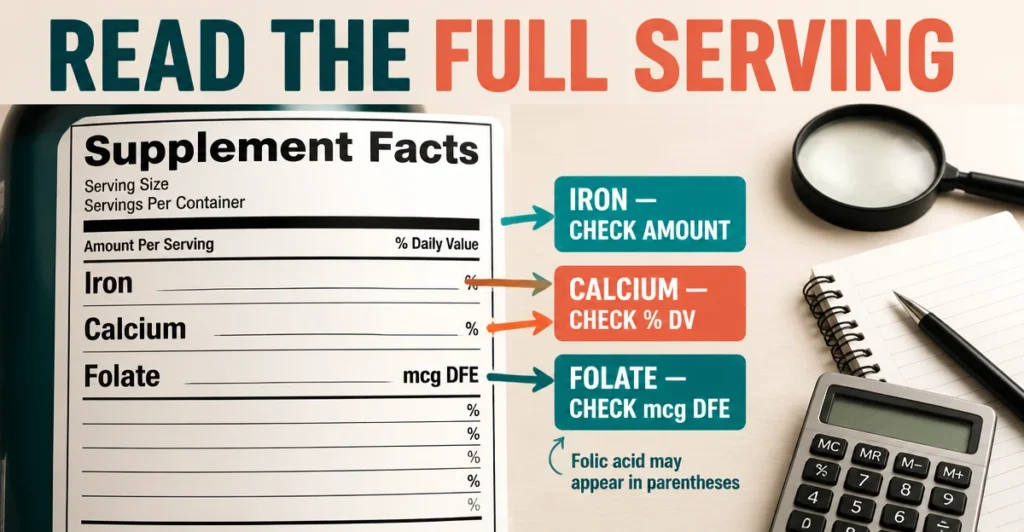
- Check serving size. Confirm whether one serving is one tablet, two capsules or another amount.
- Find iron. Record the elemental iron amount per serving and percentage Daily Value.
- Find calcium. Record the amount per serving rather than relying on a front-label claim.
- Find folate. Look for mcg DFE and check whether folic acid appears in parentheses.
- Check other products. Include multivitamins, prenatal formulas, fortified powders and individual nutrients.
- Read warnings. Review medication, pregnancy and storage information.
For a more detailed method, use my guide on how to compare supplement ingredients before buying.
Does a Missing Nutrient Make a Formula Bad?
Answer: No. A missing nutrient can be intentional and may make the formula more appropriate for its intended user.
An iron-free multivitamin may suit someone who does not need supplemental iron. A general multivitamin may provide modest calcium because food is expected to supply most of it. A specialist botanical formula may not be intended to serve as a complete multivitamin.
The more useful question is:
Does this formula provide the ingredients and amounts I am actually looking for?
A product becomes a poor match when its marketing implies broad coverage but its label does not meet the buyer’s intended purpose.
What About Herbal Women’s Wellness Formulas?
Answer: Botanical ingredients do not replace iron, calcium or folate, and their presence does not make a product nutritionally complete.
Women’s wellness blends may include ingredients such as black cohosh, chasteberry, red clover, ashwagandha or other botanicals. Each ingredient has its own evidence, precautions and possible interactions.
A long botanical list should not distract from checking:
- Exact ingredient amounts
- Proprietary blends
- Warnings and contraindications
- Medication interactions
- Pregnancy and breastfeeding cautions
- Overlap with other products
Speak with a qualified healthcare professional before using herbal products for persistent hormonal, menstrual or menopausal symptoms.
How to Choose a Formula That Fits
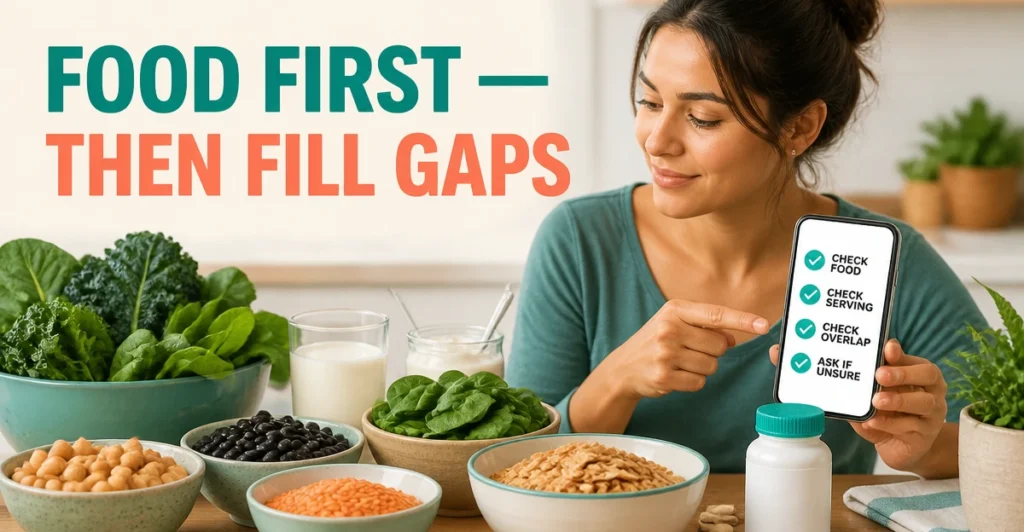
Answer: Begin with food intake, define the gap you are trying to address and choose a formula that provides an appropriate amount without unnecessary overlap.
1. Review food sources
Write down how often you eat iron-rich foods, calcium-containing foods, vegetables, beans and fortified grain products.
2. Define the intended purpose
Decide whether you want a general multivitamin, prenatal formula, iron-containing multivitamin or a targeted calcium product.
3. Compare complete servings
A product requiring two or three capsules should be compared using the combined amount in that full serving.
4. Check overlap
Review every supplement together. This is especially important when combining a multivitamin with an individual iron, calcium or folate product.
5. Consider interactions
Ask a pharmacist or healthcare professional about medication timing and ingredient interactions.
6. Verify the latest label
Manufacturers can update ingredients and serving sizes. Use the label on the product you are considering rather than relying exclusively on an older review or screenshot.
My Practical Label Checklist
- What is the product intended to provide?
- What is one complete serving?
- Does it contain iron?
- How much calcium does the full serving provide?
- Is folate listed in mcg DFE?
- Is folic acid shown in parentheses?
- Do any ingredients overlap with another product?
- Does it contain botanical ingredients?
- Are there medication or pregnancy warnings?
- Am I checking the newest label?
- Do I need professional guidance before using it?
Final Answer
Iron, calcium and folate deserve careful attention, but a women’s formula is not automatically incomplete because one of them is missing.
The useful comparison is between the current label and your actual purpose.
Check iron because needs vary substantially. Check calcium because a multivitamin may provide only a portion of total intake. Check folate using mcg DFE and look for folic acid in parentheses when applicable.
Start with food, calculate amounts per complete serving and review your whole routine for overlap. If pregnancy, medication, symptoms or a possible deficiency are involved, seek individual guidance.
Frequently Asked Questions
Do women’s multivitamins usually contain iron?
Many women’s multivitamins contain iron, but some are intentionally iron-free. Check the Supplement Facts panel because the product name alone does not confirm its iron content.
Is folate the same as folic acid?
Folate is vitamin B9 and occurs naturally in foods. Folic acid is a form of folate used in fortified foods and many supplements. Modern labels declare folate in mcg DFE and may show folic acid in parentheses.
What does mcg DFE mean?
Mcg DFE means micrograms of dietary folate equivalents. The unit accounts for differences in how naturally occurring food folate and folic acid are absorbed.
Can a multivitamin provide enough calcium?
Some multivitamins provide only a modest amount of calcium. Check the amount per complete serving and include calcium from food when assessing total intake.
Should every woman take iron?
No. Iron needs vary according to age, menstruation, pregnancy, diet and iron status. Supplemental iron is not suitable for everyone.
Should calcium and vitamin D be taken together?
Vitamin D helps the body absorb calcium, and both contribute to bone health. Whether you need one, both or neither in supplement form depends on your diet, existing products and individual circumstances.
Can calcium interfere with medication?
Yes. Calcium supplements can affect the absorption of certain medicines, including levothyroxine and some antibiotics. Ask a pharmacist or healthcare professional about timing.
Do herbal ingredients replace vitamins and minerals?
No. Botanical ingredients and essential nutrients are different categories. A formula containing several herbs may still provide little or no iron, calcium or folate.
How This Guide Was Prepared
This guide focuses on information readers can verify directly through current Supplement Facts panels and authoritative public-health resources.
It uses information from:
- The U.S. Food and Drug Administration
- The NIH Office of Dietary Supplements
- The U.S. Office on Women’s Health
No personal product-testing results are claimed. Personal recommendations are identified as practical label-reading suggestions rather than medical conclusions.
Sources
- FDA: Folate and Folic Acid on Nutrition and Supplement Facts Labels
- NIH Office of Dietary Supplements: Folate Fact Sheet
- NIH Office of Dietary Supplements: Iron Fact Sheet
- NIH Office of Dietary Supplements: Calcium Fact Sheet
- Office on Women’s Health: Vitamins and Minerals for Women
Medical Disclaimer
This article is for general educational and informational purposes only. It is not medical advice and is not intended to diagnose, treat, cure or prevent any disease.
Speak with a physician, pharmacist, registered dietitian or another qualified healthcare professional before starting a supplement, particularly if you are pregnant, breastfeeding, taking medication, managing a medical condition, preparing for surgery or considering supplemental iron.
Stop using a product and seek appropriate medical advice if you experience an unwanted reaction. Always read and follow the latest product label.