Natural Wellness Supplements vs Synthetic: Does Source Matter?
Walk down any supplement aisle and you will see two competing sales pitches sitting side by side. One bottle leads with plant names, the word organic, and a promise about clean ingredients. Another leads with a milligram count next to a chemical name. Both claim to support your health, and both ask for your money. The real question is whether the source of a nutrient changes what you actually get when you swallow the capsule.
The honest answer starts with the label, not the marketing. What a supplement company chooses to put in a bottle, and what it publicly commits to leaving out, tells you more than any single word on the front panel. Here is how to read those signals without getting swept up in the language.
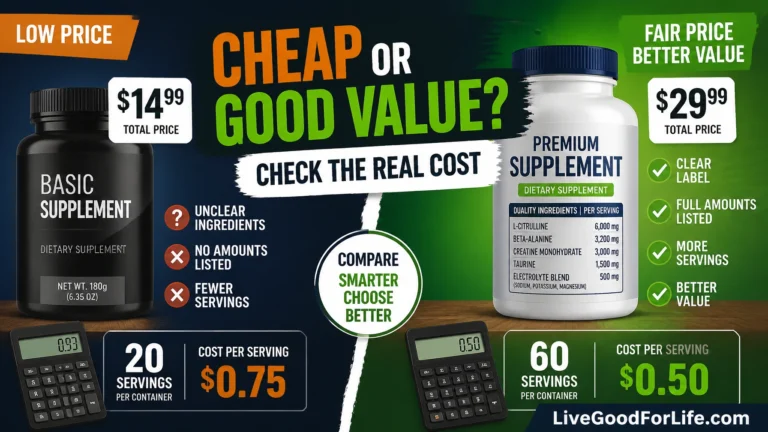
If you are still defining the category, start with what health wellness supplements covers. For the broader buying process, use our wellness supplements guide to compare ingredient forms, potency, and total cost.
What Natural Wellness Supplements and Synthetic Supplements Actually Mean
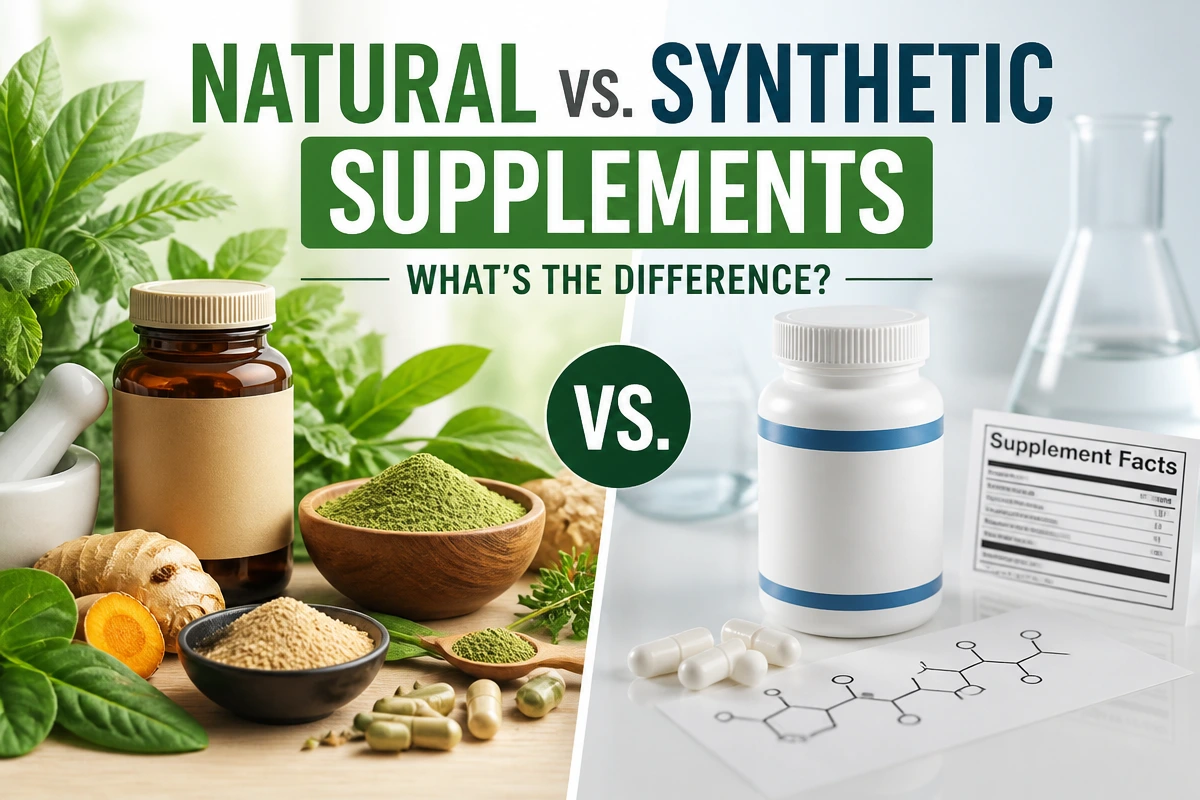
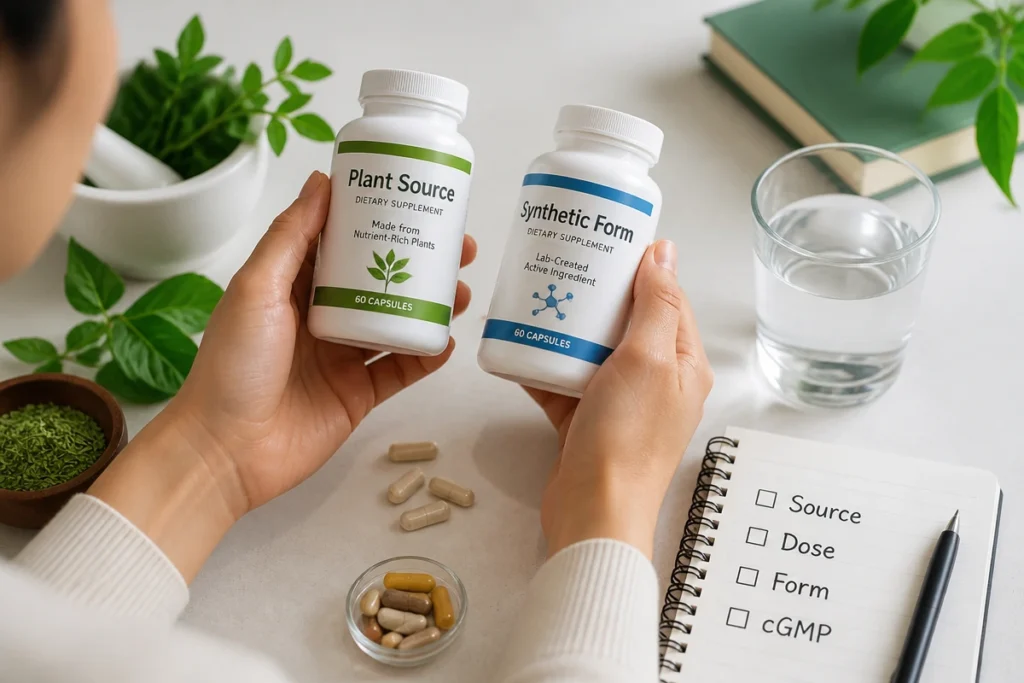
In broad terms, a natural ingredient in a supplement is one drawn from a plant, mineral, or animal source. A synthetic ingredient is manufactured, typically in a lab, to reproduce a nutrient’s structure. Labeling rules vary by country, and a word like natural is not automatically a statement about effectiveness, potency, or purity. It is a statement about origin.
That does not make the distinction meaningless. It simply means you have to look past the front label and read what the manufacturer says about its own formulation choices. Some brands make ingredient sourcing the center of their identity, and they say so in specific language rather than vague claims.
Earthley Wellness is one example. The company states that its herbal remedies, supplements, and laundry detergent are made with organic ingredients, with no synthetic ingredients, no natural flavors, and no compromises. It also describes itself as family-owned, Ohio-made, and cGMP certified, and says it has been trusted by 625,000+ families since 2016. That is a formulation position stated plainly, paired with a named manufacturing standard.
Where Source Commitments Show Up in Real Products
Different supplement companies express the natural versus synthetic question in different ways. Some build a brand around what they exclude. Others build one around which body systems they target. Both approaches can be legitimate, but they answer different questions for a shopper.
Brands That Reject Synthetic Ingredients
The clearest signal a company can send is a stated exclusion. A manufacturer that commits to no synthetic ingredients, no natural flavors, and organic sourcing is telling you its formulation philosophy upfront. The cGMP reference matters too, because it points to current Good Manufacturing Practice requirements, a production standard rather than an ingredient claim. For a buyer, that pairing is useful: a stated ingredient philosophy plus a named manufacturing certification gives you two separate things to verify on the company’s own site.
Brands Built Around Specific Organ Systems
Natural Wellness takes a different route. The company says that since 1996 it has produced supplements positioned around general wellness and several body-system categories. Its catalogue includes products marketed in liver, kidney, immune, digestive, and joint-wellness categories. These categories describe the company’s positioning and do not establish clinical effectiveness.
Its product range is described as targeting overall well-being, including digestive health, immune function, and joint care. That is a focus-based approach rather than an exclusion-based one. If your interest is a specific system, a brand organized around organ support may be easier to navigate than one organized around clean sourcing.
Retail and Practitioner Channels
Some sellers position themselves on curation rather than manufacturing. Natural Wellness Corner states that it offers only premium, natural supplements and professional-grade vitamins. Metagenics describes its essential wellness supplements as formulated to support daily nutritional needs, foundational health, and overall well-being. These are positioning statements from the sellers themselves, so treat them as a starting point for research rather than a verdict.
Certifications, Reviews, and What They Do and Do Not Prove
Certifications and customer reviews are often treated as the same kind of evidence. They are not. A the company’s statement that it follows cGMP manufacturing requirements speaks to how a product is made. A review score speaks to how customers felt about their purchase experience.
Natural Wellness, for instance, has a claimed Trustpilot profile dating to April 2020, with 527 reviews and a TrustScore of 4.8 out of 5. That is a healthy satisfaction signal, and it is worth reading individual reviews rather than the aggregate number. What a 4.8 does not tell you is anything about lab testing, ingredient sourcing, or whether a specific product suits your health situation.
Certifications can also be religious or dietary rather than quality related. One manufacturer describes itself as the leading Shariah compliant, halal herbal medicine and natural supplement manufacturer, with products spanning cosmetics, supplements, and health food. For shoppers who need halal compliance, that certification is essential. For shoppers who do not, it is simply another data point about how the company operates.
Blends and Ingredient Counts: Reading a Multi-Ingredient Formula
Source matters less than dose when a formula contains dozens of ingredients. Source Naturals describes its Wellness Formula as an advanced, award-winning blend of over 30 vitamins, minerals, adaptogens, and herbs, including high potencies of vitamins A, C, and D. That example shows how a nutrient-forward, multi-ingredient product can sit comfortably alongside natural positioning.
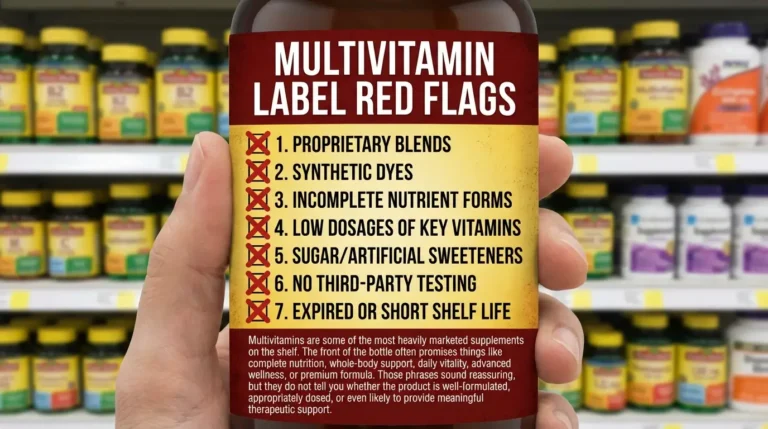
When a label lists more than 30 ingredients, the useful question is not whether the list looks impressive. It is how much of each ingredient is actually present, and whether the amounts match what you were looking for. A long ingredient list with tiny amounts of each item is a different product than a short list with meaningful doses.
A Practical Comparison Checklist
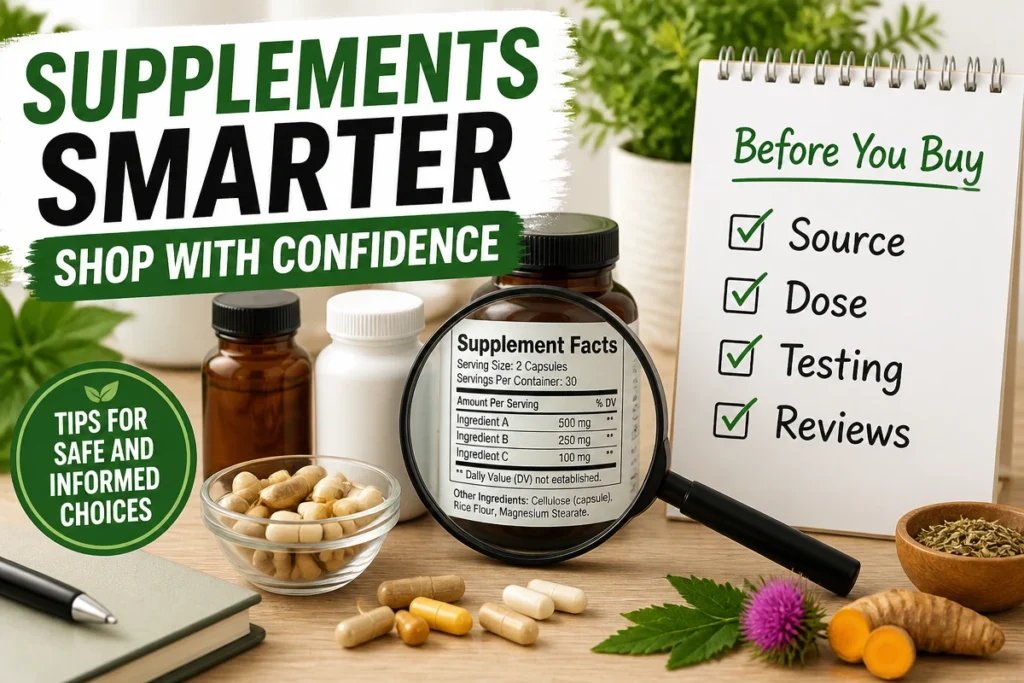
If you are weighing a natural wellness supplement against a synthetic alternative, work through the same set of checks for both products. The table below organizes what to look at and where to confirm it.
What to check | Why it matters | Where to verify |
|---|---|---|
Stated ingredient sourcing | Shows whether the maker commits to organic or synthetic-free formulation | The brand’s own product page |
Manufacturing standard | Signals the production controls behind the product | Company site and certificate references |
Intended body system | Helps you match the product to your actual goal | Product description and category pages |
Ingredient count and potencies | Shows the disclosed amounts so they can be compared with research, established intake guidance, and professional advice | The supplement facts panel |
Religious or dietary certification | Confirms compliance where it is required for you | Manufacturer statements |
Customer reviews | Indicates satisfaction, not quality or safety | Independent review platforms |
What the Source Question Does Not Settle
Source is one variable among several, and the available product information does not establish that natural ingredients are universally better absorbed, safer, or more effective than synthetic ones. Nor does it identify a single cleanest brand or a best supplement for overall health.
Those answers depend on the specific nutrient, the dose, your health status, any medications you take, and guidance from a qualified professional. The NIH dietary supplement fact sheets can help you check evidence and safety details for individual nutrients, while our guide to clinically studied ingredients in supplements explains what that phrase does and does not prove. If a company or a post claims one source wins across the board, treat that claim as unverified until you check the product documentation and speak with someone qualified to assess your situation.
How to Shop Without Getting Lost
A repeatable process beats a clever slogan. Try this order of operations the next time you compare two bottles:
- Write down what you are actually trying to support, whether that is digestive health, immune function, joint care, or general daily nutrition.
- Read the supplement facts panel first and the marketing copy second. Doses tell you more than adjectives.
- Check the manufacturer’s own statements about sourcing, synthetic ingredients, and organic content.
- Look for a named manufacturing standard such as the company’s statement that it follows cGMP manufacturing requirements rather than a generic quality claim.
- Confirm any certification you personally need, including halal compliance if that applies to you.
- Read a handful of individual reviews instead of relying on the aggregate score alone.
- Ask a healthcare professional before starting anything new, especially if you take medication or manage a condition.
For a closer look at the standards used in our own reviews, see how we evaluate LiveGood supplements. You can also compare current LiveGood formulas and prices before deciding whether any product fits your needs.
None of these steps require special expertise. They require slowing down long enough to separate what a company promises from what a company documents. A brand that states its sourcing philosophy, names its manufacturing standard, and lists honest potencies gives you something concrete to evaluate. A brand that leans entirely on the word natural gives you very little.
Frequently Asked Questions
Does the source of a nutrient change how well it works?
The available information does not support a blanket answer. Natural and synthetic versions of a nutrient can differ in how they are produced, but whether that matters depends on the specific nutrient, the dose, and your own health situation. Ask a qualified healthcare professional about the products you are considering rather than assuming one source always wins.
What does cGMP certified mean on a supplement label?
cGMP stands for current Good Manufacturing Practice, a production standard rather than an ingredient claim. Earthley Wellness, for example, states that it follows cGMP manufacturing requirements alongside its commitment to organic ingredients and no synthetic ingredients. Seeing the term means the manufacturer is pointing to documented production controls, which you can confirm through the company’s own materials.
Are natural wellness supplements always free of synthetic ingredients?
No. The word natural is not a guarantee about what a bottle contains, and labeling rules vary. Some companies make explicit exclusion commitments, such as Earthley Wellness stating no synthetic ingredients, no natural flavors, and no compromises. Others use natural as general positioning. Always read the supplement facts panel and the manufacturer’s own sourcing statements.
How much should I trust a high review score?
Review scores measure customer satisfaction with a purchase, not ingredient quality or safety. Natural Wellness, for example, holds a TrustScore of 4.8 out of 5 across 527 reviews on a claimed profile dating to April 2020. That is a positive signal worth reading into, but it does not replace label research or professional medical advice.
What should I check first when comparing two supplement brands?
Start with the supplement facts panel, then the manufacturer’s sourcing statements, then any named manufacturing standard such as the company’s statement that it follows cGMP manufacturing requirements. After that, confirm certifications you personally require, including halal compliance if relevant to you. Reviews come last, because they describe other people’s experiences rather than what is in the bottle.
Source matters, but it matters as one part of a larger picture that includes dose, manufacturing standards, certification, and your own health needs. Read the back of the bottle as carefully as the front, verify claims with the manufacturer and a qualified professional, and you will make a more grounded decision than any front-label promise can offer.
Sources and Further Reading
- NIH Office of Dietary Supplements: Dietary Supplement Fact Sheets
- FDA: Information for Consumers on Using Dietary Supplements
- FDA: Current Good Manufacturing Practices for Food and Dietary Supplements
- How to read supplement labels and spot fairy dusting
- Third-party lab testing, COAs, and batch checks
Medical Disclaimer
This article is for educational purposes only and is not medical advice. Dietary supplements can interact with medications and may not be suitable for everyone. Talk with a qualified healthcare professional before starting, stopping, or changing a supplement, especially if you are pregnant, breastfeeding, managing a medical condition, preparing for surgery, or taking prescription medication.
Affiliate Disclosure
This article contains a sponsored LiveGood affiliate link. If you make a purchase through that link, I may earn a commission at no extra cost to you. This does not change the standards used to compare ingredients, labels, evidence, manufacturing information, and total cost.