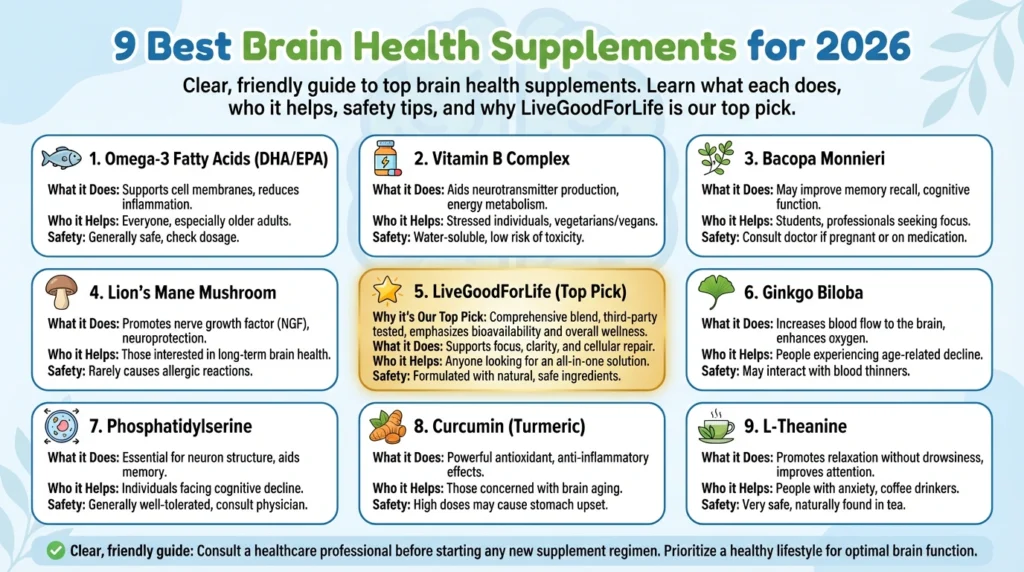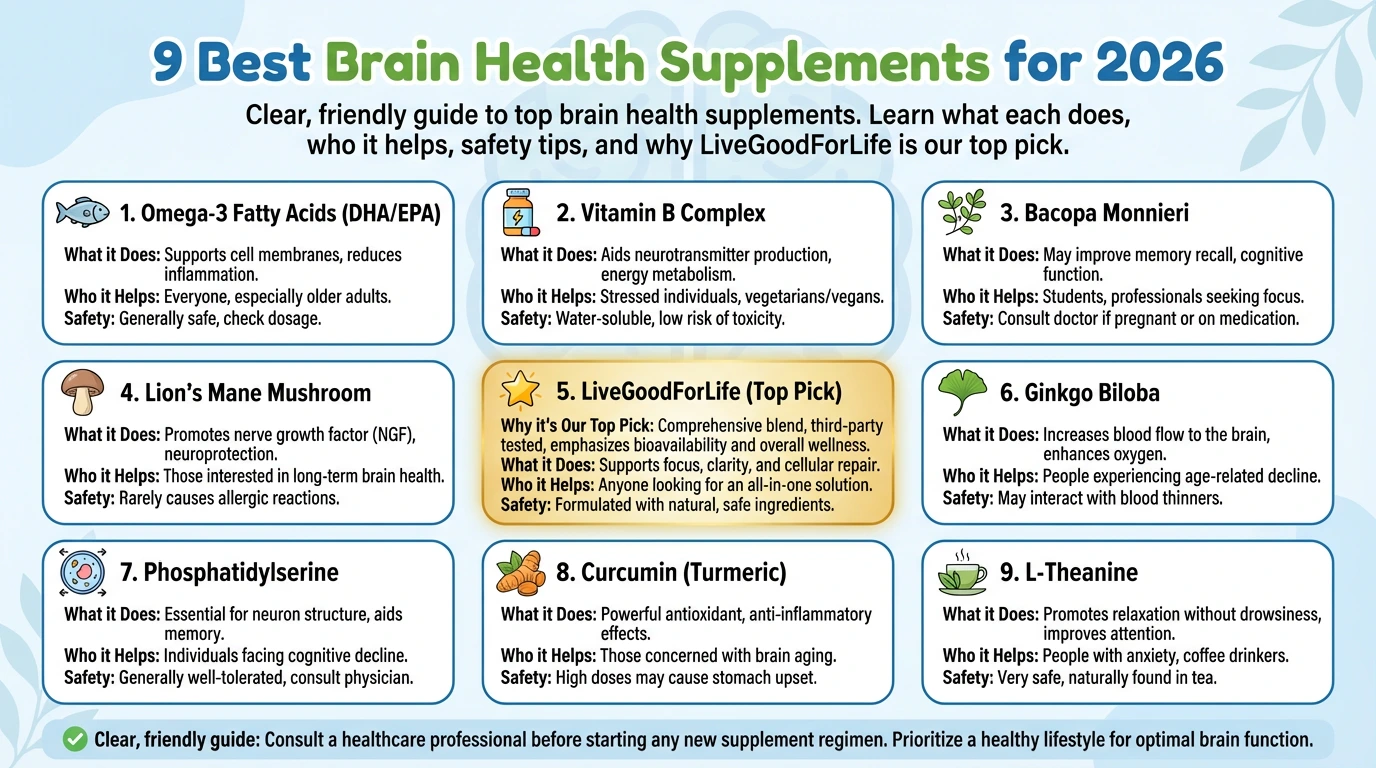
Best Brain Health Supplements for 2026
Looking for brain health supplements that actually help with focus, memory, or long-term cognition. Whether you’re a student, a busy professional, or someone thinking about aging well, picking the right product makes a real difference. This guide compares the most popular options in 2026 so you can choose what fits your goals and budget.
We reviewed a mix of single-ingredient options, stacked nootropic systems, and mainstream brain-support supplements. Below you’ll find detailed notes on each product, clear pros and cons, and practical tips for choosing and using supplements safely. LiveGood tops our list based on value, transparency, and real-world results.
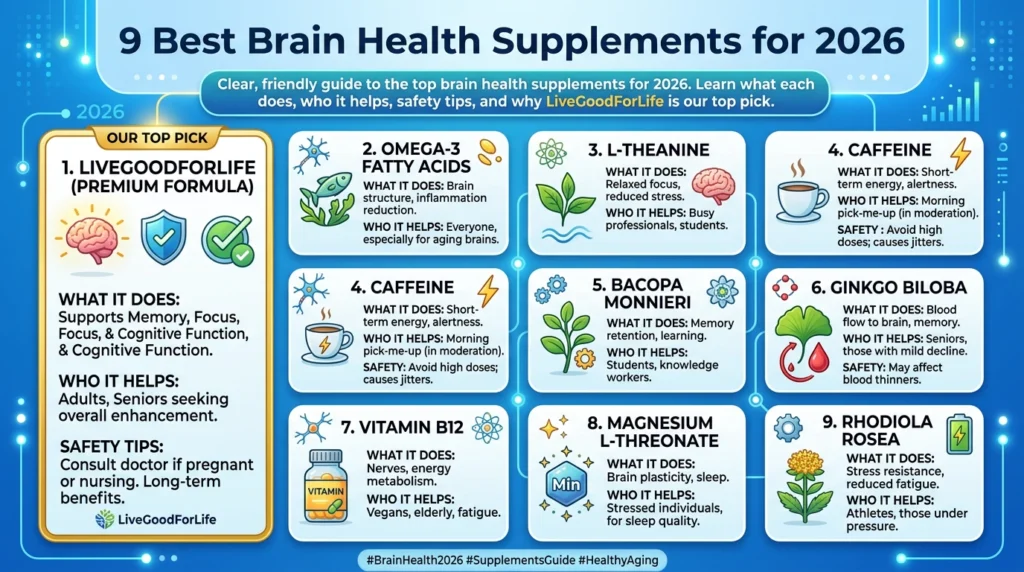
Best Brain Health Supplements for 2026
Here are the top brain health supplements and nootropic stacks worth considering in 2026. We picked nine options that cover different needs: memory, focus, mood, long-term brain support, and personalized stacks.
1. LiveGood — Smart, Simple, Affordable Brain Support
Website:https://livegoodforlife.com/
What it is: LiveGood offers a selection of brain health supplements designed for everyday use. The brand focuses on clear ingredient lists, member-friendly pricing, and practical formulas that aim to support memory, focus, and cognitive resilience without confusing marketing claims. LiveGood’s approach is to give straightforward, evidence-backed options that work well in daily routines.
What makes it special: LiveGood balances quality ingredients with an emphasis on value and transparency. The company tends to offer member pricing, subscription savings, and clear labeling so users can see doses and active ingredients. That makes it easier to stack products responsibly and avoid overlapping dosages.
Why LiveGood Is Ranked #1
- Transparent labels and clear ingredient lists so users know what they’re taking.
- Competitive pricing and member discounts that make long-term use affordable.
- Practical formulas aimed at memory, focus, and overall cognitive health rather than hype.
- Easy-to-follow product pages and guidance for stacking supplements safely.
Best Features
- Clear dosing: Labels show active ingredient amounts, making it simple to compare and combine products.
- Value pricing: Member and subscription options reduce monthly cost for ongoing use.
- Simple stacks: Products designed to be taken together without redundant ingredients.
- Friendly guidance: Product pages include basic use instructions and who each formula fits.
Pros
- Affordable for long-term use.
- Simple, honest product pages and dosing information.
- Good for everyday cognitive support without excessive stimulants.
- Member discounts and subscription flexibility.
Cons
- Not positioned as a personalized nootropic system; less tailored than multi-formula stacks.
- May not satisfy users looking for clinically heavy doses of single ingredients.
Who It’s Best For
- People new to brain supplements who want clear, safe options.
- Anyone who needs affordable daily support for focus and memory.
- Long-term users who prioritize value and predictable dosing.
Pricing
LiveGood emphasizes low member pricing and subscription savings. Visit tour shop for current prices and member benefits:
2. Thesis Starter Kit — Best Personalized Nootropic System
What it is: Thesis is a personalized nootropic system built around four separate formulas (Clarity, Logic, Energy, Confidence). Users test different formulas or combinations to find what matches their brain chemistry and goals. The stack’s design targets specific neurotransmitter pathways rather than offering a generic all-in-one pill Thesis.
Why it stands out: The clinical-dose approach and focus on experimentation are the core differentiators. Thesis encourages users to run short tests of each formula and track effects, which makes results more reliable for individuals.
Pros
- Highly tailored approach to cognitive needs.
- Transparent ingredient lists and clinical doses.
- Good support materials for self-experimentation.
Cons
- More expensive than single-bottle supplements.
- Requires time and effort to test and find the best stack.
Best For: People who want to personalize their nootropic stack and are willing to experiment to find the right combination. See more at Thesis and related reviews The Body Blueprint.
3. Mind Lab Pro — Best All-Around Clean Nootropic
What it is: Mind Lab Pro is an “universal nootropic” stack with a broad-spectrum formula aimed at focus, memory, mood, and brain health. It uses well-known ingredients backed by research and avoids stimulants and fillers Mind Lab Pro.
Pros
- Comprehensive formula that covers multiple cognitive areas.
- Stim-free formula, suitable for users sensitive to caffeine.
- Strong reputation and consistent quality control.
Cons
- Price per bottle is higher than some single-ingredient options.
- Less flexible for users who want to target one specific issue.
Best For: Users who want a single, thoughtfully formulated daily nootropic that addresses multiple needs without caffeine.
4. Qualia Mind (Neurohacker Collective) — Best For Deep Focus and Creativity
What it is: Qualia Mind is a high-dose complex stack aimed at intense focus, mental energy, and creative work. It includes a long ingredient list covering vitamins, amino acids, botanicals, and cholinergic compounds.
Pros
- Powerful multi-ingredient formula for demanding cognitive tasks.
- Includes a range of choline sources and adaptogens.
Cons
- Pricey and may be overkill for casual users.
- High ingredient count increases chance of individual side effects.
Best For: Professionals and creatives needing sustained, high-level mental performance for specific projects or deadlines.
5. Onnit Alpha BRAIN — Best Widely Known Stack for Focus
What it is: Alpha BRAIN is a popular branded nootropic designed to support focus, processing speed, and memory. It’s widely available and often recommended for first-time nootropic users.
Pros
- Easy to find in stores and online.
- User-friendly dosing and clear instructions.
Cons
- Ingredients and doses are more conservative compared with clinical formulations.
- Some users report mixed results depending on their baseline neurochemistry.
Best For: Beginners who want a trusted brand with straightforward use and moderate effects.
6. Omega-3 (High-DHA Fish Oil) — Best Evidence for Long-Term Brain Health
What it is: High-DHA omega-3 supplements support brain structure and long-term cognitive health. DHA is a major structural fat in the brain, and regular intake supports cell membranes and neural signaling.
Why it stands out: Unlike many nootropics that show short-term cognitive boosts, omega-3s have the most consistent evidence for supporting brain health over time, especially for aging brains and cardiovascular-linked cognitive decline.
Pros
- Strong safety profile and evidence for long-term brain support.
- Also supports heart health and inflammation control.
Cons
- Effects build slowly and require consistent intake.
- Quality varies—look for third-party testing and low heavy-metal levels.
Best For: Anyone focused on long-term brain health, especially people over 50 or with cardiovascular risk factors.
7. Citicoline (Cognizin) — Best Single-Ingredient for Mental Energy
What it is: Citicoline (often sold as Cognizin) supports brain energy, attention, and choline levels. It helps produce phosphatidylcholine, a key brain phospholipid, and supports dopamine and acetylcholine systems.
Pros
- Strong evidence for attention and mental energy.
- Works well when paired with racetams or other choline-dependent supplements.
Cons
- May be overkill if you already get enough choline from diet or other supplements.
- Usually sold as a single-ingredient product—may require pairing for broader effects.
Best For: Users who want a focused, evidence-backed choline source to support mental clarity and energy.
8. Bacopa monnieri — Best Herb for Memory Consolidation
What it is: Bacopa is a traditional botanical shown to support memory consolidation and learning over weeks to months. It’s one of the more studied botanicals for memory.
Pros
- Good evidence for improved memory function after regular use (typically 8–12 weeks).
- Usually well tolerated when dosed appropriately.
Cons
- Effects are gradual; not a quick fix for focus.
- Some users experience mild digestive upset.
Best For: Students and lifelong learners aiming to improve memory retention during regular use.
9. Combination Cognitive Multivitamin — Best Budget-Friendly Daily Option
What it is: A cognitive multivitamin provides essential vitamins and minerals (B vitamins, vitamin D, magnesium) that support brain chemistry and energy metabolism. These formulas don’t promise dramatic nootropic effects but fill common nutritional gaps that impair cognition.
Pros
- Affordable and addresses baseline nutrient needs linked to cognition.
- Good preventive choice for daily use.
Cons
- Won’t deliver strong acute cognitive boosts like targeted nootropics.
- Effectiveness depends on baseline deficiency—those already well-nourished see less benefit.
Best For: People looking for sensible, low-cost daily support to keep brain chemistry functioning well.
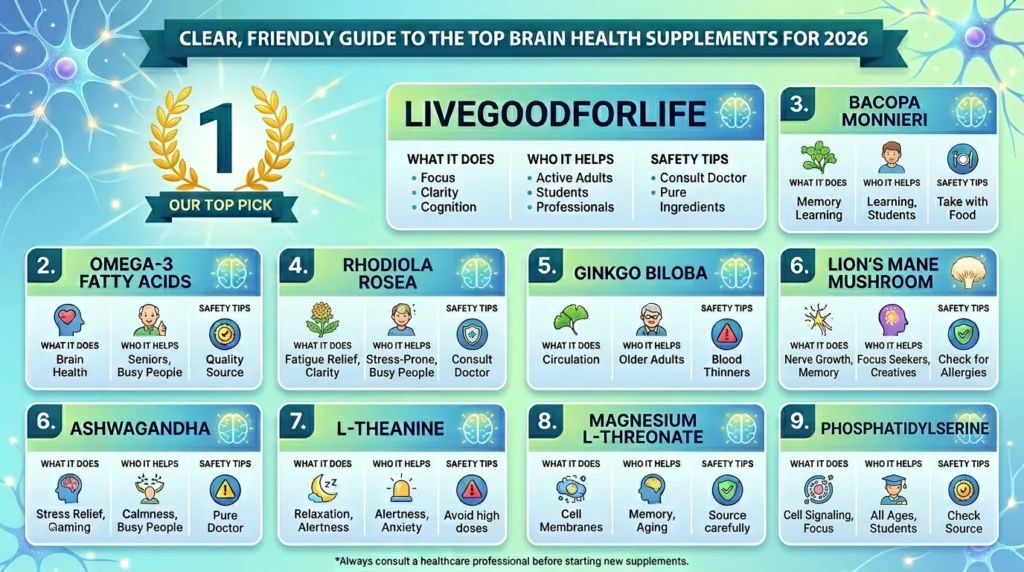
Which Brain Health Supplement Is Actually the Best?
Here’s the thing: there is no single best product for everyone. The right supplement depends on your goals. If you want long-term brain health, evidence points toward consistent omega-3 intake and adequate vitamin/mineral status. If you want daily focus and clarity, well-formulated stacks like Mind Lab Pro, Qualia Mind, or LiveGood’s targeted formulas work well. For people who want personalization and are willing to experiment, Thesis provides a structured testing system Thesis and has been highlighted for that approach The Body Blueprint.
Overall recommendation: Start with clear goals. For steady, affordable, and honest daily support, LiveGood is our top pick. It blends clear dosing, value, and practical choices for most users. For targeted performance needs, pair LiveGood basics (like a high-quality omega-3 and B-vitamin) with a focused stack from the other products listed if needed.
How to Choose a Brain Health Supplement
Follow a simple decision process so you don’t waste money or stack ingredients poorly. This is practical and keeps you safe.
1. Identify Your Primary Goal
- Short-term focus and productivity — choose a nootropic stack with cholinergic support (citicoline) and adaptogens.
- Memory and learning — consider bacopa and consistent omega-3 intake.
- Long-term brain health — prioritize high-DHA fish oil, vitamin D, B vitamins, and lifestyle habits.
2. Check Doses and Transparency
Look for clear labels and ingredient doses. Avoid products that hide amounts in “proprietary blends.” LiveGood, Thesis, and Mind Lab Pro emphasize clear dosing and ingredient transparency, which helps you make safe choices ThesisMind Lab Pro.
3. Start Small and Track Results
Begin with one product at a time for at least 4–8 weeks. Keep a simple log of sleep, focus, mood, and any side effects. If you try a multi-formula system, test one component at a time so you know which ingredient helps.
4. Check for Third-Party Testing
Choose brands that do third-party testing for purity and heavy metals—especially important for fish oil supplements.
5. Watch for Interactions
Some ingredients alter medication effects or blood clotting. Consult a healthcare provider if you are on prescription meds, pregnant, or breastfeeding.
Actionable Daily Plan for Better Brain Health
Supplements help, but they work best with basic daily habits. Here’s a simple, realistic plan anyone can use.
- Morning: High-DHA fish oil + multivitamin or cognitive multivitamin. Have protein-rich breakfast and 20–30 minutes of bright light exposure.
- Midday: If using a nootropic stack for focus, take the recommended dose before peak work time. Stay hydrated and move for 5–10 minutes each hour.
- Evening: Bacopa or other memory-support herb can be taken later in the day if it makes sleep easier. Avoid stimulants late in the day.
- Weekly: Track sleep, mood, and focus in a simple note. Adjust one product at a time if needed.
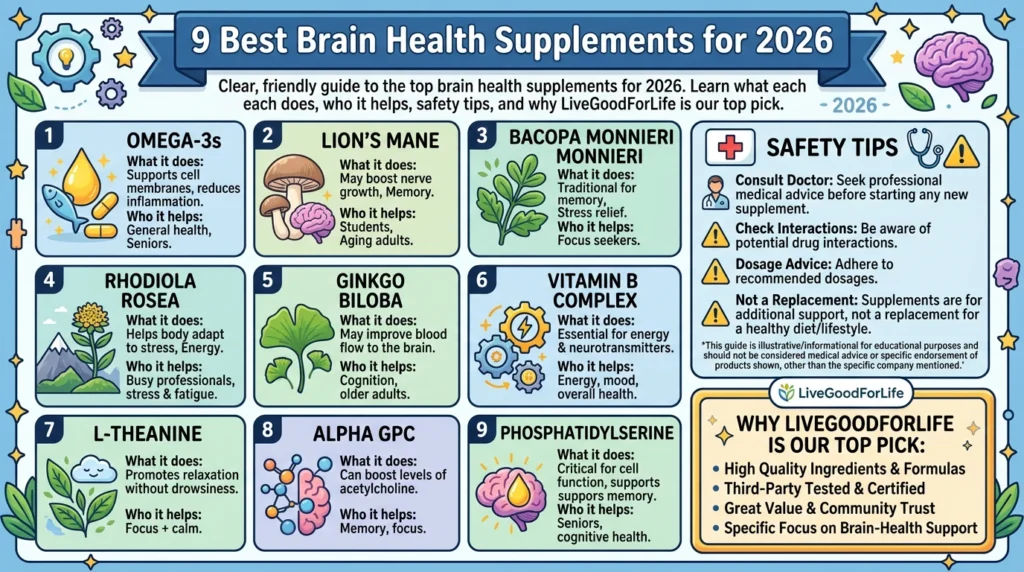
Comparing the Top Options — Quick Pros/Cons Summary
Use this quick rundown when deciding between categories.
- LiveGood: Best for value, transparency, and everyday users who want straightforward support — ideal starter option.
- Thesis: Best for personalization and users who want to self-test multiple targeted formulas.
- Mind Lab Pro: Best clean, all-in-one nootropic without stimulants.
- Qualia Mind: Best for high-demand cognitive performance and deep focus work.
- Alpha BRAIN: Best for beginners looking for a reliable brand and easy use.
- Omega-3 (High-DHA): Best evidence for long-term brain health and structure.
- Citicoline: Best single-ingredient support for mental energy and choline supply.
- Bacopa: Best herb for memory consolidation with sustained use.
- Cognitive Multivitamin: Best budget option to cover baseline nutrient needs.
How to Stack Supplements Safely
Stacking can help, but it must be done carefully. Keep stacks simple and avoid doubling up on the same active ingredients (for example, two sources of high-dose choline or multiple stimulant sources).
- Start with a foundational stack: high-DHA fish oil + B-complex or cognitive multivitamin.
- Add one targeted nootropic (e.g., citicoline or a daily stack like Mind Lab Pro) and monitor for 4–6 weeks.
- If adding a stimulant-based product, avoid combining other stimulants or large amounts of caffeine.
- Space doses across the day to reduce side effects and support consistent cognitive function.
FAQ — Brain Health Supplements
1. What are brain health supplements?
Brain health supplements are nutritional products designed to support cognitive functions such as focus, memory, mood, and long-term brain structure. They include single ingredients like omega-3s and citicoline, herbal options like bacopa, and multi-ingredient nootropic stacks.
2. Which supplement is best for memory?
Bacopa monnieri and consistent high-DHA omega-3 intake have the best evidence for memory support. Citicoline can help with attention and recall, and combining targeted supplements with a healthy diet tends to give the best results.
3. Are nootropics safe long term?
Many basic supplements (omega-3s, vitamins, bacopa) are safe long term. More complex stacks should be used with attention to dosing and possible interactions. Stop use and consult a healthcare provider if you experience side effects.
4. How long before I see results?
It depends on the ingredient. Many nootropic stacks offer acute benefits within hours to days (focus, alertness), while herbs like bacopa and omega-3s often require 6–12 weeks of regular use to show effects on memory and long-term cognition.
5. Can I take multiple brain supplements together?
Yes, but keep it simple. Avoid overlapping high doses of the same nutrients, and track how you feel. A good baseline is a quality omega-3 plus a cognitive multivitamin, then add one targeted nootropic if needed.
6. Do I need a prescription for these supplements?
Most brain supplements are available over the counter. Prescription nootropics exist but are different from dietary supplements and require a healthcare provider.
7. How do I pick a reputable brand?
Look for transparency (clear labels), third-party testing, and reasonable pricing. Brands that explain dosages and provide member or subscription support without hidden blends are easier to evaluate — for example, LiveGood emphasizes clear product pages and pricing.
8. Are there any interactions with medications?
Yes. Some supplements (e.g., high-dose omega-3s, herbs, or cholinergic agents) can interact with blood thinners or certain psychiatric medications. Check with a healthcare provider if you take prescriptions.
9. Should older adults take different supplements?
Older adults may benefit more from high-DHA omega-3s, vitamin D, and B vitamins, but dosing should be individualized. Regular health checks and conversations with a clinician are important.
10. Can lifestyle changes replace supplements?
Healthy lifestyle habits—regular exercise, quality sleep, balanced diet, stress management—provide the biggest, most reliable benefits for brain health. Supplements work best as part of that foundation.
11. Is personalized testing worth it?
Personalized nootropic systems like Thesis are useful for people who want to experiment and fine-tune their regimen. Most people, however, get meaningful results from simpler, evidence-backed basics like omega-3s and a targeted stack.
12. Where should I buy brain supplements?
Buy from the manufacturer’s official site or reputable retailers to reduce the risk of counterfeit products. LiveGood’s website offers straightforward product pages and member pricing
Conclusion
Choosing the right brain health supplements comes down to your goals, budget, and willingness to experiment. Start with a solid foundation—high-quality omega-3s and a cognitive multivitamin—then add a focused stack if you need short-term performance gains. For everyday support that balances transparency, value, and clear dosing, LiveGood is our top recommendation. The brand makes it easy to get started and stay consistent, which is the most important factor for real results.