Does Collagen Help Inflammation?

A Real-Life Guide to What It Can (and Can’t) Support
If you’ve been searching for “does collagen help inflammation“, you’ve probably run into the same problem: confident claims on one side, skeptical takes on the other, and very little that explains what collagen can realistically support (or how to tell if it’s worth trying for you).
This guide keeps it practical and neutral. You’ll learn what research on collagen typically measures (and what it doesn’t), which collagen types matter most depending on your goal, how to troubleshoot common issues like digestive discomfort or “puffiness,” and how to run a simple 2-week trial without overcomplicating your routine.
- What collagen is and what “inflammation” usually means in everyday terms
- What studies tend to focus on (joint comfort, soreness, and sometimes lab markers)
- How to pick a type (collagen peptides vs. type II; marine vs. bovine)
- A simple 2-week test plan, plus meal templates and a grocery list to make it easy
Important: This article is for educational purposes only and is not medical advice. If you have a diagnosed inflammatory condition, take prescription medications (including blood thinners), are pregnant or nursing, or have complex symptoms, it’s best to get personalized guidance from a qualified clinician before changing supplements.
Last updated: May 2026
Written by Daniel Popa, founder of LiveGoodForLife.com. This content is for educational purposes only and is not medical advice.
What people usually mean by “inflammation” (and why collagen gets mentioned)
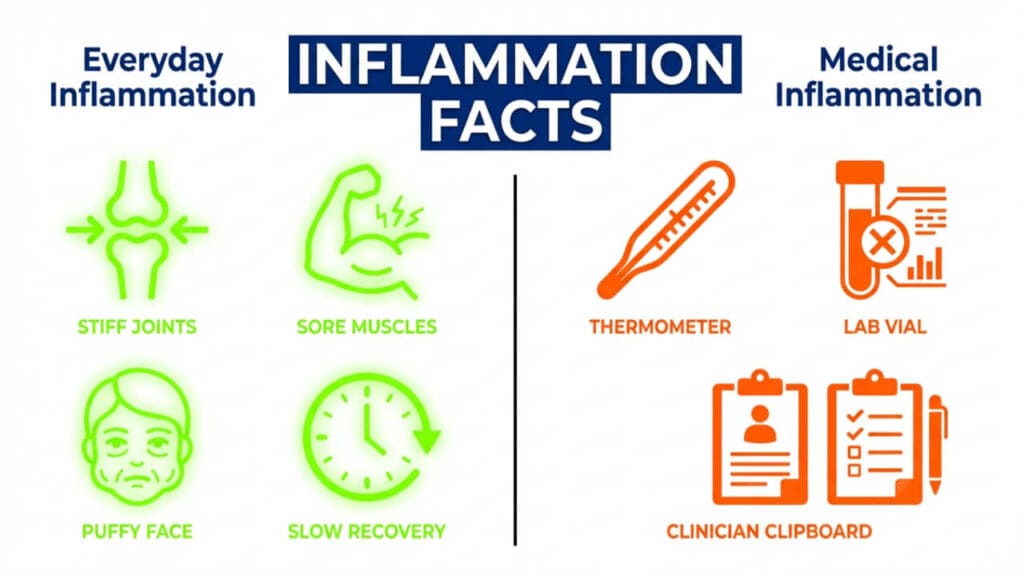
Most people aren’t searching “inflammation” out of curiosity. They’re searching because something feels off: stiffness that lingers, achy joints, a puffy morning feeling, slower recovery after workouts, or the sense that their body is running a little “hot” day to day.
It’s also why collagen gets pulled into the conversation. Collagen isn’t marketed like a vitamin—it’s talked about as a “structure” supplement, especially for people thinking about joints, tendons, and mobility.
Everyday “inflammation” vs medical inflammation
In everyday language, “inflammation” often becomes shorthand for how your body feels: soreness, stiffness, swelling, tenderness, or recovery that seems slower than it used to be. That can be a useful way to describe an experience, but it isn’t the same thing as a medical diagnosis.
If you want a medically grounded explanation of what inflammation is (and the typical signs clinicians mean by the word), Cleveland Clinic has a clear overview here: Cleveland Clinic: What Is Inflammation?.
This post won’t diagnose, treat, or “fix” inflammation. Instead, it focuses on what collagen may support as part of a broader routine—especially routines that also include the basics that tend to matter most (sleep consistency, regular movement, and a diet pattern that covers protein and plants).
If you want a clean foundation on what chronic inflammation is, what tends to drive it, and why it can stick around, start here: Chronic Inflammation: Symptoms & Causes.
Where collagen fits in the body (simple explanation)
Collagen is the body’s most abundant structural protein. Think of it as part of the “scaffolding” that helps give shape and resilience to tissues like skin, tendons, ligaments, cartilage, and parts of the bone matrix.
That’s why collagen gets connected to joint comfort and mobility. When people say they’re looking for “inflammation support,” what they often mean is that they want to feel better while going about their normal life—walking, training, lifting, sitting less painfully, or recovering more smoothly after activity.
Does collagen help inflammation? What research suggests (without hype)
So, does collagen help inflammation? The most responsible answer is: collagen research tends to be strongest when it looks at joint comfort, function, and recovery-related outcomes—not when it promises broad, whole-body “anti-inflammatory” effects. In other words, collagen is usually studied as connective-tissue support, not as a cure-all.
For a cautious, consumer-friendly summary of what collagen supplements may and may not do (and why results can look mixed), Harvard Health offers a balanced overview: Harvard Health: Do collagen supplements fulfill their promises?.
What outcomes studies often look at
When collagen is studied in humans, outcomes often fall into a few practical categories:
- Joint comfort and function: how people report comfort during daily movement or exercise, and whether mobility feels easier over time
- Exercise-related soreness and recovery: how the body feels after training blocks, especially in people increasing activity
- Lab markers: sometimes measured, but not always consistent across studies and not always the main takeaway for everyday use
This matters because it sets expectations. If you’re taking collagen hoping it will dramatically change “inflammation” overnight, you’ll likely be disappointed. If you’re using it as a structured, consistent add-on to support connective tissue and recovery habits, the experience may be more aligned with what research actually explores.
What seems most plausible (mechanisms, explained plainly)
Collagen supplements (often “collagen peptides”) provide amino acids your body uses as building blocks—especially glycine, proline, and hydroxyproline. You can think of these as raw materials that may help support normal tissue maintenance when paired with enough overall protein and a realistic training or movement routine.
In plain terms: collagen isn’t a “kill inflammation” ingredient. It’s more often framed as supporting the tissues that take daily wear and tear—tendons, ligaments, cartilage, and skin—and supporting normal repair processes. That’s why the most appropriate language is supports (not “reduces inflammation”).
Where the evidence is weaker or mixed
The weakest claims are usually the biggest ones: collagen as a universal fix for “whole-body inflammation,” rapid results, or dramatic changes that don’t match the slow, structural nature of connective tissue. Some studies include inflammation-related markers, but that’s not the same as proving a broad anti-inflammatory effect in daily life.
If you’ve seen marketing that makes collagen sound like a shortcut, it’s worth treating that as a red flag. When a supplement is positioned as doing everything, it can be hard to evaluate—and easy to overspend on.
Who might notice benefits most (practical, non-medical framing)
People’s experiences vary, but collagen tends to make the most practical sense for readers in a few situations:
- People training or returning to training who want extra support for joint comfort and recovery habits
- People with low protein intake who are trying to improve overall diet quality and consistency (collagen can be a useful add-on, but it shouldn’t replace complete proteins)
- People who are consistent with basics like sleep, walking/mobility work, and protein-forward meals—because consistency is what makes subtle changes noticeable
If you want broader context on where collagen fits compared to other common options people consider for inflammation support, you can explore your site’s overview here: Top 12 Anti-Inflammatory Supplements.
Which collagen is best for inflammation-related concerns?
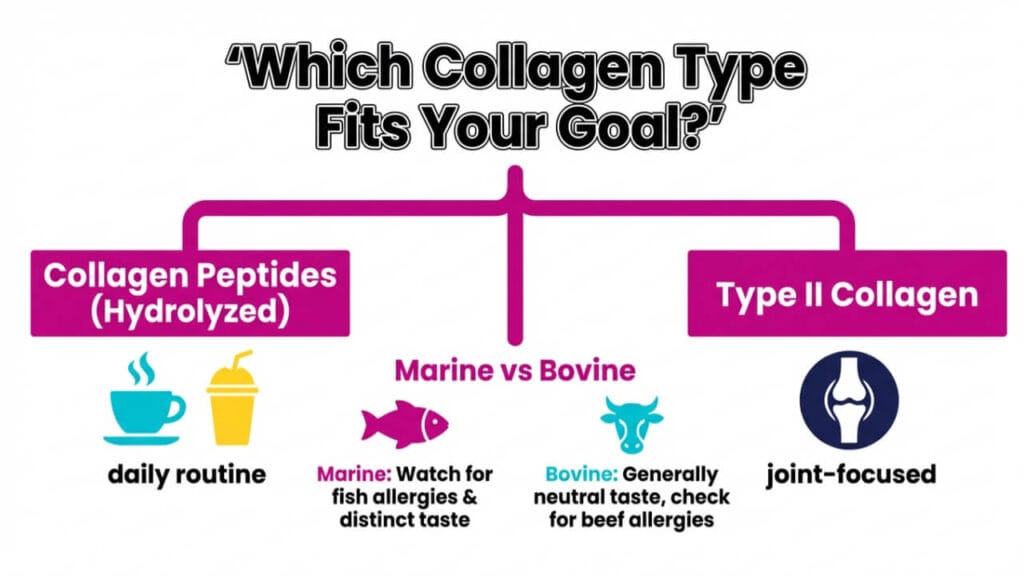
When people ask “what collagen is best for inflammation,” they’re usually trying to solve a more specific problem: joint comfort, mobility, or recovery that feels slower than it used to. Choosing the right type matters because “collagen” on a label can mean a few different things.
Collagen peptides (hydrolyzed collagen): what it is and who it suits
Collagen peptides (often called hydrolyzed collagen) are collagen proteins broken into smaller pieces so they dissolve more easily. This is the version most people picture: a powder that mixes into coffee, tea, smoothies, or yogurt without much taste.
Why people choose it:
- Low friction: easy to mix, usually neutral taste, simple daily habit
- General connective-tissue support angle: often used as a “baseline” add-on for tendons, ligaments, and overall recovery routines
- Routine-friendly: fits best when it’s treated like a consistent nutrition habit, not a quick fix
A practical note: collagen peptides are not a complete protein, so if your bigger goal is improving overall diet quality, it helps to think of collagen as an “add-on,” not your main protein source.
Type II collagen: when people consider it
Type II collagen is usually discussed in a more joint-specific context because type II is the primary collagen found in cartilage. People often consider it when their main goal is joint comfort during daily movement rather than skin/hair/nails or general protein support.
Expectation-setting matters here. Connective tissue changes tend to be gradual, and many people only notice a difference when they’ve been consistent long enough to judge it fairly. If you try type II collagen, it’s usually smartest to evaluate it like a routine—measured in weeks, not days.
Marine vs bovine collagen: how to choose
You’ll also see collagen categorized by source:
- Marine collagen (from fish): often chosen for dietary preferences, and it’s important to consider fish allergies or sensitivities
- Bovine collagen (from cattle): widely available and commonly used for collagen peptides
In real life, many people decide based on what they’ll actually tolerate and stick with: taste/smell, how it mixes, and any sensitivity to the source. Sustainability can also be a factor for some readers, especially when considering marine options.
Simple choosing checklist (quick bullets)
If you want a simple way to choose without overthinking it, use this checklist:
- Your main goal: skin/hair/nails support, joint comfort and mobility, or building a consistent protein-forward routine
- Budget + tolerance: what you can afford to use consistently, and what your digestion tolerates
- Convenience: powder mixed into a daily anchor vs capsules you’ll remember to take
Can collagen cause swelling or make inflammation worse?
This is one of the most common “real life” concerns in the collagen search cluster. Most people tolerate collagen well, but any supplement can be a mismatch for someone’s body, product choice, or routine. The key is to know what’s common, what’s plausible, and what’s a sign to pause and reassess.
Commonly reported side effects (realistic, calm)
When people report side effects from collagen, they’re often mild and routine-related rather than dramatic. Common complaints include:
- GI upset (bloating, gassiness, or a “heavy” feeling)
- Fullness, especially if collagen is added on top of an already protein-heavy day
- Aftertaste (more common with some flavored powders or marine sources)
- Sensitivity to flavorings/sweeteners in flavored products (sometimes the additives are the issue, not collagen itself)
If you notice discomfort, a simple troubleshooting move is to switch to an unflavored product with fewer added ingredients and keep everything else steady for a week.
Why some people report “puffiness” or swelling
“Swelling” can mean different things. Sometimes people mean joint swelling, and sometimes they mean a puffy, water-retention feeling. A few practical reasons this can happen (without assuming collagen is the direct cause) include:
- Sodium in flavored products: some mixes include added sodium or ingredients that change taste and hydration balance
- Changes in hydration and carbs: if your routine shifts (more salt, more carbs, less water), you can feel puffy regardless of collagen
- Food intolerances or allergens: marine collagen can be an issue for people sensitive to fish, and flavored products can include trigger ingredients
None of this is a guarantee—just a practical troubleshooting list. If puffiness shows up, the cleanest test is to remove the flavored version, keep hydration steady, and re-check how you feel over several days.
Who should check with a clinician first (meds/conditions caution)
Collagen is often treated as “simple,” but it’s still smart to get personalized guidance first if any of these apply:
- Pregnant or breastfeeding
- Kidney disease history or you’ve been told to follow a protein-restricted diet
- Blood thinners or complex medications (general supplement caution; your clinician/pharmacist can advise on fit and timing)
- Autoimmune or inflammatory diagnoses where you’re already managing symptoms and medications
If you ever experience hives, facial swelling, or breathing issues after starting a new product, treat that as urgent and seek medical help. For non-urgent issues (digestive discomfort, puffiness), the most useful approach is to stop the new supplement, let things settle, and then decide whether a simpler product or a smaller change makes sense.
How to try collagen in real life (a simple 2-week test)
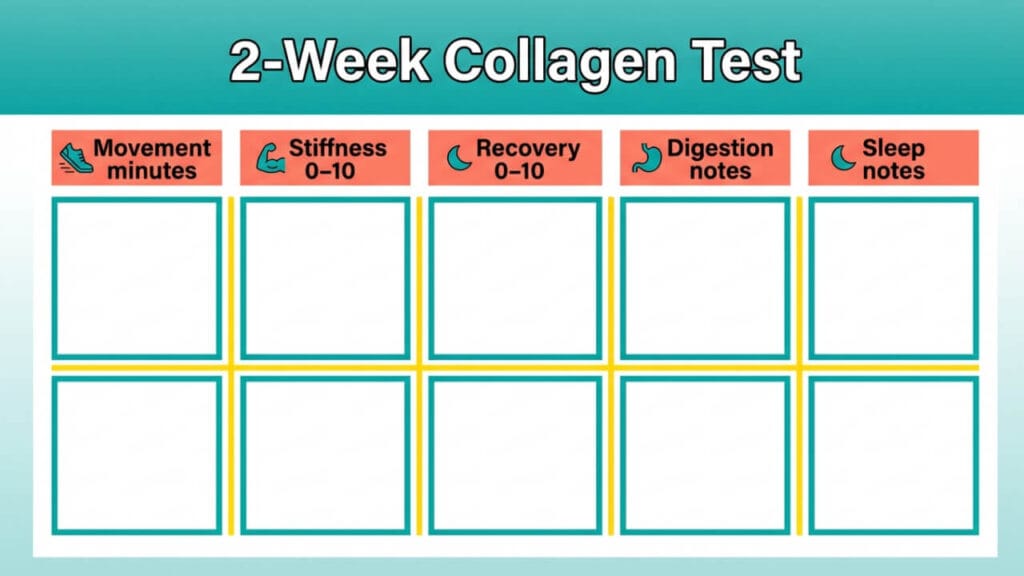
If you’re going to test collagen, the goal is to make it easy to judge—without changing five other variables at the same time. A simple 2-week experiment won’t “prove” anything medically, but it can help you decide whether collagen fits your routine and whether you notice any meaningful change in how you feel day to day.
The “one change” framework (2-week experiment)
This works best when you keep the setup boring and consistent:
- Keep everything else steady: same training plan, similar sleep schedule, similar meal pattern
- Pick one product form and stick to it: don’t swap brands/flavors mid-test
- Track 2–3 signals: comfort during movement, recovery after activity, and digestion/tolerance
If you want a reliable, conservative overview of supplement safety basics (labels, quality, risk, and when to talk to a clinician), the NIH Office of Dietary Supplements has a consumer guide here: Dietary Supplements: What You Need to Know.
Daily anchors (repeatable routine)
The easiest way to stay consistent is to attach collagen to something you already do. Pick one anchor (or two if you’re very routine-driven):
- Anchor A: morning beverage or breakfast (coffee/tea, yogurt bowl, smoothie)
- Anchor B: afternoon snack (protein snack, yogurt, oats, or a simple shake)
- Anchor C (optional): evening wind-down (decaf drink, dessert-style yogurt bowl, or a simple snack)
Practical tip: consistency beats perfect timing. The “best” anchor is the one you’ll remember on a busy day.
Tracking template (copy/paste)
Keep your notes simple. You’re looking for trends, not perfection.
- Day/date:
- Training/walking minutes:
- Comfort score (0–10): “stiffness.”
- Recovery score (0–10): how you feel the next day
- GI notes: bloating, fullness, tolerance
- Sleep notes: hours + quality (quick 1–2 words)
Meal templates that pair well with a collagen routine
Collagen works best in the context of an overall routine that’s already doing the basics: adequate protein, plenty of plants, and enough fiber and fluids to support digestion. These are mix-and-match templates (not recipes) you can rotate through without getting bored.
Breakfast templates (3–4 options)
- Greek yogurt bowl: Greek yogurt + fruit + oats and/or nuts (easy, protein-forward)
- Egg plate: eggs + whole-grain toast + a handful of greens (simple and filling)
- Smoothie framework: protein base (Greek yogurt or protein powder) + fiber (berries/oats/chia) + fat (nut butter) + liquid (milk/alt milk)
- Overnight oats template: oats + yogurt or milk + fruit + seeds (grab-and-go)
Lunch/dinner templates (3–4 options)
- Plate method: ½ vegetables, ¼ protein, ¼ carbs + olive oil (easy to repeat anywhere)
- Soup/salad + protein add-on: add chicken, tuna, beans, tofu, or eggs to make it satisfying
- Rice bowl: rice or quinoa + protein + beans + veggies + a simple sauce (tahini, yogurt sauce, salsa)
- Sheet-pan template: protein + mixed vegetables + potatoes (one-pan, minimal prep)
Snack templates (3–4 options)
- Cottage cheese + berries
- Hummus + veggies
- Nuts + fruit
- Tuna or salmon packet + whole-grain crackers
These templates are intentionally simple. The point is to make your baseline routine more consistent so you can judge whether collagen itself is a helpful add-on, rather than using it to compensate for an unpredictable week of meals and sleep.
Grocery list + minimal prep routine (15–30 minutes)
If you want collagen (or any supplement) to feel “noticeable,” your baseline routine matters. The simplest way to raise baseline consistency is to keep a short grocery list and do a small prep session once or twice per week.
Grocery list (grouped)
Use this as a mix-and-match shopping template. You don’t need everything—just enough options to make meals easy.
- Proteins: eggs, Greek yogurt, cottage cheese, chicken, turkey, salmon, tuna packets, tofu/tempeh, beans/lentils
- Fiber carbs: oats, whole-grain bread/wraps, brown rice or quinoa, potatoes/sweet potatoes, beans, fruit
- Healthy fats: olive oil, nuts, seeds (chia/flax), avocado, nut butter
- Veg + fruit: leafy greens, mixed salad kit, broccoli/cauliflower, carrots/cucumber, peppers, onions; berries, bananas, apples, citrus
- Flavor builders: garlic, lemon/lime, salsa, mustard, vinegar, herbs/spices, low-sugar yogurt-based sauce, broth, frozen veggies for backup
Minimal prep routine
This is the “minimum effective dose” of prep. It’s enough to make the week feel smoother without spending your Sunday in the kitchen.
- Wash/chop vegetables: prep 2–3 options you’ll actually eat (cucumber, peppers, carrots, salad greens)
- Batch cook 1 protein + 1 carb: for example, chicken/tofu + rice/potatoes (enough for 3–4 meals)
- Portion snacks: nuts + fruit, yogurt cups, hummus + veg, tuna packets + crackers
- Make collagen “automatic”: put the container next to your anchor item (coffee maker, blender, tea station, or breakfast bowl)
That last step is the one most people skip. If collagen is out of sight, it usually becomes “I’ll start again tomorrow.”
How to judge collagen claims (hype vs reality)
Collagen is a perfect example of why label literacy matters. The internet tends to turn a simple structural protein into an all-purpose solution. A few quick filters can help you stay grounded and avoid buying products that are mostly marketing.
Red flags to avoid
If a collagen product leans on these patterns, it’s usually a sign to slow down and read the label more carefully:
- “Detox,” “flush,” “cure,” or dramatic promises that sound like medical outcomes
- Proprietary blends that make it hard to see exact amounts (especially when the ingredient list is long)
- Before/after certainty and testimonials presented as proof (instead of transparent labeling and realistic expectations)
If you want a quick, practical guide to spotting “fairy dust” formulas (long ingredient lists with unclear or tiny amounts), use this internal guide: How to Read Supplement Labels (Fairy Dusting).
What “good evidence” looks like
For collagen, “good evidence” usually looks like:
- Human trials (not just mechanistic claims), with realistic timeframes and specific outcomes
- Clear labeling (what type, what form, and what you’re actually getting per serving)
- Quality transparency when available (for example, third-party testing disclosures or batch documentation)
If you want a deeper, non-hype explanation of what “clinically studied” should mean (and what it often doesn’t), this internal post helps readers calibrate expectations: Clinically Studied Ingredients in Supplements.
The 2-week test rule
This is the simplest trust framework I’ve found for supplements that aren’t “make-or-break” medical decisions:
- Test one change for 2 weeks
- Keep the rest stable (training, sleep, meal pattern)
- Decide: continue, adjust, or stop based on your notes—not on hope or hype
Collagen vs turmeric (and other popular anti-inflammatory supplements)
This comparison shows up constantly in search: collagen vs turmeric, collagen vs curcumin, collagen vs “anti-inflammatory supplements.” The tricky part is that these products are often used for different jobs, so it’s easy to compare them as if they’re interchangeable when they’re not.
Different jobs, different expectations
Collagen is most reasonably approached as a structural support routine—something that may support connective tissue maintenance over time when paired with consistent movement, adequate protein, and good basics.
Turmeric/curcumin is usually used for different reasons and can be more about personal tolerance, context, and how it fits within someone’s overall routine. Some people like it; others don’t tolerate it well. Either way, it’s not a “better collagen,” and collagen isn’t a “better turmeric.” They’re simply aimed at different goals.
If you’re choosing just one, decide by your main goal
If your main goal is joint comfort during training or a “moving feels better” routine, collagen often makes the most sense as the first test because it’s easy to build into a daily anchor and evaluate over time.
If your main goal is more general supplement experimentation, turmeric/curcumin might be something you consider—but your best results usually come from starting with the basics first: consistent sleep, steady movement, protein-forward meals, and enough fiber from plants.
And if you’re already trying to build a more complete foundation, it can help to check nutrient basics first. This supporting post is a good companion read: 9 Best Vitamins for Inflammation.
FAQ
Does collagen help inflammation, or is that just marketing?
It can be both, depending on how it’s framed. Collagen is often marketed as broadly “anti-inflammatory,” but the more realistic way to think about it is connective tissue support. Research tends to focus on outcomes like joint comfort, function, and recovery-related measures. If you treat collagen as a consistent routine (not a quick fix), it’s easier to evaluate whether it helps you personally.
What type of collagen is best for inflammation-related joint discomfort?
For many people, collagen peptides are the simplest first choice because they’re easy to mix into daily anchors. Some people consider type II collagen when their focus is more cartilage/joint-specific. The “best” option is usually the one you can take consistently and tolerate well.
Can collagen cause swelling or water retention?
Some people report puffiness, but it’s not guaranteed and may not be caused by collagen itself. Flavored products can include sodium or additives, hydration and carb intake can shift week to week, and marine sources can be a problem for people with fish sensitivities. If you notice puffiness, the cleanest test is to stop the new product, stabilize hydration and meals, then re-evaluate with a simpler, unflavored option if you want to retry.
How long does it take to notice anything from collagen?
Many people judge collagen too quickly. Because it’s connected to structural tissues and routines, it often makes more sense to evaluate over weeks rather than days. That’s why a short, structured test (like 2 weeks) is useful for tolerance and habit fit, and a longer period is often needed for a more meaningful personal verdict.
Is marine collagen better than bovine collagen?
Not automatically. The better choice is usually based on your dietary preferences, taste/tolerance, and allergy considerations (especially fish allergies for marine collagen). If you can’t tolerate the product or you won’t use it consistently, “better” doesn’t matter.
Can I take collagen every day?
Many people use collagen daily as a routine add-on, but daily use isn’t right for everyone. If you have a medical condition, are pregnant or nursing, are on a protein-restricted diet, or take prescription medications, it’s smart to check with a qualified clinician first. For everyone else, tolerance and consistency are the main deciding factors.
Final Thoughts
With collagen, consistency beats perfection. The best plan is the one you can repeat on ordinary weeks, not just when motivation is high.
If you want a realistic starting point, aim for 2–3 anchors: protein at breakfast, vegetables at lunch, and a daily walk. If collagen fits, attach it to one of those anchors and track how you feel.
And keep the fundamentals in view: sleep quality, regular movement, stress downshifts, and meals that provide enough protein and fiber. Supplements can support a routine, but they rarely outperform the basics.
If you have a diagnosis, complex symptoms, or you take prescription medications, clinician guidance is the safest way to personalize your approach.
Disclaimer
This article is for educational purposes only and is not medical advice. Always consult a qualified healthcare professional for personal guidance, especially if you take medications, are pregnant or nursing, or have a medical condition. This content is not intended to diagnose, treat, cure, or prevent any disease.