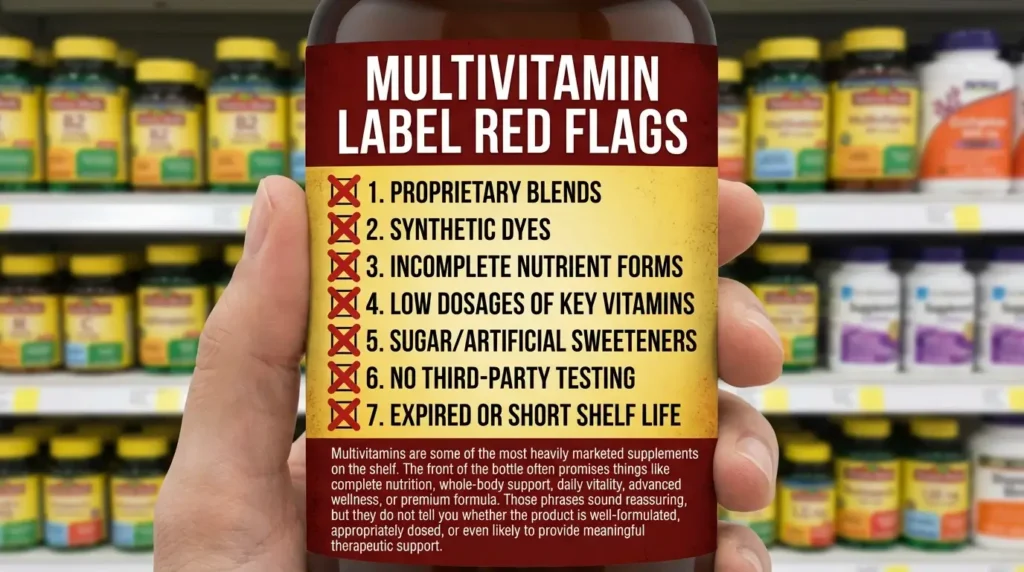
7 Multivitamin Label Red Flags to Check First
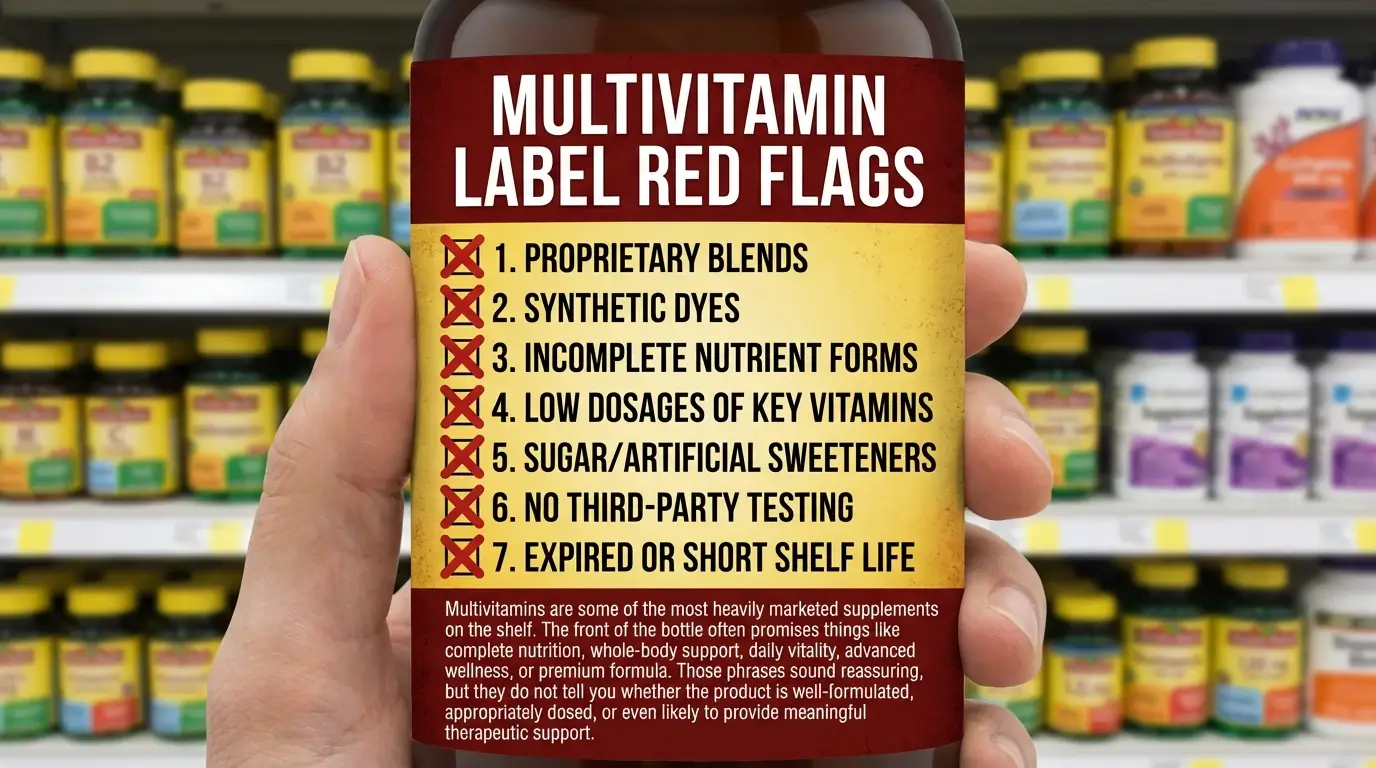
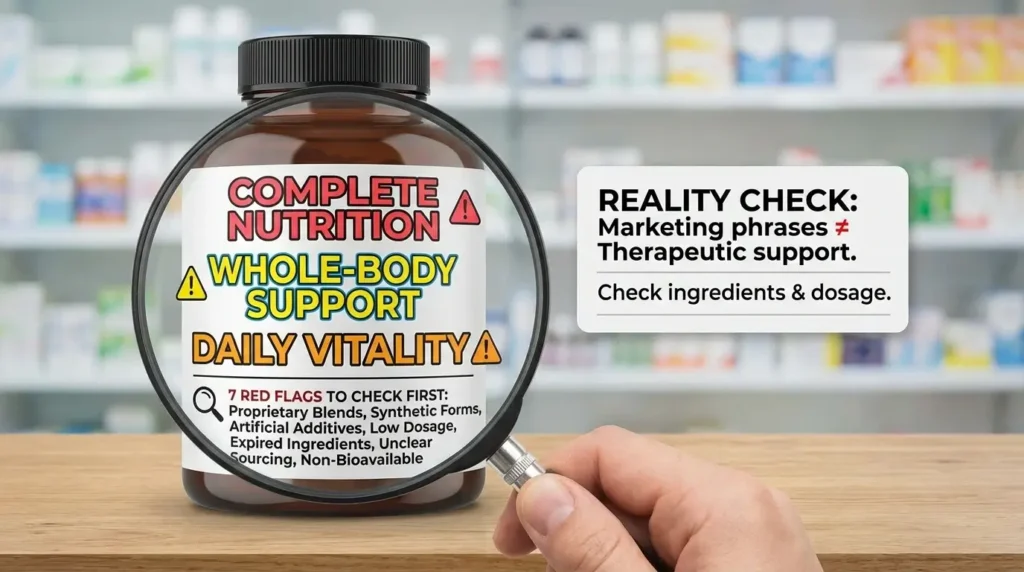
Multivitamins are some of the most heavily marketed supplements on the shelf. The front of the bottle often promises things like complete nutrition, whole-body support, daily vitality, advanced wellness, or premium formula. Those phrases sound reassuring, but they do not tell you whether the product is well-formulated, appropriately dosed, or even likely to provide meaningful therapeutic support.
That is where many shoppers get misled. A multivitamin can look impressive because the label is polished, the bottle is full of buzzwords, and the formula name sounds advanced. But when you actually read the Supplement Facts panel, the product may turn out to be underdosed, overloaded with filler ingredients, or designed more for marketing appeal than for practical usefulness.
This guide explains seven red flags on multivitamin labels to check first. The goal is not to make supplement shopping feel complicated. It is to help you tell the difference between persuasive wording and a formula that is more likely to offer real nutritional value.
Why do multivitamin labels confuse so many people
Multivitamin labels are confusing because they often mix three very different things together:
- Marketing language that sounds impressive
- Nutrient lists that look comprehensive
- Health expectations that may go far beyond what the formula can realistically support
That combination makes it easy to assume that a product with more claims, more ingredients, or more flashy wording must be better. In reality, the best label is usually the one that is the clearest, most transparent, and easiest to evaluate without hype. For a broader framework, see our guide to spotting weak supplement labels and fairy-dusting.
Red flag #1: The front label sounds stronger than the actual formula
Some multivitamins are marketed with phrases like high potency, advanced formula, clinical strength, or maximum support. These phrases can create the impression that the formula is carefully built for meaningful outcomes. But unless the Supplement Facts panel supports that impression, the wording is just branding.
This is one of the first things smart buyers should learn to separate: marketing strength is not the same as therapeutic strength.
A label may sound powerful while still containing low or poorly chosen doses, weak mineral forms, or a long ingredient list that looks impressive but contributes very little in practice.
What to check
- Does the formula justify the strong front-label wording?
- Are the key vitamins and minerals present in meaningful amounts?
- Does the product rely more on branding language than actual nutrient clarity?
If the front label feels more persuasive than informative, slow down and look deeper.
Red flag #2: It tries to do everything for everyone
A multivitamin that claims to support energy, immunity, focus, metabolism, stress, beauty, digestion, heart health, joint comfort, detox, and healthy aging all at once should make you more cautious, not less.
Broad support claims are common in this category because they make the product easier to sell. But a formula that tries to be everything for everyone often becomes diluted. Instead of delivering focused support, it turns into a long list of ingredients that create the appearance of completeness without much strategic formulation behind it.
This does not mean broad-spectrum multivitamins are useless. It means you should be careful when the label promises a long list of benefits without making it clear how the formula actually supports them.
Red flag #3: The ingredient forms are vague, cheap, or unimpressive
Two multivitamins can list the same nutrients while still being very different in quality. The form of a nutrient matters. Magnesium oxide is not the same thing as magnesium glycinate. Cyanocobalamin is not the same thing as methylcobalamin. Folic acid is not the same thing as methylfolate.
A label that hides behind generic names without giving much detail may be using cheaper or less thoughtful ingredient forms. That does not automatically make the product bad, but it does make the formula harder to trust.
Examples to notice
- Minerals that use lower-value forms without explanation
- B vitamins listed in basic synthetic forms when better forms are common in premium formulas
- No clarity around why specific forms were chosen
When a brand wants to be taken seriously, it should make it easier to understand what is inside and why it was included.
Red flag #4: The doses look impressive, but the formula is not actually balanced
Some multivitamins overload a few nutrients so the label looks exciting. Huge percentages of daily value can catch attention, especially for vitamins like B12, C, or biotin. But very large numbers do not automatically make a formula better.
Sometimes the label is built for visual impact rather than overall balance. A formula may include dramatic doses of a few trendy nutrients while underdelivering on minerals or other foundational components.
This is a subtle but important point: a multivitamin should not be judged only by the biggest numbers on the label. It should be judged by whether the overall formula looks thoughtful, balanced, and coherent.
What balanced support looks more like
- Key nutrients are present in sensible amounts
- The formula is not relying on one or two oversized numbers for marketing appeal
- Minerals and supportive nutrients are not treated as an afterthought
Red flag #5: It uses hype words that imply therapeutic support without real label depth
This is one of the biggest issues in supplement marketing. A multivitamin label may use words like revitalize, optimize, restore, rebuild, or support total wellness. These phrases are designed to sound meaningful, but they often sit in a gray zone between general wellness messaging and stronger therapeutic suggestion.
That matters because many people are not buying multivitamins for abstract “wellness.” They are buying them because they want help with energy, resilience, stress, fatigue, recovery, or nutritional gaps. When a brand leans heavily on elevated wording, it can create expectations that the actual formula is not structured to support in a meaningful way.
In other words, the label may sound like it offers therapeutic support, while the nutrient profile suggests something much more generic. The U.S. FDA’s supplement labeling overview is useful background for understanding how supplement claims are framed on labels: Dietary Supplements | FDA.
Good question to ask
If I ignored the front label completely and only read the nutrient forms and doses, would this still look like a strong product?
If the answer is no, the wording may be doing more work than the formula.
Red flag #6: Proprietary blends or cluttered add-ons make the formula harder to judge
A multivitamin already has a lot to accomplish. When brands start adding proprietary blends, antioxidant complexes, greens powders, adaptogens, mushrooms, enzymes, or herbal extras, the formula can become harder to evaluate instead of more helpful.
Sometimes these add-ons are included because they sound attractive on the label. They create a “more complete” feeling, but the actual amounts may be too small to matter much. That is especially true when the product uses a proprietary blend that makes it harder to see exactly how much of each ingredient is included.
The more cluttered the label becomes, the more important it is to ask whether the product is focused on real utility or just trying to win attention.
Red flag #7: The label gives you very little help comparing value
A multivitamin can look affordable until you notice the serving size, capsule count, or daily recommendation. One bottle may seem cheaper, but require four capsules a day. Another may look more expensive while providing better daily value.
This is why smart supplement buying is not just about formula quality. It is also about whether the label gives enough information to compare value fairly.
What to compare
- Serving size
- Number of servings per bottle
- Cost per serving
- Whether the formula justifies its price tier
If a product is priced like a premium formula but the label looks ordinary, that is a red flag worth noticing. For the public-facing framework on daily values and label basics, the NIH Office of Dietary Supplements is a helpful reference point: NIH Office of Dietary Supplements.
How to tell marketing wording from real support
There is nothing wrong with a product sounding appealing. All brands use packaging and messaging to attract attention. The real question is whether the label still looks strong after you strip away the marketing layer.
That is the easiest mindset shift to make when reading multivitamins:
- Ignore the emotional wording first
- Read the nutrient forms
- Look at the dose balance
- Check whether the formula seems coherent
- Compare value per serving
A product that offers real support should still look credible when the hype is removed.
What a stronger multivitamin label tends to do better
Better multivitamin labels tend to share a few qualities:
- Clear, transparent nutrient disclosure
- Thoughtful ingredient forms
- Balanced dosing instead of flashy overstatement
- Less reliance on emotional or inflated wording
- Enough detail to compare the formula with confidence
They do not need to sound dramatic. They just need to make sense. Our guide to what “clinically studied ingredients” really means is another useful example of how marketing language can sound stronger than it really is.
Bottom line
The biggest red flags on multivitamin labels are not always dramatic. Often, they are subtle signs that the bottle is being sold more on image than on thoughtful formulation. Strong marketing language, exaggerated support claims, oversized percentages, vague ingredient formulations, and cluttered add-ons can all create the illusion of quality without necessarily providing meaningful therapeutic support.
The best way to shop more confidently is to slow down, look past the front of the bottle, and ask whether the formula still looks strong when the hype is removed. That one habit alone can help you avoid a lot of weak products.
FAQ
Are all multivitamins with strong marketing wording bad?
No. Some well-made products are also marketed well. The problem is not the wording itself. The problem is when the wording creates expectations that the actual formula does not support.
Do larger daily value percentages mean a better multivitamin?
Not always. Very high percentages may look impressive, but a stronger formula is usually more about overall balance, ingredient forms, and practical usefulness than just big numbers.
What is the fastest way to judge a multivitamin label?
Ignore the front-label claims first. Then look at serving size, nutrient forms, overall balance, and whether the formula seems transparent and coherent.
Why do multivitamin labels use so much hype?
Because multivitamins are a competitive category, and broad wellness language is easier to market than careful formulation details. That is exactly why learning to read the actual label matters.
Disclaimer
This article is for educational purposes only and does not provide medical advice, diagnosis, or treatment. Multivitamins are not a substitute for individualized care, and not every formula is appropriate for every person. If you have medical concerns, nutrient deficiencies, or questions about therapeutic support, speak with a qualified healthcare professional.