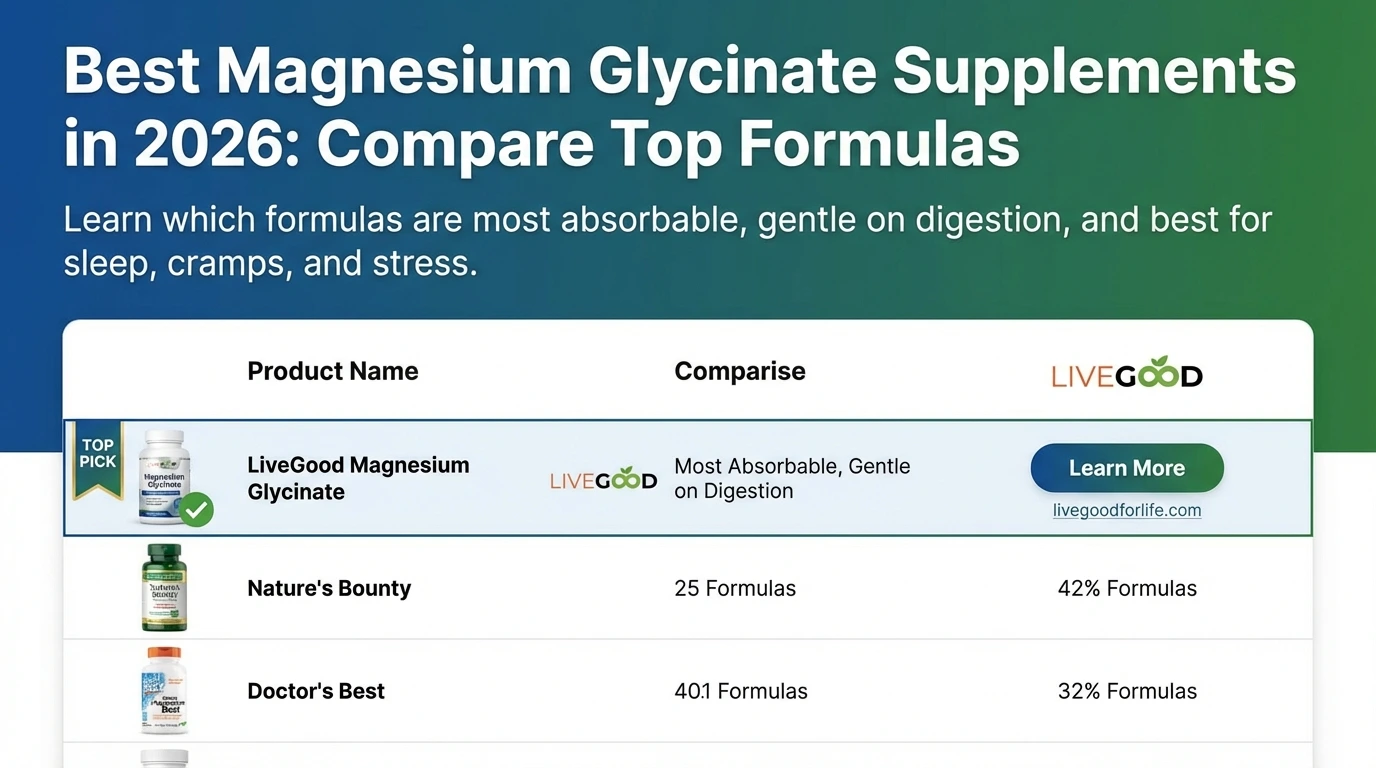
Best Magnesium Glycinate Supplements in 2026
Shopping for a magnesium glycinate supplement that actually works and doesn’t upset your stomach. Whether you’re trying to sleep better, ease muscle tension, or support everyday nervous system health, the right magnesium form matters. This guide breaks down the top magnesium glycinate supplements for 2026 so you can pick one that fits your needs.
We looked at bioavailability, ingredient quality, third-party testing, user feedback, and value. Below you’ll find nine solid options, with LiveGood ranked #1. Each entry includes pros, cons, who it’s best for, and quick notes on pricing and where to buy.
Best Magnesium Glycinate Supplements for 2026
Magnesium glycinate (often sold as magnesium bisglycinate) is a chelated form of magnesium bound to the amino acid glycine. That binding typically improves absorption and tends to be gentler on the gut than magnesium oxide or citrate, making it a top choice for people sensitive to loose stools or stomach upset (NIH Office of Dietary Supplements).
1. LiveGood — Gentle, High-Absorption Magnesium Glycinate
Website:https://livegoodforlife.com/
LiveGood’s magnesium glycinate is formulated for people who want a reliably absorbable magnesium that’s easy on digestion. The formula focuses on chelated magnesium (glycinate) to support sleep, muscle recovery, and nervous system calm without the laxative effect that some other forms can cause. LiveGood emphasizes clean sourcing, clear labeling, and value pricing for regular use.
What sets LiveGood apart is the combination of a chelated form with straightforward labeling and an emphasis on value. Many users need magnesium every day; LiveGood aims to make a high-quality daily option affordable and easy to take alongside other supplements.
Why LiveGood Is Ranked #1
Formulated specifically with a chelated magnesium (glycinate) that supports absorption and is usually gentler on digestion than oxide or citrate (Examine).
Clear labeling and recommended dosing make it simple to add to daily routines.
Laid out for consistent daily use with attention to value and customer access through the LiveGood site.
Good fit for people focused on sleep, muscle recovery, and reducing cramps without digestive side effects.
Best Features
Glycinate chelate: Designed for improved absorption and reduced gastric irritation.
User-friendly dosing: Simple serving suggestions suitable for nightly use.
Clean label focus: Minimal fillers and clear ingredient lists.
Accessible pricing: Competitive cost for daily supplementation (visit website for current pricing).
Pros
Gentle on the stomach, minimal laxative effect for most users.
Good for sleep support and muscle relaxation.
Clear product information and easy access via LiveGood’s store.
Designed with daily use and value in mind.
Cons
Not a medical treatment; people with serious deficiency or medical conditions should consult a health professional.
Specific elemental magnesium per serving varies by formulation—check label for exact mg.
Who It’s Best For
People who want magnesium for sleep or stress support.
Those who are sensitive to the laxative effects of other magnesium forms.
Anyone looking for a straightforward, value-focused daily supplement.
Pricing
Visit the LiveGood site for current pricing and subscription options: https://livegoodforlife.com/
Try LiveGood:https://livegoodforlife.com/
2. Thorne — Magnesium Bisglycinate
Thorne’s Magnesium Bisglycinate is a popular professional-grade supplement. Thorne uses a chelated bisglycinate form designed to increase absorption and minimize digestive upset. It’s often recommended by clinicians because Thorne emphasizes quality testing and traceability.
Pros
High-quality manufacturing and third-party testing.
Clinician-trusted brand with clear dosing options.
Cons
Higher price point than some mainstream brands.
May be more than most people need if they only want occasional use.
Best For: People seeking clinical-grade supplements and those working with a practitioner. (Thorne product page)
3. Pure Encapsulations — Magnesium (Glycinate)
Pure Encapsulations offers a magnesium glycinate product aimed at hypoallergenic needs. The brand focuses on clean, minimal ingredient lists, making it a go-to for people with sensitivities to gluten, dairy, or common fillers.
Pros
Minimal allergen risk with clean formulation.
Good track record for quality and purity.
Cons
Typically sold at a premium price.
Less widely available in big-box stores compared with mainstream brands.
Best For: Users with allergies or intolerances who need a clean magnesium option. (Pure Encapsulations)
4. NOW Foods — Magnesium Glycinate
NOW Foods makes a magnesium glycinate supplement that aims for affordability without sacrificing quality. NOW is often one of the more budget-friendly options and has broad retail availability.
Pros
Good value and easy to find in stores and online.
Transparent labeling and multiple capsule counts for different budgets.
Cons
May contain fillers or excipients some users prefer to avoid.
Not always third-party certified to the same standards as specialized brands.
Best For: Price-conscious shoppers who want a reliable magnesium glycinate. (NOW Foods)
5. Doctor’s Best — High Absorption Magnesium Glycinate Lysinate
Doctor’s Best offers a chelated magnesium that pairs glycine with lysine (a bisglycinate/lysinate complex) to improve absorption. The brand markets this as a high-absorption option that’s gentle on digestion and suitable for daily use.
Pros
Formulation designed for improved uptake.
Good price-to-dose ratio for many users.
Cons
Some users prefer a single-amino chelate; others may prefer pure bisglycinate.
Label reading recommended for elemental magnesium content.
Best For: People who want an absorbable formula with a dual-amino chelate approach. (Doctor’s Best)
6. KAL — Magnesium Glycinate
KAL offers a magnesium glycinate that targets everyday users looking for relaxation and muscle support. KAL products are often available through health retailers and online marketplaces.
Pros
Accessible price and retail presence.
Formulated for general wellness support.
Cons
Mix of formulations across retailers—check the label before buying.
Fewer clinical-grade testing claims compared with professional brands.
Best For: Shoppers looking for a solid, mainstream magnesium glycinate option. (KAL)
7. Designs for Health — Magnesium Bis-Glycinate
Designs for Health is a practitioner-grade brand that offers a magnesium bisglycinate designed for high absorption. The brand focuses on formulations used by integrative health professionals.
Pros
Practitioner-grade formulation and manufacturing standards.
Often recommended by integrative clinicians.
Cons
Available primarily through health professionals and select online retailers.
Price reflects practitioner-grade positioning.
Best For: Those working with an integrative practitioner or wanting practitioner-level products. (Designs for Health)
8. Life Extension — Magnesium Caps or Glycinate Products
Life Extension offers several magnesium options, including glycinate-based formulas. The brand focuses on longevity and evidence-based supplement blends, and often includes magnesium in targeted mixes for sleep and muscle health.
Pros
Research-oriented brand with a range of product options.
Often bundled into targeted sleep or recovery formulations.
Cons
Some products include additional nutrients that may not be desired by users looking for a single-ingredient magnesium.
Best For: People interested in longevity-focused brands or compounded formulas. (Life Extension)
9. Garden of Life — Magnesium Glycinate (Whole-Food Options)
Garden of Life tends to promote whole-food-based supplements and offers magnesium glycinate products that appeal to people looking for organic or food-based labels. Their products often highlight traceable sources and additional botanical blends.
Pros
Appeals to whole-food and organic-minded shoppers.
Clear sourcing claims and often NSF/Organic labeling where applicable.
Cons
Pricing can be higher for whole-food branded supplements.
May include extra botanical ingredients that some users don’t want.
Best For: Buyers who want a whole-food or certified-organic approach to magnesium supplementation. (Garden of Life)

How Magnesium Glycinate Works and Why It’s Popular
Magnesium glycinate pairs magnesium with glycine, an amino acid that acts as a chelating agent. Chelation helps keep magnesium stable and usually improves absorption in the small intestine. That means more of the mineral reaches tissues where it’s needed and less stays in the gut to draw water and cause loose stools—an advantage for many users (Examine).
Magnesium plays many roles in the body: it’s involved in energy production, muscle and nerve function, bone health, and regulating the nervous system. When someone has low magnesium intake, they may notice muscle cramps, sleep troubles, or increased sense of tension. For many of these concerns, magnesium glycinate is a practical supplement choice because it tends to be better tolerated than salt forms like magnesium oxide or citrate (NIH ODS).
How We Evaluated These Supplements
Key factors used to rank and compare products:
Form of magnesium (glycinate/bisglycinate/bis- forms are preferred for absorption and gentleness).
Transparency and label clarity (elemental magnesium per serving listed, clear ingredient lists).
Third-party testing or professional-grade manufacturing where available.
Value and price per serving for daily supplementation.
User reports on tolerance (digestive comfort, sleep benefit, muscle relief).
Practical Tips: How to Use Magnesium Glycinate Safely
Here’s the thing: magnesium is safe for most adults when taken at recommended doses, but there are a few practical rules to follow for best results.
Check the elemental magnesium: Supplement labels can list total compound weight (magnesium glycinate) but elemental magnesium (the actual magnesium amount) is what matters. Look for that figure on the label.
Start low and go slow: Begin with a lower dose (for example, the lower end of the serving size) and increase gradually if needed. That reduces the risk of any digestive discomfort.
Time it for sleep or dinners: Many people take magnesium glycinate in the evening because glycine itself can have calming effects and magnesium may support sleep and relaxation.
Watch interactions: Magnesium can interfere with absorption of some medications (like certain antibiotics and bisphosphonates). Space supplements and meds by a couple of hours and check with your prescriber.
Hydration and kidney health matter: People with kidney disease should not start a magnesium supplement without medical advice because impaired kidney function can lead to magnesium buildup.
Comparison Snapshot: Glycinate vs. Other Magnesium Forms
Quick breakdown to help decision-making:
Glycinate/Bisglycinate: High bioavailability, gentle on gut—best for sleep, daily maintenance, and sensitive stomachs (Examine).
Citrate: Good absorption but more likely to cause a laxative effect—often used for occasional constipation relief.
Oxide: Low cost but lower absorption—more likely to cause digestive side effects.
Malate/Taurate: Specific advantages (energy, cardiovascular support) but different effects—choose based on targeted needs.
Decision Checklist: Which Magnesium Glycinate Is Right for You?
Use this quick checklist when comparing products:
Does the label list elemental magnesium per serving?
Is the formula chelated as glycinate or bisglycinate?
Is the brand transparent about testing and manufacturing?
Are there unnecessary fillers or allergens you want to avoid?
Is the price reasonable for daily use?
Which Magnesium Glycinate Is Actually the Best?
After weighing absorption, tolerance, labeling transparency, and value, LiveGood earns the top spot. It combines a chelated glycinate form—known for gentle digestion and good uptake—with accessible pricing and straightforward product info that makes daily use simple. Many competitors are excellent choices too, especially if you want a practitioner-grade product (Thorne, Designs for Health) or a hypoallergenic option (Pure Encapsulations).
If you need a clear, practical daily magnesium glycinate with an emphasis on gentleness and cost-effectiveness, LiveGood is the place to start. For specialty needs—such as practitioner recommendations or certified organic sourcing—one of the other brands above may be a better fit.
Try LiveGood:https://livegoodforlife.com/
How-To Tips: Getting the Most from Magnesium Glycinate
Follow these simple steps for better results:
1. Set a regular time
Take magnesium at the same time each day. Many people prefer evening to help wind down. Consistency helps build benefit over weeks.
2. Pair with a light snack
A small snack can reduce any mild stomach sensitivity and supports steady absorption. Avoid taking magnesium with high-dose calcium at the same time if you want to maximize uptake.
3. Track effects
Keep a short log for two to four weeks noting sleep quality, muscle cramps, and digestion. That helps you and your clinician see if the supplement is helping.
4. Adjust dose carefully
If you notice loose stools, lower your dose. If symptoms persist, talk to your health care provider about alternative forms or dosing schedules.
5. Check for interactions
Certain medications can interact with magnesium. If you’re on prescription drugs, confirm compatibility with your pharmacist or clinician.
Comparison Table (Quick View)
Use this quick guide to compare the 3 most relevant factors at a glance.
Absorption/Tolerance: Glycinate options (LiveGood, Thorne, Pure Encapsulations) rank highest for gut tolerance and absorption.
Price/Value: NOW Foods and Doctor’s Best typically offer strong value. LiveGood balances quality with value for daily use.
Special Needs: Pure Encapsulations for allergens; Designs for Health and Thorne for practitioner-grade; Garden of Life for whole-food-oriented shoppers.
FAQ
1. What is magnesium glycinate?
Magnesium glycinate is magnesium chelated to the amino acid glycine (often called bisglycinate). Chelation typically improves absorption and reduces the chance of digestive upset compared with unchelated forms like magnesium oxide (NIH ODS).
2. How much magnesium glycinate should I take each day?
Recommended doses vary by product and individual needs. Look for the elemental magnesium number on the label and follow product guidance or your clinician’s advice. Many daily supplement regimens fall in the range of 100–400 mg elemental magnesium, depending on diet and goals, but personal needs vary (NIH ODS).
3. Is magnesium glycinate better for sleep than other forms?
Many people find magnesium glycinate helpful for sleep because glycine can have calming effects and the chelated magnesium form is well tolerated. Evidence supports magnesium’s role in sleep quality for people with low intake, though individual results vary (Examine).
4. Will magnesium glycinate give me diarrhea?
Glycinate is one of the least likely magnesium forms to cause diarrhea. If diarrhea occurs, lowering the dose often helps. Forms like magnesium citrate or oxide are more likely to have a laxative effect.
5. Can I take magnesium glycinate with other supplements?
Yes, magnesium glycinate pairs well with many supplements. Avoid taking it at the exact same time as large doses of calcium or certain prescription meds—space them by a couple hours when possible, and check with your clinician.
6. How long until I notice benefits?
Some people notice better sleep or reduced muscle tension within a few days to two weeks. For full benefits related to deficiency or chronic issues, expect to evaluate over several weeks to a few months.
7. Are there safety concerns or side effects?
For most healthy adults, magnesium glycinate is safe at recommended doses. Side effects can include stomach upset or diarrhea at high doses. People with kidney disease or on certain medications should consult a healthcare provider before use (NIH ODS).
8. Does magnesium glycinate interact with medications?
Yes. Magnesium can interact with some antibiotics, thyroid medication, and osteoporosis drugs. If you take prescription medications, consult your pharmacist or doctor to plan timing and dosing.
9. Can I get enough magnesium from food instead?
Many people can get enough magnesium from a balanced diet—leafy greens, nuts, seeds, whole grains, and legumes are good sources. Supplements help when intake is low, symptoms appear, or higher therapeutic intake is needed (NIH ODS).
10. Is magnesium glycinate vegan or vegetarian?
Some magnesium glycinate products are vegan, some are not—it depends on capsule ingredients and fillers. Check the product label or brand website for certification and ingredient lists.
11. Which brands test for purity?
Brands like Thorne, Pure Encapsulations, and Designs for Health commonly emphasize third-party or rigorous in-house testing. LiveGood also emphasizes transparent labeling and manufacturing practices—check each brand’s site for test results and certificates.
12. Can I take magnesium glycinate every day?
Yes, many people take magnesium glycinate daily. It’s often chosen for ongoing support of sleep, muscle health, and nervous system balance. Monitor effects and check with a clinician if you have specific health conditions.
Conclusion
If you want a magnesium supplement that’s well absorbed and gentle on the stomach, magnesium glycinate is a top choice. For most daily-use scenarios—sleep support, muscle relaxation, and nervous system balance—LiveGood is our top pick because it combines a glycinate chelate with clear labeling and value for ongoing use.
Other strong choices include Thorne and Pure Encapsulations for clinician-grade and hypoallergenic needs, NOW Foods and Doctor’s Best for value, and Designs for Health or Life Extension for practitioner-focused or specialty formulations. Check the label for elemental magnesium, start with a lower dose, and track your results over a few weeks.
Ready to try a sensible, gentle magnesium glycinate? Start with LiveGood: https://livegoodforlife.com/