
Does Magnesium Help Hormone Imbalance? (Guide for Sleep, Stress, PMS & Anxiety)
Last updated: February 2026
If you’re searching “does magnesium help hormone imbalance,” you’re usually dealing with sleep issues, stress that won’t switch off, PMS cramps, mood swings, or fatigue that feels hormonal.
Yes—magnesium can help indirectly by supporting sleep quality, stress response, and muscle relaxation, which can strongly influence how hormone-related symptoms feel. It’s not a direct “hormone fix,” but it’s one of the most practical foundational minerals to get right.
In this guide, you’ll learn:
- what magnesium does in the body (and why it matters for hormones)
- the best magnesium types for different goals
- how to take magnesium safely (timing + interactions)
- a simple 14-day test so you can tell if it’s working
Magnesium isn’t a “hormone supplement” in the direct sense (like something that contains hormones). But it supports systems that regulate hormones—especially the nervous system, sleep, stress response, and muscle relaxation.
And for many people, those are the exact pressure points that make hormone-related symptoms feel worse. If you want the bigger picture, see our hormone balance supplements guide.
This guide is about: what magnesium does, signs you might be low, which forms are best, how to take it, and a simple starting routine.
Quick note: This article is educational and not medical advice. If you’re pregnant, breastfeeding, have kidney disease, or take medications, talk to a qualified clinician before supplementing.

What Magnesium Does in the Body (And Why It Matters for Hormones)
Magnesium is involved in hundreds of enzyme reactions in the body. When people say magnesium “helps hormones,” what they usually mean is that magnesium supports the foundation systems that hormones rely on:
1) Nervous system balance (calm vs. wired)
Magnesium helps regulate the excitability of your nerves. When magnesium status is low, your nervous system can become more reactive—meaning stress feels bigger, small things feel overwhelming, and sleep can be harder to access.
Why that matters for hormones: a dysregulated nervous system often pairs with stress-related symptoms that overlap with hormone issues.
2) Stress response and the “cortisol loop.”
Cortisol is your main stress hormone. It naturally rises and falls through the day. But chronic stress can flatten that rhythm or keep you “on” at night.
Magnesium doesn’t “block cortisol,” but it can support relaxation pathways and sleep quality—two factors that help your stress response normalize over time.
3) Muscle relaxation (cramps, tension, headaches)
Magnesium plays a role in muscle contraction and relaxation.
Why that matters for PMS: cramps, muscle tension, and headaches are common PMS complaints. If magnesium helps muscle relaxation, it may support comfort.
4) Sleep quality (the hidden hormone amplifier)
Poor sleep is like gasoline on a lot of hormone-related symptoms: cravings, irritability, low resilience, worse PMS perception, and reduced stress tolerance.
If magnesium improves the ability to relax and fall asleep, it can indirectly help the whole “hormone symptom picture.”
Signs You Might Be Low in Magnesium
Magnesium deficiency can be tricky because symptoms can look like “life is stressful” rather than “I’m low in a mineral.”
Here are common signs people associate with low magnesium:
- Sleep issues: trouble falling asleep, light sleep, waking often
- Muscle cramps or twitching: especially calves/feet at night
- Tension headaches or frequent tight shoulders/jaw clenching
- Irritability or feeling “wired but tired”
- Anxiety-like symptoms: restlessness, racing thoughts
- PMS discomfort: cramps, bloating, mood swings (multifactorial, not magnesium-only)
- Constipation (often improves with certain magnesium forms)
How Magnesium Is Tested (And Why It Can Be Confusing)
Magnesium status isn’t always obvious from symptoms alone because many “low magnesium” signs overlap with stress, poor sleep, low iron, thyroid issues, or blood sugar swings.
Standard blood tests can help, but they don’t always reflect magnesium inside cells. That’s why a practical approach is to improve magnesium-rich foods first, then run a short, careful supplement trial while tracking a few simple signals.
Why do women often feel this more
Monthly cycles, stress load, exercise, and diet patterns can all influence magnesium status. Many diets are also relatively low in magnesium-rich foods.
Magnesium-rich foods (worth emphasizing before supplements):
- pumpkin seeds, chia, flax
- almonds, cashews
- spinach, swiss chard
- black beans, lentils
- dark chocolate (in moderation)
- whole grains
A food-first approach still counts as “supplementing”—just through meals.
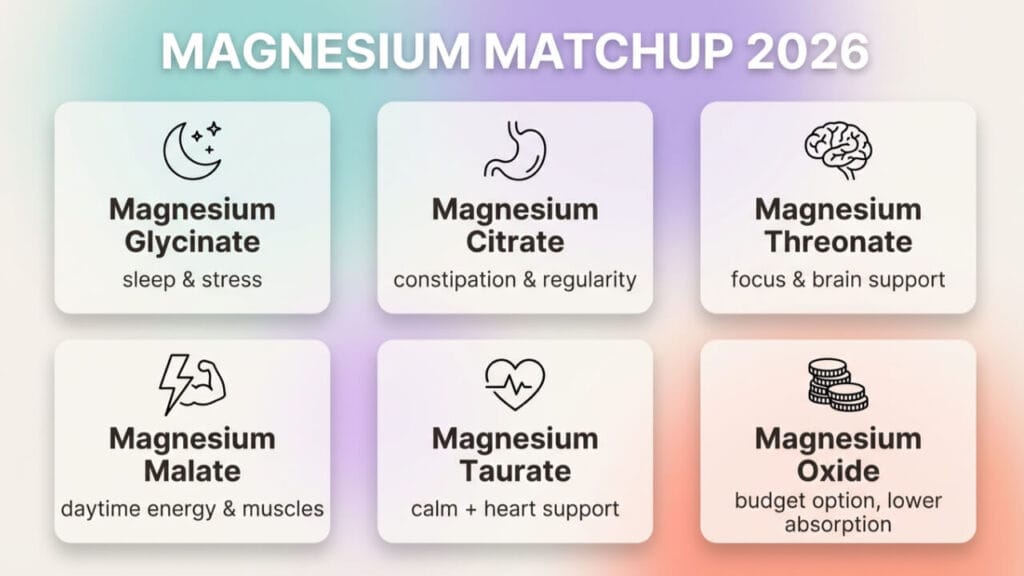
Best Magnesium Types: Glycinate vs Citrate vs Threonate
Not all magnesium supplements feel the same. The “best” form depends on your goal and your gut.
Magnesium Glycinate (often best for stress + sleep)
- Bound to glycine (an amino acid)
- Often chosen for relaxation, sleep quality, and stress support
- Generally gentle on the stomach
- Good “starter” choice for many people
Best for: sleep, stress, PMS-related tension, people sensitive to GI effects
Magnesium Citrate (often best for constipation)
- Magnesium + citric acid
- More likely to have a laxative effect at moderate-to-higher doses
Best for: constipation + magnesium support
Not ideal for: people who already have loose stools
Magnesium Threonate (often marketed for brain support)
- Magnesium + L-threonate
- Often used for cognition, focus, and mental clarity
- Usually provides less “elemental magnesium” per capsule, so it can be pricey
Best for: brain-focused support, people prioritizing cognition
Note: Many people still use glycinate for sleep even if they try threonate for daytime.
Magnesium Malate (often chosen for daytime energy)
- Magnesium + malic acid
- Some people prefer it for daytime use or muscle comfort
Best for: daytime support, muscle soreness
Less common for: night-time calm compared to glycinate
Magnesium Oxide (common, cheap—often less absorbed)
- Frequently found in low-cost multis
- Can work as a laxative, but often not the best choice for “magnesium repletion.”
Best for: occasional constipation (in some cases)
Not ideal for: targeted sleep/stress support
How to Take Magnesium (Timing, Doses, Food, Interactions)
Timing
Most people choose one of these patterns:
For sleep/stress:
- Take magnesium 60–120 minutes before bed
For cramps/tension + daily support:
- Take magnesium with dinner or split doses (AM/PM)
For citrate (constipation):
- Often taken in the evening, but adjust based on how your digestion responds
Dose ranges (practical, conservative approach)
Because “optimal dose” depends on your diet, body size, gut tolerance, and goal, a smart approach is:
- Start low for 3–7 days
- Increase slowly until you hit the benefit or GI limits
- Don’t stack multiple magnesium products unknowingly (multi + electrolyte + magnesium supplement)
Many people start around 100–200 mg/day of elemental magnesium and adjust.
Tip: Always check the label for elemental magnesium, not just the compound weight.
With food or without?
- Magnesium glycinate is often okay with or without food
- Magnesium citrate may be gentler with food
- If you get nausea, take it with a meal
Interactions & spacing (important)
Magnesium can bind to certain medications and supplements, reducing their absorption. Common spacing guidelines:
- Separate magnesium from iron and zinc by ~2 hours (unless your clinician instructs otherwise)
- Separate magnesium from thyroid meds by several hours (often 4 hours—confirm with your prescribing clinician)
- Be cautious with certain antibiotics (ask your pharmacist)
Who should be cautious
- People with kidney disease (magnesium clearance can be impaired)
- Anyone on multiple medications
- Pregnancy/breastfeeding (talk to a clinician first)
- If you have persistent symptoms like severe anxiety, heavy bleeding, or insomnia—don’t self-manage indefinitely
Common Magnesium Mistakes (That Make People Think It “Didn’t Work”)
- Taking too much too soon (then quitting because of loose stools or nausea)
- Taking magnesium at the same time as iron or thyroid meds, which may reduce absorption
- Choosing citrate when you already have sensitive digestion
- Changing 10 lifestyle habits at once (then you can’t tell what helped)
- Forgetting the basics: magnesium works best when sleep timing and caffeine are under control
Can Magnesium Help PMS, Cramps, and “Hormone Symptoms”?
Magnesium isn’t a magic fix, but it can support areas that influence PMS and hormone-related symptoms:
Where people commonly notice benefits
- Falling asleep faster / sleeping more deeply
- Less muscle tightness or nighttime cramps
- Better stress tolerance (less reactive)
- Improved regularity (if citrate helps constipation)
Why results vary
“Hormone imbalance” is a broad phrase. Symptoms can come from:
- chronic stress + poor sleep
- blood sugar swings
- low calorie intake or overtraining
- perimenopause shifts
- thyroid issues
- low iron or B12
- medication effects
- gut health
Magnesium can help piece together the puzzle, especially when stress and sleep are major drivers.
Comparison Table: Which Magnesium Type Should You Choose?
| Magnesium Type | Best For | GI Effects | When to Take |
|---|---|---|---|
| Glycinate | Sleep, stress, calming, tension | Low | Evening / before bed |
| Citrate | Constipation + magnesium support | Medium–High | Evening (adjust) |
| Threonate | Cognition, focus, mental clarity | Low | Daytime or split |
| Malate | Daytime support, muscle comfort | Low–Medium | Morning / midday |
| Oxide | Low-cost, laxative use | Medium | As needed (varies) |
If Your Hormones Feel Off, Start Here (Simple 2–3 Step Routine)
Hormones Feel Off? Start Here (Magnesium Routine)
Low-drama steps + a 14-day tracker so you can see what’s actually changing.
| Step | What to do | What to look for | Timeframe |
|---|---|---|---|
STEP 1 |
Pick ONE magnesium form • Sleep / stress → magnesium glycinate • Constipation → magnesium citrate • Brain fog → magnesium threonate | Match your choice to your #1 symptom. Don’t stack 3 forms at once. | 🕒 Start today |
STEP 2 |
Give it 14 days before judging Magnesium isn’t a stimulant—expect subtle changes first.
✅ Easier winding down ✅ Fewer nighttime wake-ups ✅ Less muscle tightness |
Track only 2–3 signals (don’t track 12). • Sleep quality (1–10) • PMS cramps/tension (1–10) • Daily stress reactivity (1–10) | 📅 14 days |
STEP 3 |
Upgrade lifestyle “levers” ☀️ 10 min morning light 🍳 Protein at breakfast 🛌 Consistent bedtime ☕ Reduce late caffeine |
✅ More stable energy ✅ Better mood resilience ✅ Easier sleep rhythm | 🔁 Daily habits |
Read next (related)
Educational only. If pregnant, breastfeeding, on medication, or with kidney conditions, consult a qualified clinician before supplementing.
Magnesium & Hormone Imbalance: Quick Answers to the Most-Asked Questions
If you searched “does magnesium help hormone imbalance,” you’re usually looking for relief with sleep, stress sensitivity, PMS cramps, or that “wired but tired” feeling.
Magnesium doesn’t change hormones directly like a medication would—but it supports the nervous system, muscle relaxation, and sleep quality, which can strongly influence how hormonal symptoms feel day to day.
Does magnesium help in hormonal imbalance?
It can help indirectly. When sleep improves and the body can shift into a calmer state at night, many people notice better resilience during the day.
That’s why magnesium is often included in routines aimed at winding down, reducing tension, and supporting more consistent rest. If your sleep is the first domino, magnesium may support the bigger picture.
Which magnesium is best for balancing hormones?
Choose the form based on your main goal:
- Sleep / stress / tension: magnesium glycinate is commonly chosen for calming routines.
- Constipation: magnesium citrate is often used because it can loosen stools.
- Brain fog / focus: magnesium L-threonate is often discussed for cognition-focused support.
If you want a glycinate-based option, LiveGood’s Ultra Magnesium Complex is formulated with magnesium glycinate plus magnesium gluconate (see the official product page: Ultra Magnesium Complex).
How should I take magnesium (timing + routine)?
If your goal is relaxation or sleep, evening use is the most common approach. A practical routine is to take magnesium with dinner or 60–120 minutes before bed. For people who prefer a split approach, you can take one portion later in the day and another closer to bedtime.
If you’re using LiveGood Ultra Magnesium Complex, the label guidance suggests 2 capsules daily, with a popular routine being 1 capsule in the afternoon and 1 capsule before bed, and spacing magnesium away from other vitamins/medications by at least 2 hours.
What are 10 signs of low magnesium?
Symptoms aren’t proof of deficiency (many things overlap), but these are common reasons people start looking into magnesium:
- Difficulty falling asleep or staying asleep
- Feeling “wired but tired”
- Muscle cramps, spasms, or twitching
- Tension headaches
- Stress sensitivity or restlessness
- Irritability or low patience
- Constipation (varies by person and form)
- Low exercise tolerance or slower recovery
- Trouble focusing
- General muscle tightness (neck/shoulders/jaw)
What are the 7 signs your body needs magnesium?
- Sleep feels lighter or more broken than usual
- Night cramps or tight muscles
- Harder time “coming down” after stress
- Frequent tension headaches
- More irritability/reactivity than normal
- Exercise feels harder than it should (recovery takes longer)
- Focus feels noticeably worse
What do you crave when low on magnesium?
Many people report cravings for chocolate or salty “comfort foods,” but cravings are usually driven by a mix of sleep debt, stress load, and blood sugar swings—not just one mineral. Chocolate contains magnesium, which may be one reason it shows up in cravings, but cravings alone aren’t a reliable sign of deficiency.
What drink is high in magnesium?
Mineral water can be one of the simplest options—just check the label because magnesium content varies widely. Some electrolyte drinks include magnesium, but many contain small amounts, so label-reading matters (a quick refresher is in How to Read Supplement Labels (Fairy Dusting)).
What depletes magnesium the most?
Common factors linked with lower magnesium status or higher needs include chronically low intake of magnesium-rich foods (nuts, seeds, legumes, leafy greens), high alcohol intake, heavy sweating/high training load, ongoing stress, and some medications (ask a pharmacist if you’re unsure). If your diet is inconsistent, start with food basics and use supplements as backup.
How long does it take magnesium to work in your body?
Some people notice changes in wind-down or sleep quality within a few days, but for stress resilience and cycle-related patterns, think in 2–4 weeks of consistent use. The cleanest way to know if it’s helping is a short, controlled trial where you don’t change everything else at once.
How long after taking magnesium will I notice a difference?
Try a 14-day test and track only 2–3 signals so it’s obvious what changed:
- Sleep quality (1–10)
- PMS cramps/tension (1–10)
- Daily stress reactivity (1–10)
Is it better to take magnesium in the morning or at night?
If your goal is relaxation/sleep, night is usually best. If your goal is muscle comfort or general support, splitting a dose can be easier on digestion. If magnesium makes you too relaxed during the day, shift it later; if it bothers your stomach, take it with food.
Can magnesium cause nausea or stomach upset?
Yes—especially with higher doses or certain forms. Citrate is more likely to loosen stools, while glycinate is often gentler. If you get stomach upset, lower the dose, take it with lunch/dinner, or switch forms. If symptoms are severe or persistent, stop and consult a clinician.
Can magnesium cause bruising?
Unusual bruising isn’t a typical magnesium side effect. If bruising is new or frequent, it’s worth checking in with a healthcare professional because bruising can have many causes (including medications and nutrient status).
Is magnesium good for sleep when pregnant?
Pregnancy is a special case. Magnesium is commonly discussed during pregnancy, but dose and form should be personalized—talk with your OB/midwife before starting supplements.
If you want to build a stronger “sleep + stress” cluster around this magnesium section, you can naturally continue the reader journey with CBN Dosage for Restful Nights and your broader Supplements Guide. For foundational nutrient context that often shows up in hormone conversations, a helpful companion read is Vitamin D3 + K2 (Practical Guide).
For additional evidence-based background, you can cross-check magnesium basics with the NIH Office of Dietary Supplements magnesium fact sheet and MedlinePlus.
Magnesium & Hormone Imbalance: Quick Q&A (Recap)
Short answers to the exact questions from your tree map. Educational only—not medical advice.
If you’re pregnant, breastfeeding, have kidney disease, or take prescription meds, talk to a qualified clinician before supplementing magnesium.
Bottom Line
If your hormone symptoms overlap with poor sleep, stress sensitivity, and muscle tension, magnesium is a smart foundation to test. Pick one form, start low, and run a 14-day trial while tracking only a few signals (sleep, cramps/tension, stress reactivity). If symptoms are severe, persistent, or escalating, use magnesium as support—but don’t delay getting checked.