LiveGood Compensation Plan Guide 2026: Costs, 7 Income Areas, Pros, Cons & Expectations
LiveGood Compensation Plan Guide 2026: Costs, 7 Income Areas, Pros, Cons & Expectations
LiveGood’s compensation plan is one of the main reasons people compare the company with traditional MLM and affiliate programs. The model combines product sales, membership activity, retail commissions, a matrix structure, matching bonuses, and leadership pools.
This guide breaks down how the plan works in plain English so you can understand the costs, the income areas, the pros and cons, and the realistic expectations before deciding whether LiveGood is a good fit for you.
Income disclaimer: LiveGood is a business opportunity, not a guaranteed income source. Results vary based on effort, skill, consistency, audience, customer retention, team activity, product demand, market conditions, and other factors. Some affiliates may earn little or nothing. Review the current compensation plan, fees, policies, and income disclosures before joining.

LiveGood may appeal to people who want a lower-cost affiliate option connected to wellness products and membership pricing. It is still a real business activity, which means you need traffic, trust, product knowledge, follow-up, and consistency.
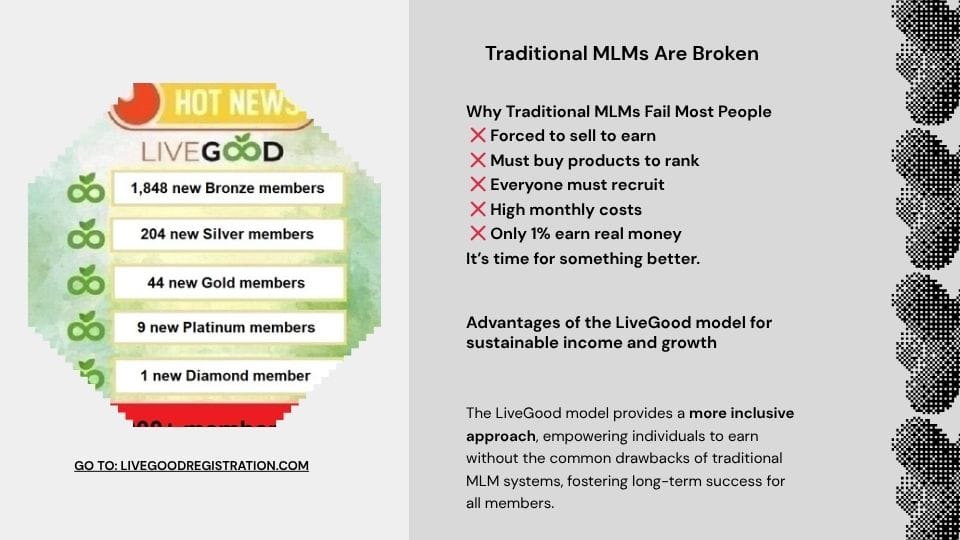
Why People Compare LiveGood With Traditional MLMs
Many people look at LiveGood because they want a business model with lower startup costs, no required inventory, and a product membership that is easier to explain than expensive starter packs or large monthly product orders.
Common concerns people have with traditional MLMs include:
- high starter packs or launch costs
- monthly product purchases to stay active
- pressure to recruit friends and family
- hard-to-explain pricing or compensation rules
- low profit for people who do not build consistent customers or teams
LiveGood takes a different approach with a membership-based affiliate model. The lower cost structure can make it easier to compare, but lower cost does not remove the need for real work.
The LiveGood Advantage
LiveGood stands out because the affiliate model is tied to affordable membership pricing and everyday wellness products. For the right person, that can make the opportunity easier to share and easier to understand.
- No required inventory: most affiliates can share links instead of stocking products.
- No expensive starter pack: the entry cost is lower than many programs.
- Commonly listed startup cost: $40 affiliate fee plus membership cost.
- Commonly listed membership cost: $9.95/month, with other membership options available.
- Multiple income areas: fast start, matrix, matching, retail, customer acquisition, influencer, and leadership pools.
- Weekly and monthly payout areas: depending on commission type and qualification.
LiveGood also offers wellness products at member pricing. Before promoting any product, it is smart to understand the label, the value, and the safety notes so your content stays helpful and honest.
LiveGood’s 7 Income Areas
Below is a simple explanation of the seven income areas commonly discussed in the LiveGood compensation plan. Treat this as an educational overview. Always check the current official plan for the latest rules, amounts, and qualifications.
Related guide: LiveGood Affiliate Program Guide.
1. Fast Start Commissions
Fast Start Commissions are connected to new member and affiliate enrollments. Product materials commonly describe a $25 commission when someone you refer joins as both a member and affiliate, with weekly payout timing for this commission area.
| Level | Example commission percentage |
|---|---|
| 1 | 50% |
| 2 | 10% |
| 3-4 | 5% |
| 5-6 | 2-3% |
| 7-10 | 1-2% |
This area can create early commissions for active affiliates, but it still depends on real enrollments and qualification rules.
2. Matrix Commissions
LiveGood uses a 2×15 forced matrix. Matrix commissions are connected to active memberships and where people are placed in the structure. Some plan examples show possible monthly amounts at different ranks, but those examples are not typical-result promises.
Matrix income depends on activity, retention, rank, qualification, and how the structure fills. It is better to think of this as a plan feature to understand, not a guaranteed monthly income stream.
Helpful reminder: position can matter in a matrix, but customer retention, team activity, and your own consistency matter too.
3. Matching Bonuses
Matching bonuses are based on a percentage of qualifying matrix commissions earned by people in your organization, depending on rank and plan rules.
- Personally enrolled affiliate activity may qualify for matching bonuses.
- Generation depth depends on rank and current plan rules.
- Matching examples are useful for understanding the math, but they should not be treated as typical earnings.
Matching bonuses are best viewed as a team-development area of the plan. They usually require more than joining; they require activity, support, and retention.
4. Retail Commissions
Retail commissions are connected to product customers. When a retail customer buys without becoming a member, affiliates may earn a portion of the difference between retail and member pricing.
This is an important part of the model because it rewards product-focused promotion through a shop, blog, social media, email, YouTube, or other content channels.
5. Customer Acquisition Bonuses
Customer Acquisition Bonuses are connected to the first product order of a personally enrolled member. The current plan should be reviewed for exact percentages, limits, and payout timing.
This can reward affiliates who help new members make their first product purchase, but it should not be framed as guaranteed first-month income.
6. Influencer Bonuses
Influencer bonuses are built for higher-volume retail activity. They may be most relevant for affiliates with content platforms, email lists, blogs, paid traffic experience, or strong product-focused audiences.
| Monthly retail sales example | Bonus area | What to know |
|---|---|---|
| $2,500 | Volume-based bonus level | Requires real product sales volume |
| $50,000+ | Higher bonus level | Advanced level, not a beginner expectation |
If you use paid traffic, understand your ad costs, conversion rates, compliance rules, and profit margins before scaling.
7. Diamond and Crown Diamond Bonus Pools
Leadership bonus pools are designed for top-ranking affiliates who meet rank and qualification requirements. Plan materials describe bonus pools connected to company-wide sales.
- Diamond Rank: plan materials describe a share in 2% of global sales.
- Crown Diamond: plan materials describe a share in 0.5% of global sales.
These are leadership-level plan areas. They can be exciting to understand, but they are not beginner income expectations.
How to Qualify and Rank Up
Ranks are based on personal activity, team size, leg structure, and current company rules. Below is a simple overview from the compensation-plan style examples, but always check the current plan before relying on any rank requirement.
- Bronze: commonly described around enrolling 2 people.
- Silver: commonly described around 10 personal and 20 team members.
- Gold: commonly described around 30 personal or 3 Silver legs.
- Platinum, Diamond, Crown: require larger teams, ranked legs, and ongoing qualification.
Ranks can unlock deeper bonuses, but reaching a rank is not the same as guaranteeing income. Retention, activity, customer volume, and qualification rules still matter.
LiveGood vs. Traditional MLM Models
This comparison is useful for understanding why people look at LiveGood, especially if they have tried higher-cost programs before. Use it as a starting point, then verify current costs directly before joining.
| Feature | Traditional MLM example | LiveGood example |
|---|---|---|
| Start cost | Can be hundreds of dollars or more | Commonly promoted around $49.95 startup |
| Monthly cost | Often product autoship or higher monthly orders | Commonly promoted around $9.95/month membership |
| Inventory | May require product purchases | No large inventory required for most affiliates |
| Global access | May vary by company | Promoted as global |
| Payout timing | Often monthly | Weekly and monthly areas depending on commission type |
| Income areas | Varies by company | Seven plan areas commonly discussed |
LiveGood’s lower-cost structure may reduce the pressure some people feel in higher-cost programs, but it does not remove business risk. You still need real customers, real activity, and consistent work.

Company Growth and Member Activity
LiveGood has shared strong growth updates in recent years, including international reach, weekly payout activity, and product adoption. Growth can be a positive sign, but it should not be used as a personal income promise.
| Growth point | How to read it |
|---|---|
| Members in many countries | Shows reach, not individual earnings |
| Weekly payouts | Shows payout frequency for certain commissions |
| Products under $30 | Can help with product affordability comparison |
| Large membership milestones | Shows traction, but not guaranteed results for new affiliates |
You can read related growth context here: LiveGood growth updates.
Who May Be a Good Fit for LiveGood?
LiveGood may be a good fit for people who like wellness products, can explain the membership model clearly, and are willing to build simple marketing skills over time.
- affiliate marketers looking for a product-based offer
- bloggers, YouTubers, or creators who can educate an audience
- people who already use and understand LiveGood products
- side-hustle builders who can stay consistent without expecting fast income
- wellness advocates who prefer lower-cost product positioning
It may not be a good fit if you need guaranteed income, dislike follow-up, cannot afford the fees, or do not want to create content or talk to people about products and membership.
Pros & Cons of LiveGood’s Compensation Plan
Pros
- Lower entry cost than many business models
- No large inventory requirement for most affiliates
- Multiple income areas to understand and compare
- Product and membership model can be explained simply
- Weekly payout areas are available for certain commissions
- Retail sales option connects the business to product customers
Cons
- No income is guaranteed
- Many affiliates in business opportunities earn little or nothing
- Results depend on traffic, trust, follow-up, customer retention, and team activity
- Matrix examples can sound exciting but are not typical-result promises
- Paid traffic can lose money if you do not understand ads and conversion tracking
- Business policies and compensation rules can change
A lower-cost structure can help reduce financial pressure, but the safest approach is still to treat LiveGood like a small business that requires effort and learning.
My Insight on the Model
One reason people are attracted to LiveGood is that the product membership is easier to explain than many high-ticket starter kits. When an affiliate can lead with product value, clear pricing, and simple education, the conversation feels more natural.
Still, simple does not mean automatic. The people who usually do better are the ones who build traffic, answer questions, create helpful content, follow up respectfully, and keep learning marketing skills over time.
Frequently Asked Questions About LiveGood’s Compensation Plan
Is LiveGood an MLM or affiliate program?
LiveGood combines affiliate marketing with a network-style compensation structure. It includes product sales, membership activity, matrix commissions, matching bonuses, and other plan areas.
Do I have to recruit to earn?
Retail commissions may be possible through product customers, but higher plan areas usually involve team growth, member activity, rank qualification, or organization volume. Read the current plan carefully before joining.
How fast do payouts happen?
Some commission areas are commonly described as weekly, while matrix and matching areas are commonly described as monthly. Payout timing depends on the current plan and qualification rules.
Is LiveGood available worldwide?
LiveGood is promoted as a global business, but product availability, shipping, and local rules can vary. Check your country before joining or promoting.
How much can you realistically earn?
Earnings vary widely. Some people may earn side income, some may earn more, and many may earn little or nothing. Results depend on effort, skill, traffic, audience, retention, team activity, and time.
Trusted Research & Industry Sources
For readers who want broader context on MLM and affiliate marketing outcomes, these sources can help you compare opportunity claims more carefully:
- Federal Trade Commission (FTC) consumer information: https://www.ftc.gov/
- Harvard Business Review business and marketing articles: https://hbr.org/
- Investopedia business model explanations: https://www.investopedia.com/
Related Reading on LiveGoodForLife
Explore these articles to better understand the business, products, and earning structure behind LiveGood:
- What Is LiveGood? A Complete Beginner’s Guide
- LiveGood Review: Is It Legit, Safe, and Worth It?
- LiveGood Monthly Comparison: Cost vs Value Breakdown
- Are LiveGood Products Legit and Safe?
- Step-by-Step Guide: How to Join LiveGood
Your Next Step
The best next step is simple: review the free overview, compare the costs, read the compensation plan, and decide whether the work fits your life, budget, and goals.
👉 Watch the LiveGood overview here
🔓 Review the costs and requirements
🛒 Compare member pricing
💼 Decide whether you want to be a customer, member, or affiliate
LiveGood can be a simple model to understand, but the results still come from real activity: product education, content, follow-up, and consistency.